

The Ukrainian unmanned ground vehicle rolled up to a small bunker hidden in a thicket in Kharkiv oblast then stopped. Another remote-controlled vehicle had just detonated its 66lbs of explosives at the Russian bunker’s entrance, which was still smoldering. And before that a kamikaze drone had dived inside and exploded. The operator was about to detonate his explosives when two Russian soldiers pushed a sign through the bunker’s shattered roof saying they were surrendering. They were directed to Ukrainian lines by a drone and taken into custody as POWs.
So ended the world’s first fully robotic assault on an enemy position. The remotely operated vehicle in this attack is called a Targan (“cockroach” in Ukrainian) and looks like a miniature flatbed without the cab. It’s about the size of a lawnmower and consists of just four off-road wheels, a chassis and a battery. Anything you can think of can be attached to these small electric rovers: a machine gun, medical equipment or, in the Kharkiv assault, anti-tank mines.

The pioneering operation took place last year and was recently revealed by Volodymyr Zelensky. In the past three months, Ukraine has conducted 22,000 missions using robotic vehicles, he said, saving the lives of Ukrainian soldiers on 22,000 occasions.
The battlefield has long been a laboratory for testing and improving new weapons. Now it is also a giant showroom to sell those weapons. Ukraine has partially lifted its ban on exporting arms and is cashing in on its military know-how to fund its war effort after Donald Trump pulled the US financial rug. Zelensky has become an arms dealer as well as president.
The Ukrainian military has developed a lightning-fast feedback loop between the battlefield and R&D units. When a problem is encountered on the battlefield, engineers and designers innovate quickly to overcome it. Take the Targan. Its original role was logistics, delivering ammunition and food to the frontline. With a silent motor, four wheels and a top speed of 13mph, it is a battlefield workhorse. But I witnessed how the Targan and other unmanned ground vehicles (UGVs) were being adapted far beyond its inventor’s original intentions. Last November, I visited the unit behind the robotic assault, the 3rd Assault Brigade at its training and development center – the Killhouse. Engineers were modifying UGVs with .50 caliber guns, Mk 19 40mm grenade launchers, and with mines as kamikaze units.
As dance music played in the workshop, engineers constructed the next generation of battlefield robotics and repaired damaged vehicles. They hammered, soldered and tested remote connections. Walls were adorned with unit flags, meme posters and hung with bazookas. Out of the window, I watched as soldiers practiced assaulting a nearby building.
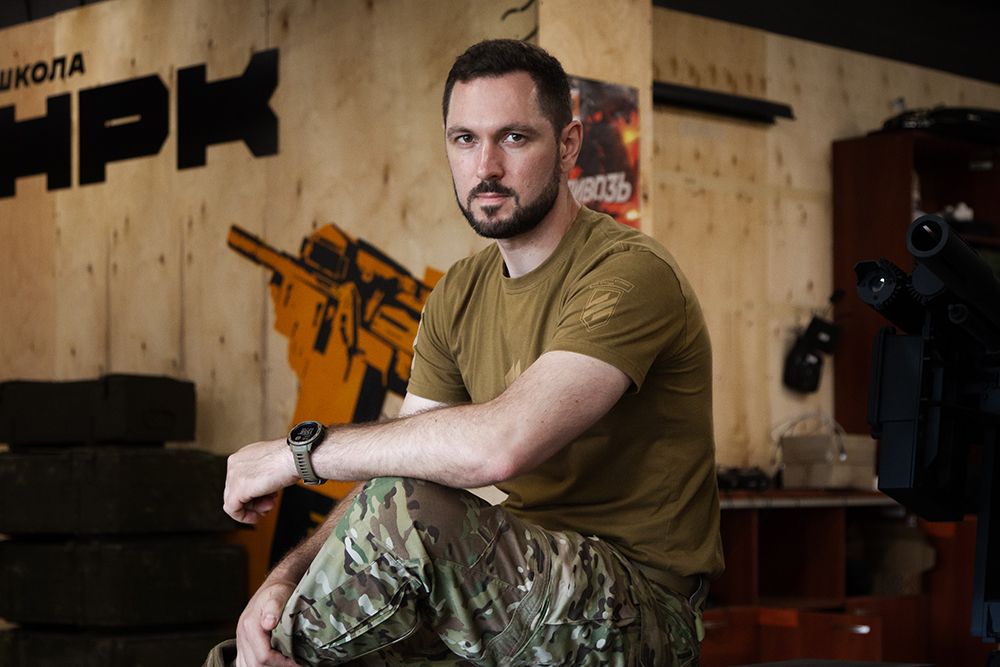
Viktor “Stark” Pavlov, director of the UGV training school at the Killhouse, oversees the operation (his nickname comes from Tony Stark in the Iron Man movies). He told me that US generals had visited the Killhouse and were envious of what they were creating. One complained that America couldn’t produce similar products because of complex bureaucracy. The generals were particularly interested in a grenade launcher mounted on a UGV with a proximity fuze to take down drones. They recognized that what was being developed at the Killhouse may be low cost – a Targan is $22,000 – but is highly effective.
If the US can’t make battlefield systems fast enough, the Ukrainians could do it for them – and anyone else who writes a big enough check. The Ukrainians can also make the cutting-edge tech more cheaply than manufacturers in the US. Engineers are paid less in Kyiv than in Silicon Valley – and are far more motivated.
Zelensky revealed the unique robotic operation in a sales-pitch video, standing in front of 56 domestically produced and battle-tested weapons with which he hopes to tempt allies: a formidable arsenal of long-range kamikaze drones, the Flamingo cruise missile, the Neptune anti-ship missile, the Vilkha rocket system, UGVs like the Targan, air defense units and specialized armored vehicles.
He is trying to secure deals with allies that will see investment pour into Ukraine and boost arms production – in exchange for Ukrainian expertise and hardware. The flashy video was released as Zelensky was in Berlin to sign a $4 billion defense cooperation deal. Germany will help manufacture weapons systems for Ukraine, such as long-range strike drones, while its own military benefits from Ukrainian frontline technology and knowledge. Similar pacts have just been struck with Italy, Norway, Sweden, and the Netherlands, as well as Saudi Arabia, Qatar and the UAE. As part of the new push to sell arms, Zelensky has lifted a strict export embargo on weapons leaving the country.
If the US can’t make battlefield systems fast enough, the Ukrainians could do it for them
The potential arms rush has caught the eye of the two Trump sons, among a horde of other US investors. Powerus, a drone start-up which counts Eric and Donald Jr. among its investors, recently added Keith Kellogg, US Special Envoy to Ukraine until last December, to its advisory board. Powerus aims to procure and market combat-tested Ukrainian drone tech to the US.
There is worry in Ukraine about some of this. If the Killhouse and the engineers have their heads turned by big money from Powerus or Raytheon, the war effort may suffer. For instance, “Stark” has his own unmanned systems company, Nova, that is focused on evacuation and logistics. Last year, I met one engineer who makes low-cost interceptor drones. He said he was offered tens of millions of dollars for his firm, but he couldn’t take the money because of the export embargo. Perhaps he’ll be inclined to cash out now that it has been partially lifted – and take his expertise with him.
Ukraine is constantly developing new technology to stay ahead in the arms race with Russia. Where Kyiv leads in tech, Russia follows around six months later by copying and then producing at scale. But Ukrainians must remember that survival, not profit, is what is truly at stake here.




Comments