
Houston, Texas
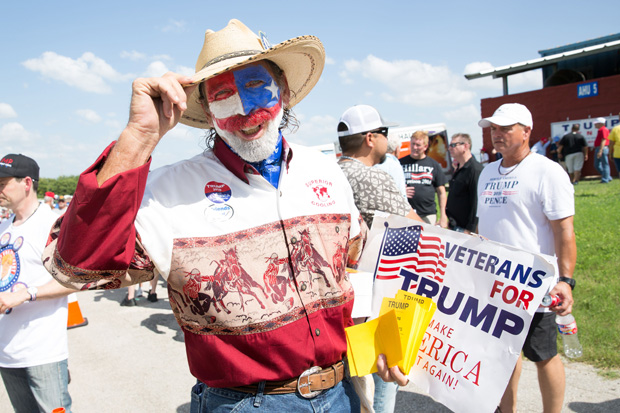
It’s hard to find anyone in polite society here who admits to having voted for Trump, even among the oil men. But 4.7 million Texans did so, giving him 53 per cent of the popular vote. In redneck rural counties the Donald carried four fifths of the ballot, but Hillary Clinton was ahead in urban Houston, whose citizens pride themselves on good relations between white, black and Latino communities and on the welcome they offer to newcomers — including, a decade ago, a quarter of a million refugees from hurricane-hit New Orleans. But still this is predominantly an oil town, and an industry that has suffered losses and slashed capital projects under the combination of sub-$50-a-barrel prices and Barack Obama’s environmental policies, awoke last week to the hope of new prosperity.
Curiously, ‘Big Oil’ gave four times more in campaign contributions to Hillary than to her Republican opponent — but not much to either, having shown an earlier preference for Jeb Bush. The industry evidently didn’t take Trump’s candidacy seriously, and the biggest players such as Exxon Mobil were concerned that his protectionism would restrict their global trade more than his deregulation policies would boost the domestic production, which is a relatively small part of their portfolio. But now he is president-elect, there’s a buzz of expectation of new drilling licences on federal land, pipeline permissions, lighter regulation of emissions and fracking, less call for renewables and even a resurgence of coal mining. Key appointments are awaited, but hot tips include climate-change sceptic Myron Ebell to run the Environmental Protection Agency, Oklahoma shale oil billionaire Harold Hamm for energy secretary, and oil products tycoon Forrest Lucas as secretary of the interior. So if you’re a bold investor — but not so adventurous as to contemplate shorting the Mexican peso, which has been in free fall since election day — you might want to take a look at mid-sized US oil and gas companies with prospects in west Texas and elsewhere that will become viable under the new regime, at coalminers such as Westmoreland (already up 25 per cent since the election), at rail companies that carry coal, and at contractors to the fracking industry such as Halliburton. But if you’re an environmentalist concerned for the American wilderness, hold your head and weep. Tomorrow’s America Sunday brunch at Hugo’s, a bustling Mexican restaurant with a mariachi band and a multi-ethnic clientele: at the next table, a big Latino family with a happy baby in a high chair. This is a true picture of Houston: only a third of its citizens are white, and only 22 per cent of under-20s; the Latino population has risen from 6 to 41 per cent in two generations, its birth rate boosted by a culture of family support that tends to produce healthier babies. What’s significant about this, according to sociologists at the city’s Rice University, is that by 2050 all of the US will look like Houston today, with a majority of minorities in all age groups below 60. Which means that what Donald Trump has been threatening — halting immigration, building a wall on the Mexican border, deporting ‘undocumented’ immigrants — cannot possibly achieve his objective of rebalancing the economy in favour of the older, white, non-college-educated working class who are his core supporters, because the societal change he and they so dislike is already irreversible. In Houston, immigration peaked in 2007: the continuing shift of population pattern is all about birth rates. The Trump revolution is an attempt to turn back history, and it must surely fail.
Comments