
I was in Budapest last month, where the city’s castle is now being rebuilt in its old neo-Baroque style. The plan is to create a near-exact replica of the complex as it stood before the city’s siege in 1945, when it was reduced to rubble during the fighting. So much of the original was destroyed that whole wings – like the palace of the Archduke Joseph – will have to be rebuilt from scratch.
The new complex has been accused of being a sort of Disneyland. This isn’t helped by the fact that many of its structures are made largely out of concrete, with the baroque facades added later as an outer shell. Yet there is a deeper reason. The project is much too self-conscious. To the planners of the new Buda castle, the kinds of architectural styles they hope to revive stand for history and tradition. But the sort of people who actually commissioned these kinds of structures never thought in those terms: to the Habsburg princelings, “it looks nice” was about as far as it went. At most they expressed dynastic might.
Trump’s architecture succeeds where the new Buda castle fails because it is living history
Motives like these seem casual and almost boyish to us now. But they were entirely unselfconscious ones, and this is what gives the original castle an authenticity that the reproduction lacks. Grand buildings like these were a byproduct of grand things that were going on anyway – like a dynasty’s grasping for power. Architectural traditionalists want to build in the old grand style to honor history; really they should be hoping that “history” starts again so that people will raise some grand buildings along the way. If Buda castle were being rebuilt at the whim of some sort of victorious warlord who had just conquered the area, or a mad scientist, then the project would be much more convincing.

There is an example of this within living memory: the postmodern style of the 1980s and 1990s. Like the new Buda castle postmodernism reproduced old forms; in fact it did so even more artlessly – slapping Doric columns and Mayan or Egyptian pyramids on glass towers. The TC Energy Center in Houston, built in 1983, is a traditional Dutch house in the form of a skyscraper. Yet few accuse these buildings of being theme-park kitsch, because for all their frivolity they were the expressions of something real in history: globalization and global capitalism. These were the things that people forging a new economic system built for themselves, and it is on this basis that they convince.
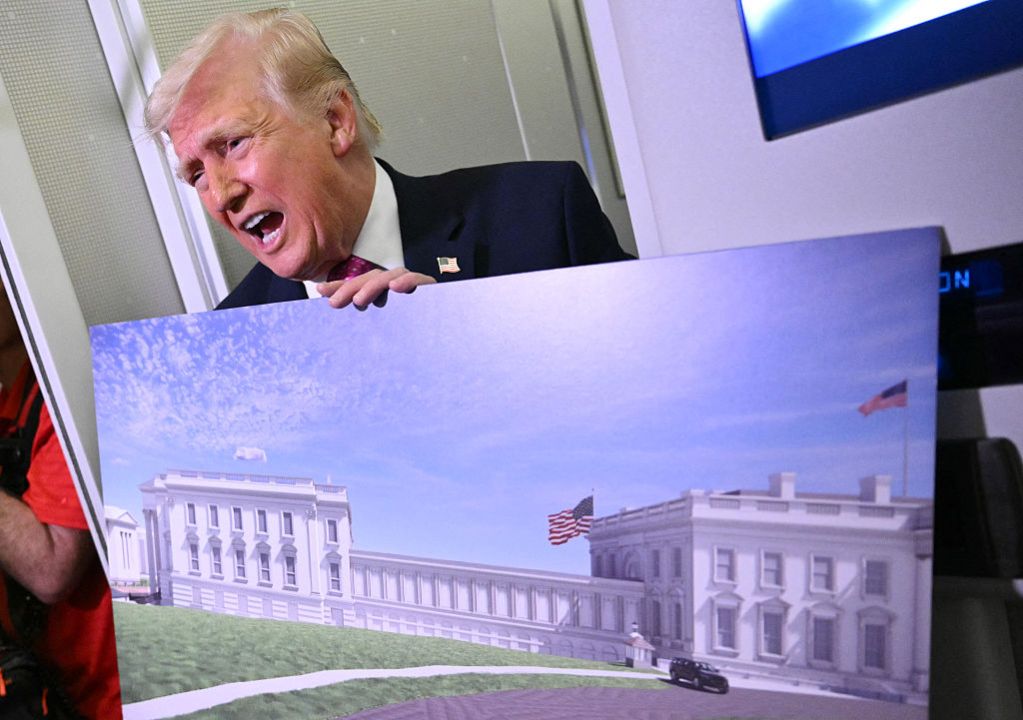
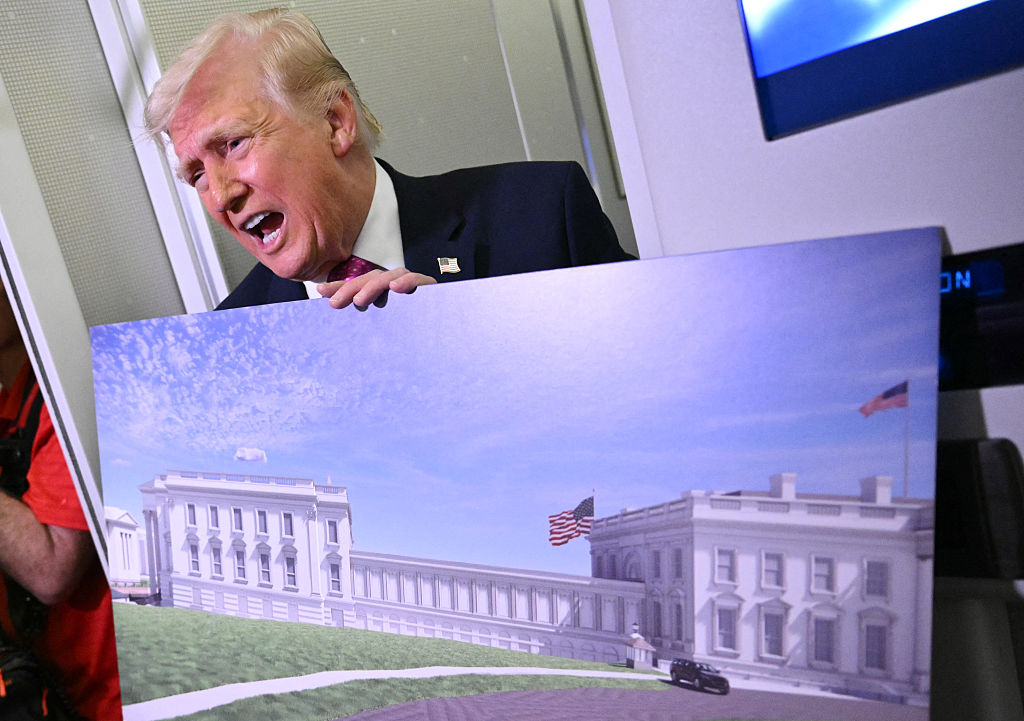
So too with Trump’s architecture, which owes much to postmodernism. His style is monumentalist with a sort of cardboard Hellenism and lots of gold ornamentation. The White House’s new ballroom will be built in this style, as will his future presidential library, which will house a gold statue of Trump. The ballroom will be flanked by columns that are, according to the President, “hand-carved, and they’re beautiful, top of the line […] They’ll be Corinthian, which is considered the best, most beautiful by far.” The planned new stadium for the Washington Commanders, which may bear his name, looks like the Parthenon if someone stepped on it. There are also plans to “beautify” the nation’s capital with a victory arch and other bits of ornamentation.
It is triumphalist and bombastic and it borrows from past motifs in the same way that casinos do. Yet for all this there is an inner seriousness. These are the personal fancies of an individual on a quest for supreme power. Trump’s architecture succeeds where the new Buda castle fails because it is living history: the physical markers of a person’s bid for dominion over the world. Donald Trump is the greatest of all actors and his architecture is all stage props, yet his was the play that became real.

Comments