
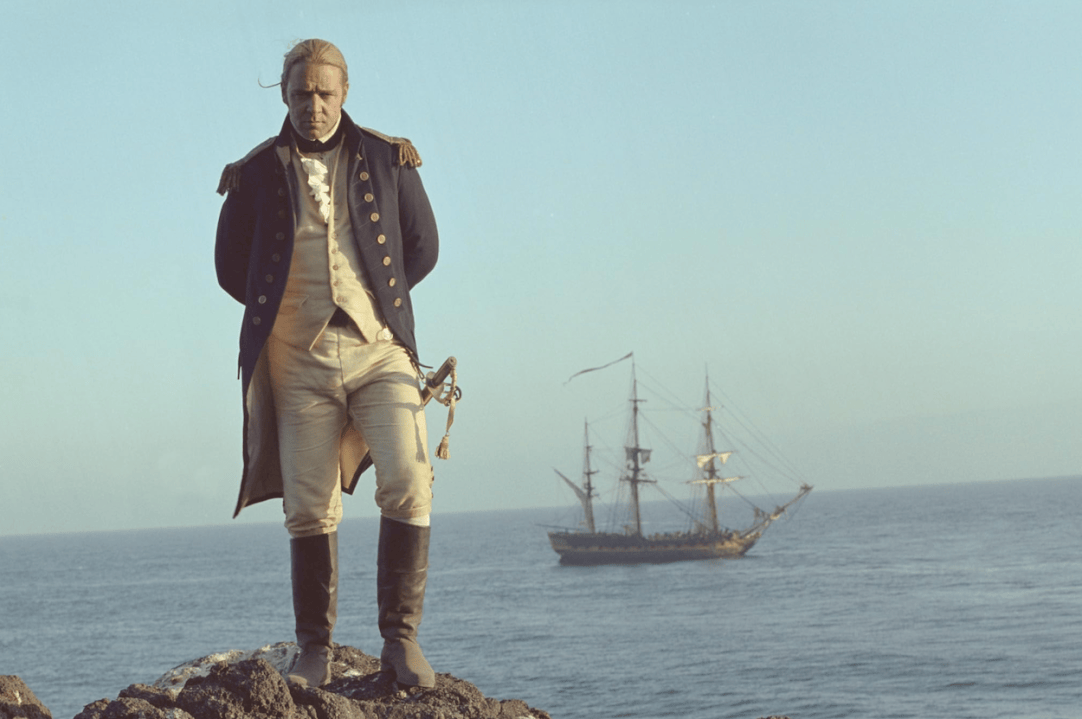
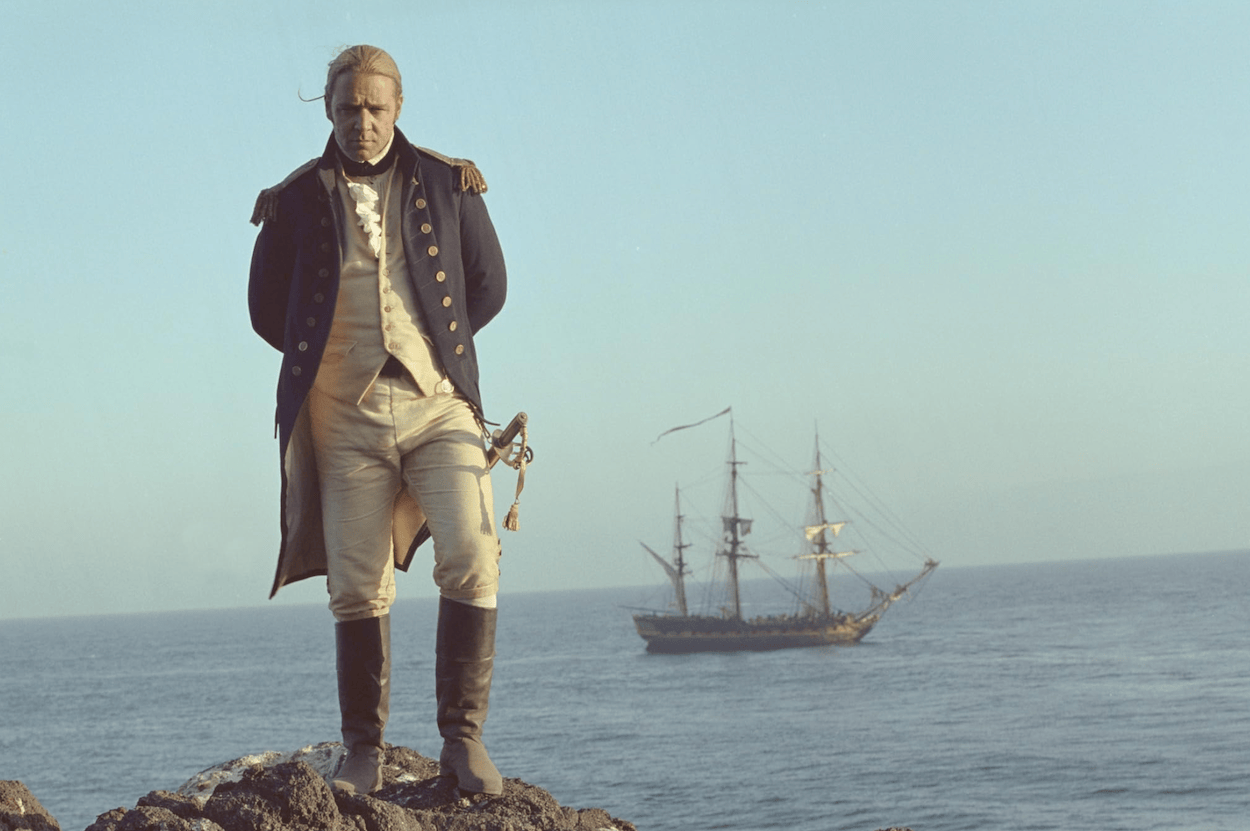
Every year, around Trafalgar Day, I rewatch Peter Weir’s 2003 film Master and Commander. It seems obvious to say that this is a film about heroism, but it took me until this year to realise that the hero is not in fact Captain Jack Aubrey, nor Stephen Maturin nor even Lord Blakeney, the 12-year-old midshipman whose arm is amputated. Nor is it an idealised form of Nelson’s navy, full stop. No, the real hero is Preserved Killick, the rancorous and difficult captain’s steward, who despite being in the midst of a storm around Cape Horn and with only the ingredients available to him aboard a late-Georgian frigate, produces an accurate blancmange rendering of the Galapagos Islands, complete with an edible French man-o’-war as its centrepiece.
I know this makes Killick the hero because I – in the considerably more auspicious surroundings of a fully-functioning 21st century kitchen – struggled to do the same thing for our Trafalgar dinner. The blancmange didn’t set, and we couldn’t figure out the sails. Killick’s care and attention to detail is a mirror to the film more generally and explains why it should rank among the greatest films of the 21st century.

The mastery and detail of the scene-setting is obvious from the opening dialogue:
‘Mr Calamy, the lead, if you please.’
‘By the mark, five fathom.’
‘Five fathom!’
‘Sand and broken shell.’
First-time viewers might not understand what much of this means – but that’s not the point. If every bit of arcane nautical terminology had to be explained, it would interrupt the immersive world Weir is trying to create. Instead, it remains true to those who sailed during the Napoleonic Wars, giving a snapshot of an isolated society which by definition may be incomprehensible to modern audiences. Weir trusts that you can figure out terms like ‘hard a’larboard!’ or ‘run like smoke and oakum’ based on the context. Compare and contrast with Christopher Nolan’s Odyssey which contains the childishly obvious line: ‘Our age of bronze is collapsing.’
Modern films often lack faith in their audience’s intelligence and insist on spelling things out. They may be right to do so. Matt Damon recently complained that Netflix commissioners prefer the plot to be explained ‘three or four times’, since home viewers are usually watching with one eye on their phones. Perhaps we get the films we deserve. Take Greta Gerwig’s Little Women adaptation. Though the film was well-received, Gerwig insists on explaining what a better filmmaker would simply show. ‘Marriage is an economic proposition’, Amy tells Laurie, in one of several ahistorical monologues. When the March sisters suddenly sound less like middle-class women from 1860s New England and more like an undergraduate sociology essay, you detect the director’s hand on the scales.
One of the delights of Master and Commander is that it contains no such nod to accessibility. The film’s attention to detail, even for a notably meticulous director (Weir famously had Kelly McGillis live among the Amish before filming Witness) is staggering. Paul Bettany and Russell Crowe read all 20 of O’Brian’s books in preparation for the role and spent the best part of a year learning to play the cello and violin for their duet scenes. Weir studied paintings of the period and had his production team build replica ships where much of the filming was conducted, rather than relying solely on CGI – soon to age poorly – like many directors of the time. Every shot resembles a masterpiece by Turner or Géricault.
These characters are of their time, reflecting the fact that most of the crew would have been uneducated and intensely superstitious. Weir makes it clear that Aubrey shares the sailors’ fears about the ‘Jonah’ on board and even suggests they might have had a point. The film doesn’t ignore the era’s religiosity either; several scenes feature prayers on deck. As Nelson wrote in his diary on the eve of Trafalgar: ‘May the great God, whom I worship, grant to my country and for the benefit of Europe in general, a great and glorious victory, and may no misconduct in anyone tarnish it; and may humanity after victory be the predominant feature in the British fleet.’
You can only applaud the total, obsessive interest in the subject-matter, which few modern filmmakers wish to pursue. Perhaps they don’t view the past as a meaningful and coherent place in its own right; but primarily of interest in how it informs our present. The best recent example of total immersion I can think of actually occurs in a video game, Red Dead Redemption 2, set in the Wild West at the turn of the century. Rockstar Games went to insane lengths to recreate the atmosphere of the time; ornithologists famously praised RDR2 for featuring a species of bird, the Carolina Parakeet, that went extinct in 1918. Yet while video games create ever-more accurate and detailed worlds for enthusiasts to inhabit, cinemagoers actually interested in the past for its own sake are largely under-served.
The harshness of the time is contextualised, rather than condemned
Weir was also helped by Patrick O’Brian’s own commitment to authenticity. Some of Aubrey’s exploits were inspired by real-life sailors from the period, including Admiral Cochrane. While commanding the small 14-gun brig sloop HMS Speedy in the early 1800s, Cochrane was chased at night by a larger, better-armed Spanish frigate, and actually performed a similar stunt to one depicted in the film, where Aubrey rigs up a lit-up decoy raft and sails his ship away under cover of darkness. The biggest change from the source material is probably choosing not to set it during the War of 1812, against a Yankee ship, but in the Napoleonic Wars against the French. Weir feared that US producers ‘would never back a film in which they were the enemy’.
The harshness of the time is contextualised, rather than condemned. In one scene, Captain Aubrey orders the flogging of a sailor for disrespecting an officer. Reprimanded by Maturin, he explains that without the enforcement of rules, you get mutiny: ‘Men must be governed!’ Morals and worldviews clash, but as in all the best films, Master and Commander doesn’t come down firmly on either side. When Maturin and Aubrey argue, both have a point. Each makes sacrifices for the other, and for the greater good; Aubrey ceases his prideful pursuit of the Acheron to allow an injured Maturin to operate on his wound onshore. Maturin abandons his Galapagos expedition to warn that the enemy ship is nearby.
The film repays multiple viewings; it took me several goes before I noticed that, to disguise the ship as a humble whaler, Aubrey temporarily orders his men to cease their usual salutes on deck. Since Aubrey earlier had a man flogged for failing to salute, this represents a significant, Maturin-inspired, bending of the rules. The film emphasises honour, duty and the bond between men who share a harsh life. A few Master and Commander viewings would do more to combat ‘toxic masculinity’ in schools than a million screenings of Adolescence.
Sadly, the film didn’t get the commercial success it deserved, partly due to an ill-timed release sandwiched between another nautical smash hit, Pirates of the Caribbean, and the final Lord of the Rings film, which swept the 2004 Oscars. Upsettingly, Crowe and Bettany never returned to the quarter-deck for a sequel. But perhaps we should just be glad that this gem exists. Like Killick’s blancmange, it was made with obsessive care, in challenging conditions, by people who believed the details mattered.






Comments