


William Atkinson has narrated this article for you to listen to.
It’s a personal delight that on 29 September 1829, the first day of Robert Peel’s new force, the first warrant number issued by the Metropolitan Police was to a William Atkinson. I’m less happy that officer number one was sacked after just four hours on duty, for being drunk.
As the Met approaches its 200th birthday, the state of it would embarrass even my namesake. The force is ineffective, scandal-prone and discredited. Shoplifting is up 104 per cent since 2020. Knife crime has reached a 14-year high. In 2023, a review by Louise Casey declared the Met riddled with institutional sexism, racism and bullying. Many recent studies have found that more than half of Londoners do not trust their police.
All the emphasis on personal development sounds more self-help book than Satanic conspiracy
Rather than get its house in order, the Met has decided to pick a fight with a very particular group: the Freemasons. Last month, the force announced that officers must reveal if they are or were members of a ‘hierarchical organisation that requires members to support and protect each other’ – a succinct summary of Freemasonry. The United Grand Lodge of England (UGLE) – the governing lodge of most English, Welsh and Commonwealth masons – is suing, arguing the demand is an ‘unlawful, unfair and discriminatory’ breach of the Equality Act.
I am not a Freemason. But as a lifelong Luton Town supporter who joined the Conservative party aged 15, I have a natural affinity with members of embattled, peculiar organisations. The Met’s attack on Freemasonry is an unjustified assault designed to distract from its own failings.
The obligation for officers to disclose their Freemasonry was recommended by a 2021 report into the Met’s handling of the unsolved murder of Daniel Morgan, a private detective, in 1987. Inquiries turned up allegations of corruption and around ten of the officers involved were masons. Although no evidence was found that Freemasonry was a factor in the murder or in subverting the investigation, the panel claimed membership had been ‘a source of recurring suspicion and mistrust’.
Freemasonry has habitually been tied to policing failures, from the scaling back of the Operation Countryman corruption inquiry to the horrors of Hillsborough. Little evidence of masonic malpractice has been forthcoming, but that hasn’t stopped imaginations running wild. Programmes such as Inspector Morse and Ashes to Ashes portrayed masonic corruption as endemic. But they don’t reflect the reality of Freemasonry in the Met today.
Out of the force’s 34,000 officers, only 400 or so are thought to be masons. Most lodges meet for ceremonies and dinners no more than eight times a year. Members of any Met football team, golf club or diversity network would meet far more regularly, with all the attendant opportunities for putting hands on shoulders or whispering in ears. Yet the Freemasons are singled out.
When, for the purposes of writing this piece, I visited the UGLE’s art-deco HQ in Covent Garden, I didn’t encounter a SPECTRE-esque cabal plotting world domination. Instead, I met several affable middle-aged chaps with a penchant for male bonding and dressing up. If you go in for that sort of thing, there are far less salubrious places for it in the West End. They were motivated not by power, but a love of tradition.
It’s worth remembering just how long-standing Freemasonry is. The first Grand Lodge of England was founded in the early 1700s. By 1900, 2,800 lodges existed under the UGLE’s jurisdiction; 900 more were set up after the first world war as returning servicemen sought camaraderie. Freemasons played an active part in public life, counting Winston Churchill and George VI among their number. Their activities were covered in the press. The air of secrecy was a second world war phenomenon, a response to the Nazi persecution of lodges. During their occupation of Jersey, the Germans ransacked the masonic lodge, looting its property for propaganda exhibitions.
Today, the organisation is much reduced. Total membership is around 175,000. Those I spoke to had various justifications for being members. Some enjoy the egalitarianism – whatever your age, faith or work, you are equal to your brother masons. Rudyard Kipling, an enthusiastic mason, wrote in his poem ‘The Mother Lodge’ of how Freemasonry overcame the tensions of the British Raj, with British soldiers equal to Muslim draughtsmen and Hindu accountants: ‘Outside – “Sergeant! Sir! Salute! Salaam!”/ Inside – “Brother” an’ it doesn’t do no ’arm.’
Other masons that I spoke to enjoyed it for the history. Many had fathers and grandfathers who had been masons. Some liked the idea of being part of the same club as Kipling, Churchill, Ernest Shackleton, Alf Ramsey, Peter Sellers and dozens of others.
Most commonly, those I spoke to saw Freemasonry as a way to devote themselves to something greater. The UGLE claims that Freemasons give almost £1 million a week to charitable causes. Recent initiatives have included assisting with the Covid vaccine rollout and launching a men’s mental health campaign. Some masons aren’t looking for a funny handshake to get a promotion, but to find a purpose. As one put it to me, meetings are ‘primarily amateur dramatics with lashings of beer and wine before and after’. The ‘overriding attraction of Freemasonry… is fraternity’.
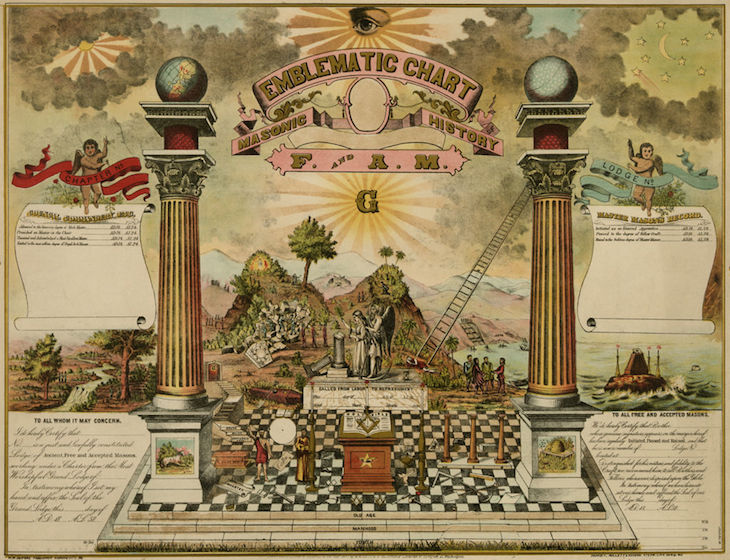
Freemasonry’s various customs – all long exposed – such as secret handshakes, blindfolded initiation ceremonies and references to the Great Architect of the Universe seem odd to us outsiders. Freemasons see themselves as heirs to Hiram Abiff – the craftsman who built Solomon’s Temple – with their initiations focusing on symbolic rebirth into a more charitable state. The so-called three degrees of Freemasonry – Entered Apprentice, Fellow Craft and Master Mason – represent stages of learning based on medieval guilds. But once you strip back the Old Testament flummery, all the emphasis on personal development sounds more like a self-help book than a Satanic conspiracy.
There will be wrong ’uns in the Freemasons. But to suggest that this society is any more harmful than any other is to lapse into conspiracy theorising. Making an example of the Freemasons won’t solve the Met’s problems, but will cause a small but notable number of public-spirited men to consider careers elsewhere because of unwarranted suspicions about their hobbies.
For the conspiracy-minded, I will disclose that when I was speaking to the Freemasons, a suggestion was made that I might be the sort of ambitious chap that they were looking for. Clearly they got the wrong impression. I won’t join any organisation that would want me as a member. Which is why, after careful consideration, I’ll apply to be a special constable in the Met Police.
Comments