
For David Cameron, there were two types of politician. Team players. Or tossers. Although he preferred a slightly saltier description for the latter type.
For a year I was the member of his team whose principal job was tosser-hunter. As government chief whip between 2014 and 2015 I was responsible for maintaining parliamentary discipline, unity and cohesion. I wasn’t a roaring success.
I was in a swimming pool on holiday in France when the news broke that our Clacton MP Douglas Carswell had defected to Nigel Farage’s Ukip. Far from proving a George Smiley whose formidable intelligence skills had smoked out a double agent, I was proving to be more of a Mr Barrowclough from Porridge, the prison warder easily outwitted by the lags I was supposed to be supervising.
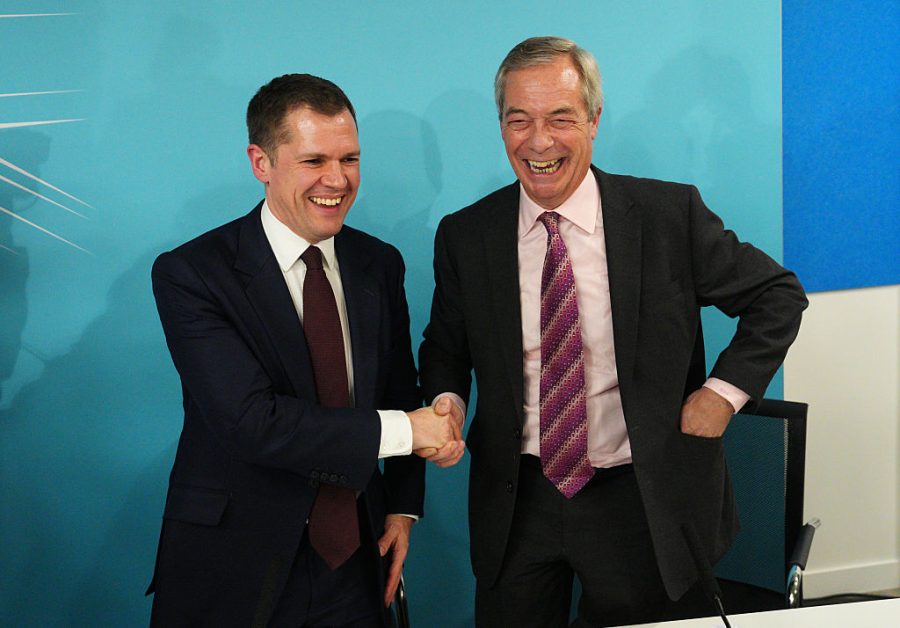
The contrast with the grip, and ruthlessness, displayed by Kemi Badenoch and her treatment’s pre-emption and smoking out of Robert Jenrick’s defection couldn’t be greater. Rather than being blind-sided by events, they controlled them. Instead of debility, they displayed strength.
When defections occur there is an immediate escalation of concern that where one has led, others could follow. So in that summer of 2014 I was charged with tracking down anyone tempted to join Douglas. His closest pal in parliament was the Rochester MP, Mark Reckless, just as hardline a eurosceptic, just as rebellious a spirit. We didn’t place a mole in his office, monitor his photocopier or have a watcher outside his office. Instead, in the true Tory spirit, I took him out for a slap-up lunch.
Mark was fidgety, nervous and sweaty throughout the meal. But then that was his natural mode. With all the subtlety of Harriet from The Traitors I asked him direct if he was planning to defect. He assured me had no intention of ratting. While avoiding my gaze and staring straight at the plate in front of him. At the end of our lunch I moved to pick up the bill. Mark insisted on paying his full share. Deeply atypical behaviour for any Conservative MP at the time. While he might be able to dissemble, just, he couldn’t bring himself to accept a freebie. It was evidence so obvious that even a Chief Constable of the West Midlands Police could not have ignored it. I, however, returned from the lunch to assure No. 10 that Mark was committed to our cause. A week later he ratted.

For Team Tory at the time, Douglas and Mark were top tossers. We were going into an election with Ed Miliband ahead in the polls and Faragistas, literally, eating our lunch. So I understand exactly how Conservative MPs feel at the moment about the Rob Jenrick démarche. And it won’t be detached curiosity.
But time lends perspective. And the course of politics is never predictable. Far from the Ukip defections capsizing the Tory party, we went on to win the 2015 election. The Tory pledge to offer a vote on our membership of the EU had made a Ukip vote superfluous and we secured an outright majority with a mandate to deliver that referendum. Where I, and indeed a majority of Conservative MPs and members, found myself on the same side of the argument as Douglas and Mark and opposed to David Cameron. Which team, by that point, were the tossers?
There’s an old maxim from the 17th century: Treason doth never prosper: what’s the reason? For if it prosper, none dare call it treason. It’s no surprise that turbulent time gave rise to that principle. It was the age of rebellion, civil war and shifting allegiances in which nobles moved from Charles I to Cromwell to Charles’s heirs. At the end of that century the first great Churchill, John, who became Duke of Marlborough, then defected from Charles’s son, James II to the usurper William III. History records that not as black perfidy but the Glorious Revolution. And, centuries later, the greatest Churchill, Winston, not only ratted but re-ratted, starting his parliamentary career as a Tory, then joining the Liberals and becoming a cabinet minister before defecting back to become a Conservative prime minister. Arguably the greatest of all time.
How defections are viewed at the time depends, to a significant extent on whether they are believed to be actuated by principle or calculation. But all politicians are driven by both principle and calculation. A politician who cannot calculate is as useful to a cause as a soldier who cannot shoot. And, despite the casual cynicism which holds that politicians are motivated only by the basest motives, I have yet to meet anyone who has chosen to endure the risks and loss of privacy that public life inevitably entails who was not motivated, at least in part, by public-spiritedness.
Michael Heseltine will forever be seen as a traitor by die-hard Thatcherites, his own ambition to be prime minister having been laid out on the back of a restaurant napkin when he was in his twenties. But Heseltine is also, and much more consequentially, a minister of rare achievement, driven by a principled attachment to one-nation Toryism. For Gordon Brown’s closest circle, Tony Blair was the usurper who selfishly elbowed his spiritual elder brother aside in 1994 to claim the Labour leadership. For Blairites, Gordon was the Incredible Sulk who could never reconcile himself to Tony’s superior appeal and whose brooding ego destabilised the government. But both were indispensable, in their way, to the achievements Labour partisans still celebrate.
I know what it’s like to wrestle with questions of loyalty and principle
There are uncanny echoes of the Brown/Blair rivalry in the turmoil currently wracking this government, with those still loyal to the stolidly Brownite Keir Starmer plotting to remove the self-consciously Blairite Wes Streeting.
For most voters this internecine conflict, the appeals to loyalty and invocations of treachery, must appear to be a self-indulgent game which is criminally irresponsible when the economy, health service, immigration system and national security demand politicians’ full attention. If they want to occupy themselves with intrigue why don’t they get Claudia Winkleman’s number and head to a castle in Scotland instead of turning the Palace of Westminster into the arena for a Gothic knife-fight?
I sympathise. But I sympathise with the politicians too. Because I know what it’s like to wrestle with questions of loyalty and principle. As Kemi Badenoch once said, quoting Woody Allen, democracy is like sex. If it’s not messy, you’re not doing it right. I’ll forever be criticised by some for treachery for breaking with my colleagues to back Brexit in 2016 and by others for blind loyalty to Theresa May or Rishi Sunak when they were implementing policies thought insufficiently Tory.
I think my motives were justified. But I also think my critics’ positions are honourable too. Not because I am a milksop split-the-difference consensus monger. Quite the opposite. Just ask the teachers’ unions. No, it’s because I think politics should be about ideas not individuals, about policies not people, that I think we should spend less time speculating on motives and trying to make windows of men’s souls and more time assessing whether the case being made for a particular course is right.
My belief, and experience, is that politics has to be about the passionate assertion of contending ideas and the vigorous implementation of determined programmes. What eventually drains people’s faith in politics is not too much turbulence but a failure to get things done. I think the real divide in politics is not between team players and others but between different visions of what is right and between those who dare to make a difference and those who prefer not to act. I am with Teddy Roosevelt, the US President who broke with his party but always loved his country, and who argued
It is not the critic who counts; not the man who points out how the strong man stumbles, or where the doer of deeds could have done them better. The credit belongs to the man who is actually in the arena, whose face is marred by dust and sweat and blood; who strives valiantly; who errs, who comes short again and again, because there is no effort without error and shortcoming; but who does actually strive to do the deeds; who knows great enthusiasms, the great devotions; who spends himself in a worthy cause; who at the best knows in the end the triumph of high achievement, and who at the worst, if he fails, at least fails while daring greatly, so that his place shall never be with those cold and timid souls who neither know victory nor defeat.






Comments