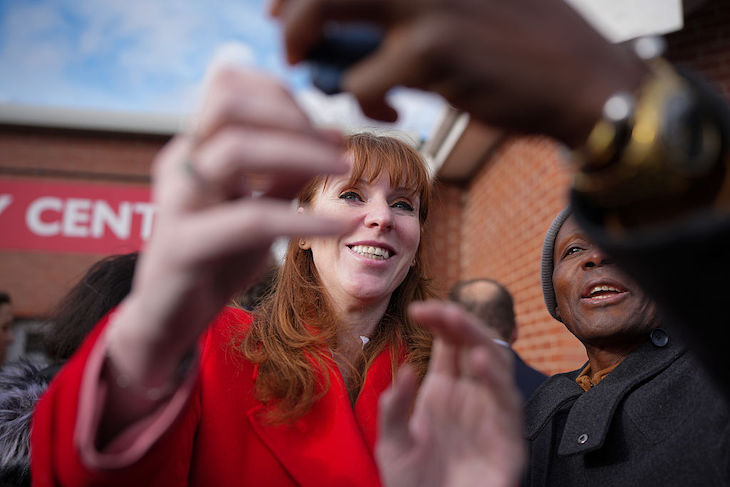
Were I ever to share a cuppa with Angela Rayner, a certain spark of kinship might be expected. After all, we share the same first name, are both Mancunians and have an equal tendency to be ‘gobby’, as we say in the North. Heck, we’ve even got the same hair colour and understand the challenge of being a fading redhead (Though Rayner’s curly blow-dry, splashed across the front pages this week, was surely another style slip-up. If you want to be taken seriously, don’t go full Shirley Temple.) But this is where the affinity – or even empathy – ends.
There are so many reasons why Rayner is the last person who should be handed the keys to No. 10
For, despite our similarities, the mere thought of Angela Rayner as prime minister – standing at the despatch box, shaping national policy and representing Britain on the world stage – is horrifying. For now, of course, she is energetically tweeting support for the beleaguered Sir Keir Starmer from the back benches. It can’t, however, be long before the spectre of her ambition rises again.
With her gravelly Northern accent and blunt vernacular – Tory scum, anyone? – Rayner may convince parliamentary colleagues of her authenticity. And her curated martyrdom has to be catnip for biopics, or best-selling memoirs. But there are so many reasons why she is the last person who should be handed the keys to No. 10.
Doubtless being incubated in the school of hard knocks might explain her unflinching hard-left orthodoxy. But does Rayner really care about the strivers? The Employment Rights Bill, which she is enthusiastically championing to shore up workers’ rights with sweeping restrictions on zero-hours contracts and premature statutory sick pay, could devastate small businesses – many of them built through the hard graft Rayner seems to believe is her story alone.
Rayner is also clearly untested in foreign affairs. And as for the topical issue of good judgment when assessing character, let’s remember that Rayner called Jeremy Corbyn “a thoroughly decent man”, even after the Equality and Human Rights Commission determined that antisemitism had spiralled under his leadership.
Then there is the hypocrisy. It’s admirable that, given her impoverished background Rayner bought her own home in 2007 – via Mrs Thatcher’s flagship Right-to-Buy scheme – going on to trouser a £48,500 profit when she sold it. Yet it hasn’t stopped her looking to reform the very initiative that helped her onto the property ladder. Funny, that.
There’s no doubt that Rayner’s path to the top of British politics is impressive and shows her determination. Rayner has soared to unimaginable heights from her humble beginnings. The 45-year-old MP for Ashton-under-Lyne grew up on one of Stockport’s poorest council estates, cared for her ailing mother, left school with no qualifications and had her first child at 16. Now she’s at the top of the tree in Westminster politics – and being talked up as one of the favourites should Starmer quit.
It’s a remarkable trajectory, and one I can relate to in a limited way. My own parents, both traditional Labour supporters, were not professional people and money was always tight. When my father, who did no financial planning, died suddenly, my mother was left an impecunious widow.
But whereas Rayner had the trade unions as surrogate parents – they took “a girl from a council estate” and turned her into “a woman who feels like she can conquer the world”, as she once reflected – I had my mum.
The daughter of impoverished Ukrainian and Russian immigrants, mum believed fiercely in the transformative power of education, even if it had to be self taught. So she read voraciously (Charles Dickens was her favourite), followed current affairs closely and made it clear to her three children that hard work at school was the only route to a satisfying career and any financial security.

Admittedly, my odds were better than Rayner’s: I secured a council-funded place at a smart girls’ school after scoring well in the 11 plus exam. But from that point any opportunity to climb the ladder was entirely my responsibility. I could rise, or fall.
So my personal circumstances, free from silver spoons or golden contacts, do offer some perspective on the once deputy prime minister’s story. Unlike some of the London-based commentators who performatively acknowledge Rayner’s background before putting in the boot, I really understand her path. But that won’t stop me from saying that Rayner would make a dreadful Labour leader – and a terrible prime minister.
Despite all her various missteps – not least her awkward failure to pay £40,000 in stamp duty – Rayner retains a loyal support base, buoyed by her background and carefully shaped “relatability”. In this sense, she follows in the tradition of John Prescott, even though his malapropisms left many wondering if English was his first language.
But, as a fellow Northerner from a modest background, I fail to accept that, in post-modern Britain, we haven’t moved on from awarding politicians brownie points for accent or birthplace.
Undoubtedly, there’s an argument for more politicians with real-world experience, not just an Oxbridge degree in PPE followed by a few nursery years in the civil service. But a hard-luck story from the distant North is no good either. It certainly shouldn’t be a free pass to the premiership if competence, judgment, and intellectual heft are lacking – as in Rayner’s case, they clearly are.
So, though we are twinned by name, hair, birthplace, and background, Red Ange will never get my support. However, I should add that, living by the laws of northern hospitality, my kettle is always on – if only to offer this ambitious though manifestly mediocre politician the name of another hairdresser.



Comments