
Ask ChatGPT to write a Spectator leader about the risks of AI and it begins like this: ‘There are two kinds of people talking about artificial intelligence today. One group is exhilarated, convinced that AI will usher in a new era of abundance, productivity and human flourishing. The other is distinctly alarmed, warning of mass unemployment, runaway systems and even existential catastrophe. They disagree on almost everything – except one crucial point. This is going to be a big change. And Britain, like most countries, is not nearly ready for it.’
As the bot identifies, the consensus among experts is that AI’s impact will be seismic, whether for good or ill. The economist Tyler Cowen suggests it will move us from stagnation back into a world of ‘moving history’ and rapid, disorientating change; the ever-present Elon Musk has suggested AI offers ‘unprecedented abundance’ and the abolition of work, but has also compared it to ‘summoning a demon’.

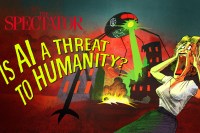
This week’s issue seeks to examine the implications of AI – the most consequential technological development since the splitting of the atom. Tim Shipman investigates the government’s plans to harness the power of AI. Louis Mosley, the UK head of technology firm Palantir, explains how AI will do away with the vast bureaucracy of the state. And Ross Clark argues that Britain will be unable to compete in the world of AI computing if our energy prices remain exorbitantly high.
Those working in the industry have their own fears. Last month, Dario Amodei, Anthropic’s co-founder, suggested that humanity is unprepared for the AI Götterdämmerung in a blog entitled ‘The Adolescence of Technology’. He is responsible for Claude, one of the most popular AI chatbots, so the essay reads a little like Victor Frankenstein warning the villagers that his latest creation is not entirely friendly. ‘Humanity,’ Amodei warns, ‘is about to be handed almost unimaginable power, and it is deeply unclear whether our social, political and technological systems possess the maturity to wield it.’ Powerful AI systems that are vastly more intelligent than Nobel prize-winners will emerge within a few years, he argues. Today’s AIs are already programming the next generation, creating an exponential growth loop and cutting out human coders entirely.
Amodei goes on to say that AIs trained on science fiction could find role models in HAL 9000 and Skynet and attack humanity; malign actors could create weapons of mass destruction; budding Big Brothers could create total surveillance states; economies may be upended by job losses of unprecedented speed; vast new wealth inequalities could soon exist.
Some of Amodei’s fears may be more likely to materialise than others – but he is at the heart of this revolution and believes the pace of change will only increase.
If even a fraction of AI’s potential power is realised, it will strengthen its possessors immeasurably. Western democracies have no choice but to develop AI before the Chinese or other hostile nations do, much as the Manhattan Project raced to build an atomic bomb before the Nazis. AI’s proponents are optimistic about the bounties for growth and scientific development, hoping humanity can navigate these uncharted waters. AI offers both triumph and disaster.
Western democracies have no choice but to develop AI before the Chinese or other hostile nations
Britain is not a marginal player in this future. In 2023, Rishi Sunak convened a summit at Bletchley Park to put us at the forefront of AI regulation. The work of the AI Security Institute and the leadership of individuals such as Matt Clifford and Henry de Zoete have made the UK a respected voice in the debate.
So far, there is little evidence that ministers are thinking seriously about what this technology means for the country. AI has never been far from ministerial lips, but only as a get-out-of-jail-free card when departmental efficiencies are called for. Grand plans for deploying AI across the public sector are constantly promised but the digitalisation of government services is stalling for lack of support.
Britain is particularly exposed to AI’s risks. Industries such as law and accountancy could be rapidly automated, threatening a white-collar wipeout comparable in scale to the deindustrialisation of the late 20th century. We do not have the leading technology firms or economic clout of the US or China; cosying up to the EU means embracing their efforts to tax and regulate AI into oblivion.
Ministers must be honest with the voters about AI’s ramifications: it should be treated neither as a panacea nor a phantom, but as a massive disruption that we must plan for with care. The development of AI infrastructure needs to be sped up, enabling homegrown companies to compete with foreign equivalents. No person in British public life is more engaged with this subject than Sunak; it would display an unusual wisdom and grace on Keir Starmer’s part to empower his predecessor to act.
Unprompted, ChatGPT picked a headline for its Spectator debut: ‘Mind the Machine’. But fearing AI is a misunderstanding. The risk is not so much from the models themselves, but the humans deploying their intelligence. We must all be worried about the Modern Prometheus, a Silicon Valley Frankenstein, pursuing advancement without responsibility. Addressing the AI revolution requires not a moratorium on technology, but a change in mindset. Humanity’s future is for us to write, not the bots.


Comments