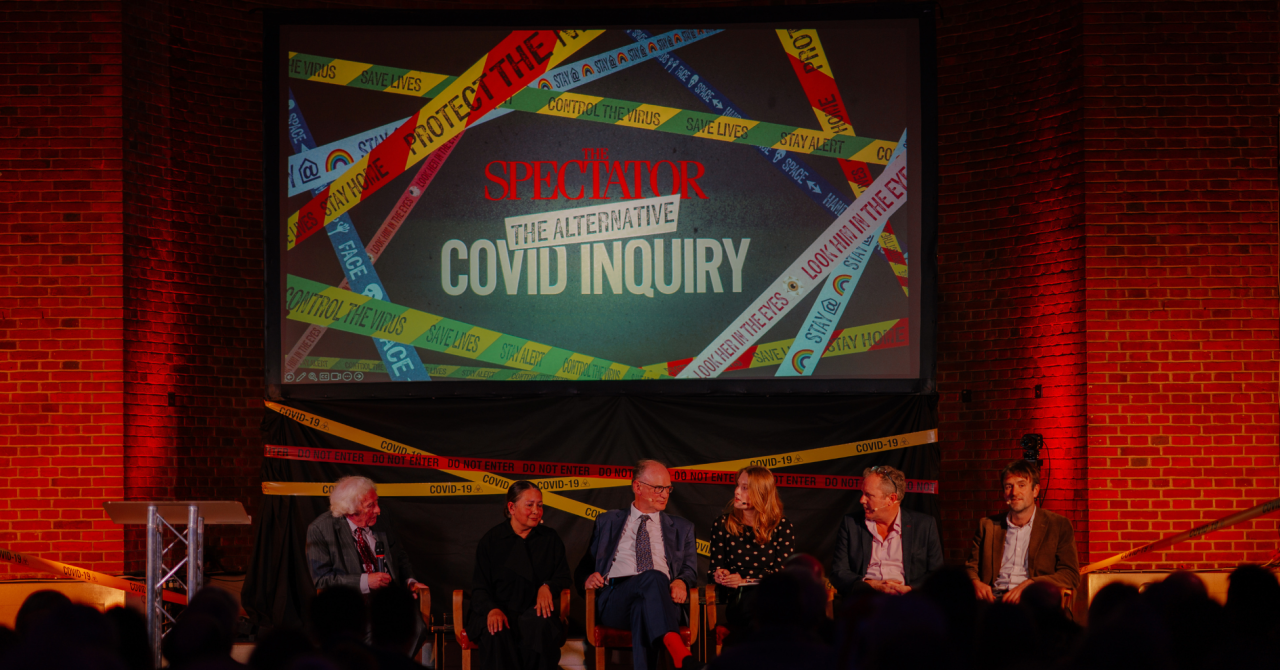
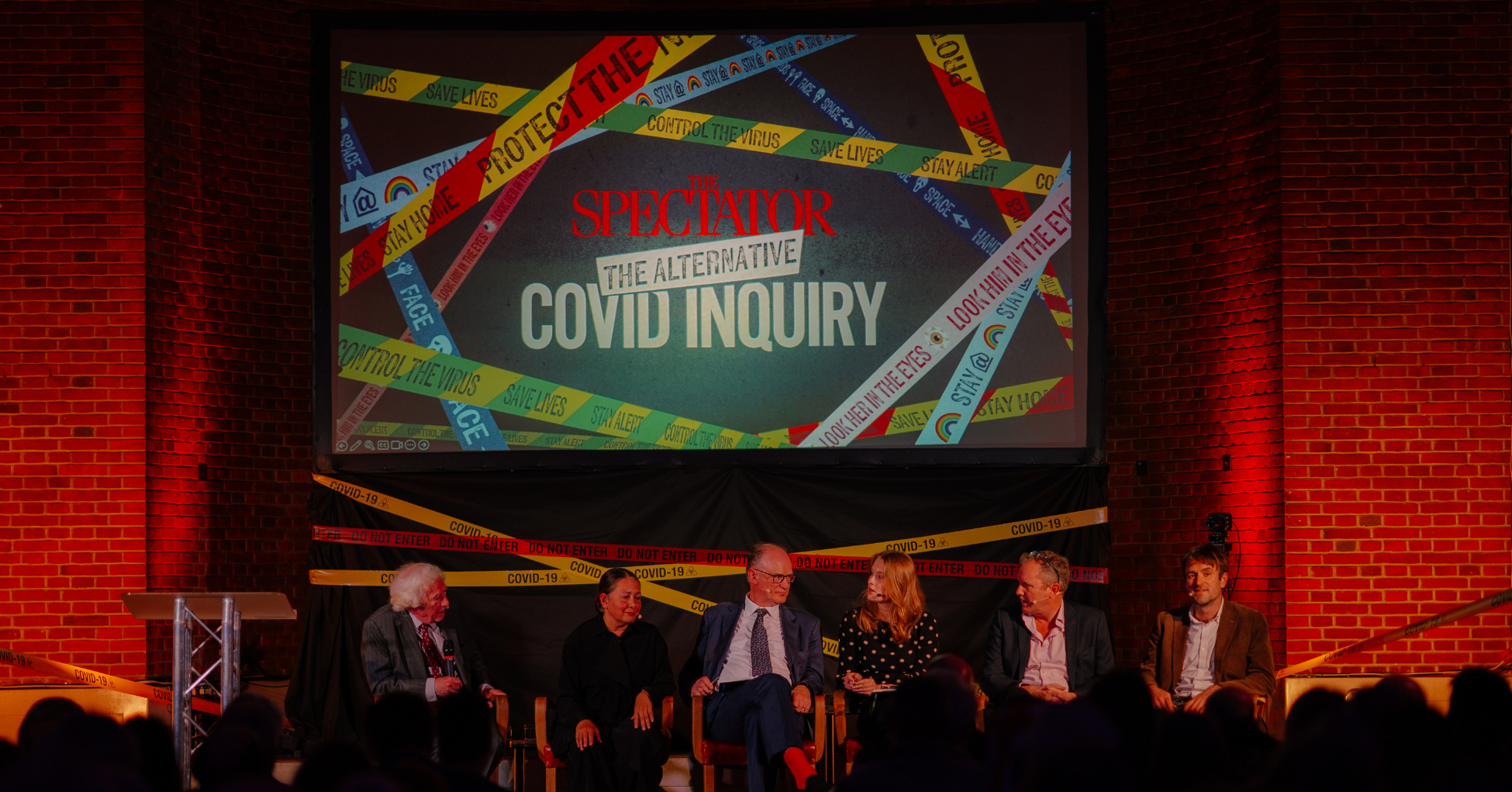
At The Spectator’s Alternative Covid Inquiry last night, science writer and journalist Matt Ridley; Sunetra Gupta, Professor of Theoretical Epidemiology at the University of Oxford; Jonathan Sumption, writer and former Supreme Court Justice; Christopher Snowdon, journalist and head of lifestyle economics at the IEA, and Tom Whipple, science writer and special correspondent at the Times, had their say on what went wrong – and right – during the pandemic. They asked the questions the experts didn’t – or wouldn’t – at the Covid Inquiry. Here is what they had to say. Spectator subscribers can view the full video of the event here.
Jonathan Sumption
This evening shouldn’t really be necessary. The reason why it is is the patent inadequacy of the reports so far produced by the official Inquiry at great public expense. Lady Hallett has retraced in minute detail the inadequacies of the decision makers, but has said remarkably little about the inadequacy of their decisions. She takes at face value models like those of Professor Neil Ferguson based on completely unrealistic assumptions about human behaviour and treats them as accurate statements of fact. She ignores the experience of other places which declined to impose draconian remedies that had been chosen by the UK. She doesn’t address the many authoritative studies which show that there is no significant correlation between the severity of non pharmaceutical interventions and mortality. Lady Hallett accepts that the really serious economic, financial and sociological consequences of lockdowns are relevant, but she then has almost nothing to say about them. She appears to have approached her task on the footing that it was inherently wrong for government ministers not to follow the advice of their scientific advisors, even when they plainly got it wrong, as they did when ministers finally plucked up courage to overrule them on the Omicron variant in December 2021.
We are talking about some of the most basic civil rights
I’m used to dealing with evidence, and I’m impressed by the evidence that human beings will take sensible and effective precautions to protect themselves against those and those around them, against infection, without the need of coercion. I’m impressed by the evidence that it was unnecessary to lock down healthy people under the age of 65 who were at minimal risk of death or serious illness from covid and could have been treated differently. I’m impressed by the fact that Sweden, which did not lock down, got comparable results to Norway, Denmark and Finland and better results than we did. I’m impressed by the evidence that lockdowns have caused a serious increase in non Covid health problems, notably mental illness and dementia, and I’m impressed by the fact that Lady Hallett has managed to reach her conclusions with only a cursory glance at any of these matters.
There is a moral dimension to all of this. I don’t believe that liberty is an absolute or overriding value, but I think it’s a very high value. We are talking about some of the most basic civil rights. The right not to be confined to a place appointed by the state at the discretion of ministers. The right to go where you please without having to justify yourself to the police. The right to associate freely with other human beings. The right to earn an honest living, regardless of whether the state thinks that it is useful or necessary. The right to make your own judgments about the risks of daily life in the light of your own circumstances and those of the people around you, rather than have a minister make these decisions for you.
Now, civil rights of this kind are not just a convenience. They are fundamental to the existence of social animals like humans and to our life as a community. They are a basic condition of human creativity. They are necessary for our mental well being and our happiness. And these are the things that life is about. It takes a great deal more to justify curtailing these rights than anything that one can find in the government’s thinking at the time or Lady Hallett’s reports subsequently.
Disease, like crime, external enemies and economic misfortune are unfortunately risks inseparable from life. Human beings have lived with epidemic diseases since the origin of mankind. The basic question posed by the covid lockdowns is, whose responsibility should it be to limit the ordinary risks inseparable from social existence? Should it be our responsibility? Or the responsibility of the state? We all have a personal responsibility to look after our own safety. We all have a personal responsibility to limit as far as we can the risks which the ordinary incidents of daily life pose to our neighbours. Liberty and safety, however, are only in conflict if we try to shuffle off these personal responsibilities to the state, because the state has only one possible response, namely coercion. And if we make the state responsible for ensuring that nothing goes wrong, then it will restrict our liberty so as to make sure that nothing ever does go wrong, and because the risk of things going wrong is inseparable from life itself, that will almost always mean suppressing a large part of life itself.
Sunetra Gupta
I’ve been tasked with answering the question of whether lockdowns did anything to stop the spread of covid. So, to answer this question, we need to understand what would have happened in the absence of any intervention. So we’re talking about, did interventions work?
Well, first of all, let’s try and understand what happens in the absence of intervention. So I’m going to try and gallop through basically my entire lecture course. But here we go. Essentially, we’re looking at a system where people go from being susceptible to being infected and then recovering and becoming immune. And when an infected individual arrives in a totally susceptible population, they will spread the infection, and then themselves become immune, and then the newly infected people spread it onto others, and they themselves also become immune.
Initially, there is a growth in numbers infected, but that growth slows down as the numbers immune build up, because there are fewer and fewer susceptibles that can be infected. Eventually we reach a threshold known as the herd immunity threshold, where the population immune is too high for the infection to continue to grow and it starts then to diminish and eventually to die out with.
The basic question posed by the covid lockdowns is, whose responsibility should it be to limit the ordinary risks inseparable from social existence?
With any coronavirus, you need to include two other ingredients, which is, first of all that there is a rapid loss of immunity, and also that transmissibility, like many pathogens other respiratory pathogens, is seasonal, so higher in the winter and lower in the summer. Once you put these into the mix, you start to see further waves of infection. And these will eventually settle into a stable pattern, what we call an endemic equilibrium, where the proportion immune oscillates around the herd immunity threshold, and you get these regular winter peaks in infection. Now, this very simple framework can actually explain pretty much every single pattern of spread that we have observed worldwide.
So if the virus arrives in high season, when it’s able to spread very quickly, you see a large initial peak, as we did, for example, in New York City, followed by smaller peaks. Whereas if it arrives in low season, as it did in Arizona, you will see a small initial peak, but bigger peaks, a bigger peak in the winter. So why am I giving you this lesson in basic epidemiology? The bottom line here is that when infections are declining, you cannot tell whether it’s due to natural processes, the buildup of herd immunity seasonality, or because of interventions that have been put in place or indeed, voluntarily adopted.
So how then can you tell whether lockdowns slowed the spread of covid?
Well, one way to do that would be, of course, to observe what happens when you lift lockdown. If lockdowns have been doing all the work to keep infections down, then when you lift it, you should get a big exit wave, which is what the modellers predicted would happen in July 2021 when we lifted lockdown. And as you know, that didn’t really happen. Another way is to compare outcomes between areas with different levels of stringency of lockdown. Jonathan Sumption’s already mentioned that a number of studies have done that, and the results are, shall we say, somewhat equivocal. One other thing that can be done, which I was really pushing for six years ago is to try and measure levels of immunity that have already accrued in the population.
If it’s come out of a laboratory, it’s been trained on human cells for many months
In our lab, we very quickly developed an assay that could detect neutralising antibodies to SARS covid two. And when we applied samples from blood donors in Scotland, we actually saw only a very modest, only modest levels of positivity by the end of April 2020, although it had climbed to 11 per cent in Glasgow. However, there are several studies which suggest there were high levels of exposure in places like London, New York, Mumbai, during that first Wave.
People who cling to the notion that lockdowns work will tell you that only 6 per cent of the UK had been exposed to covid by September 2020, but these studies are flawed for a number of reasons, not least that antibody levels decline quite sharply with time.
If you look across Europe, you can see the countries that were hardest hit in the first wave then suffered smaller subsequent waves, whereas those which had very low levels of excess deaths in the first wave got hit quite hard in the second or third wave. And that is a strong indication that herd immunity is playing an important role.
So just to sum up, what we were least certain about at the start of the epidemic, or the pandemic, was whether lockdowns could stop the spread, and the data now largely indicate that they played a fairly minor role. By contrast, what we were most certain about is that lockdowns would cause extreme long-term damage. In this context, what we should have done is exploited another feature of this epidemiological system, which is that covid fatality is restricted to a well defined class of vulnerable people, vulnerable because of their age and also because of other comorbidities. What we should have put in place is a state supported system of individual risk reduction for those who are vulnerable. That’s what we should have done earlier, rather than locking down faster and harder.
Matt Ridley
I want to pose three questions that I think the Inquiry should have asked and hasn’t. Number one, where did the virus come from? Michael Gove tried to raise that at the Inquiry, and he was immediately shut down by the lawyer for the Inquiry. No, no, no, that’s not the stock topic of our inquiry. But it’s vitally important. Why? Because if this virus came out of a laboratory, that might explain why lockdowns didn’t work? Why? Because if it’s come out of a laboratory, it’s been trained on human cells for many months, and that’s why it’s highly infectious in human beings, and that’s why it’s going to be very difficult to control with non pharmaceutical interventions.
If it’s come straight from another animal, it’s not going to be very good at infecting human beings. It might be very lethal, but it’s not very infectious
If it’s come straight from another animal, it’s not going to be very good at infecting human beings. It might be very lethal, but it’s not very infectious. That’s the normal pattern that you see.
So I think it was a vitally important question, and it almost certainly did come out of a laboratory, let’s face it. Because in exactly the right kind of lab, in exactly the right city, in exactly the right country, in exactly the right year, they were doing exactly the right experiment to put exactly the right sequence into exactly the right part of exactly the right gene of exactly the right kind of virus at exactly the wrong biosafety level. And yet the whole scientific establishment closed its mind to this possibility. It was censored. It was silenced. I tried to get the Royal Society to debate this question. They told me: No, we don’t like to debate non scientific questions. Well, I don’t know what on earth it is. I tried to get the Academy of Medical Sciences, of which I’m a fellow, and they said it’s too controversial an issue. I thought that’s what debates were for, was controversial issues. Nature magazine, the Wellcome Trust; I don’t think a single grant was given in this country to scientists to investigate the origin of this pandemic. Twenty-five million people dead. That’s roughly 1000 times as many as the Bhopal chemical accident, or 10,000 times as many as a normal plane crash. In all of those cases, we try to find out why, so that it doesn’t happen again. And yet, there was very little interest in that.
I don’t think a single grant was given in this country to scientists to investigate the origin of this pandemic
Second question, why was modelling such a failure? Before the epidemic, there was actually quite a live debate between epidemiologists and modellers about whether or not mathematical models were useful in predicting the course of pandemics, though, there were some on one side, some on the other. And when it happened, we immediately threw that debate aside and said: We’re going to trust the modellers. We’re going to talk to Neil Ferguson. We’re going to have SAGE. We’re going to believe his models. And what happened? Well, in October 2020 we were told there were going to be 4,000 deaths a day in the coming weeks. There was nothing like that. But, as Jonathan Sumption has already mentioned, in December 2021, we had a really good test of how good modellers were, because SAGE told the government, if you don’t lock down, there are going to be between 600 and 6,000 deaths per day by the middle of January 2022, which is a weirdly wide range, by the way. It doesn’t really tell you very much that gigantic range. And for once, the government called the bluff of SAGE and did not lock down against the advice of Chris Whitty and Patrick Vallance, and the result was less than 200 deaths per day at the peak, well below the bottom of the range of the model predictions. And the models gave Sweden a terrible forecast. They said it was going to be a catastrophe. The point is not that Sweden necessarily did perfectly, but that they said it would be a catastrophe.
They said it would be a disaster, and it wasn’t
They said it would be a disaster, and it wasn’t. So I would argue that the models did about as well as if the modellers were indulging in haruspicy. Do you know what haruspicy is? It’s forecasting the future by looking at the entrails of chickens.
The third question that I’d like the Inquiry to have answered is why were wildly wrong claims made about vaccines? I think this matters desperately, because I’m pro vaccines, I think they’re a very good thing, and I think we’ve badly damaged their reputation in the pandemic, but not because of the rise of anti-vaxxers so much as because of over claiming for vaccines. We were told that they would stop transmission of the virus, and they didn’t. We were told that vaccine passports would be a good idea, even though the only justification for that policy is because they stop transmission which they don’t. And we actually brought into law in this country that you would have to prove that you’d had a vaccine to get access to certain services and certain products and to fly on planes and things like that.
And then we were told very clearly that children would not be forced to take the vaccine. And then they reneged on that promise, and they started pushing the vaccine lower and lower down the age range when children were at minimal risk. So when scientists say today that they’re very worried about the number of people who will not take the measles vaccine, I think they need to look in the mirror for the cause of that, and I think that’s a great pity. So those are some of the ways in which science went wrong in the pandemic. Now, I’m not here to say science did everything wrong. There were some brilliant scientists. Things done in the pandemic, but the importance of an inquiry is that you look at the things that went wrong.
Christopher Snowdon
The economic costs of the pandemic were enormous. In 2020, we saw the biggest drop in GDP since the Great Frost of 1709. During the first lockdown, GDP fell by 20 per cent and throughout the whole covid period, the economy was artificially kept afloat through government grants, loans, furlough and such like. This was done as a result of the Bank of England creating £450 billion through quantitative easing, nearly all of which is borrowed by the government and then given to businesses and individuals, or spent on things like the vaccine rollout and test and trace.
The effect of printing all this money, quite predictably, was to produce, within a year or two, double digit inflation. So a large part of the cost of living crisis we’ve been living through should therefore be counted as a cost of government policy during the pandemic. As should the increased cost of at least some of the government borrowing, which went up because higher inflation leads to higher interest rates and because there was more debt to pay – just because we borrowed more money during covid, that cost is around 100 billion pounds a year and is ongoing.
Now these are obviously huge costs to set against whatever benefits they paid for. The benefits are much harder to calculate, because most of them are intangible, things like lost years of life, and you have to make all sorts of assumptions about what would have happened in the absence of lockdowns, that clearly not everybody agrees on, but let’s have a go.
At the start the pandemic, as already mentioned, Neil Ferguson famously said that there could be half a million deaths in total. Now, while some people greeted that with incredulity, and I agree with Matt’s comments about some of the later modelling, that was simply an estimate of what would happen if a disease with a 1 per cent fatality rate infects a large majority of an unvaccinated population of 70 million. It was really just maths, and the maths checked out in the first wave, where we saw around 5 per cent of the population get covid and 37,000 people die from it. That, of course, left 95 per cent of the population still vulnerable to catching it at a time when there was no vaccine. So if 60 per cent of the population had been infected in 2020, and they had died at the same rate, there would have been around 450,000 deaths.
To monetise that, if you use the Department of Health’s figure of £70,000 a year being the value of a quality adjusted life year, we know that the average age of somebody dying from covid was 80 and underlying health conditions were very common. Nevertheless, the average person who did die from covid lost about 10 years of life. Now, you can run these numbers with as many different assumptions as you like, but I don’t see any plausible scenario in which the monetised value of those lives saved comes close to the financial cost just to the government, let alone to the rest of society. But that does come with two major caveats.
Firstly, we do not know what the human cost, monetise it as you like, would have been had the health service completely been completely overwhelmed by covid, which, of course, was the original plan of the government to stop that happening – and which could easily have happened with a disease that hospitalises four per cent of the people who get it in a country which has pathetically few intensive care beds and is very labour intensive disease to treat.
The argument from some anti-lockdown fundamentalists is that that would never happen
Now the argument from some anti-lockdown fundamentalists is that that would never happen. The NHS would never have been overwhelmed, because people would have acted sensibly and essentially lock themselves down before each wave got out of control. And as evidences, they cite the first lockdown actually saying that the rate of infection was already beginning to dip before that lockdown began. And that is true. It’s something actually Chris Whitty acknowledged five years ago. It’s no great secret, even though it was in the papers again recently, but our lockdown began on the 24 March, 2020, eight days after Boris Johnson had told everyone to stop nonessential contact and travel. Four days after the schools had been closed, and three days after the pubs, clubs, restaurants, gyms, theatres and many other businesses had been closed. And so if the argument is that the government didn’t need to do more than that to get the infection down, fair enough, you might have a point. But the economic damage would have been nearly as great as from a full lockdown. You have to remember that most of those businesses that were closed in that and the other lockdowns were really no longer profitable by the time the lockdown began, and they were not going to be profitable for more than a year no matter what happened, so long as the virus was a threat, a lot of people were going to stay at home.
You cannot pin all the economic damage done during the pandemic on the lockdowns
Therefore, you cannot pin all the economic damage done during the pandemic on the lockdowns. Either people would have voluntarily stayed at home, as some people say, in which case the economic damage would have been roughly similar to what we saw, or they would have carried on as normal, which is more along my way of thinking, in which case hundreds of 1000s of people would have died. You cannot have it both ways, with or without lockdowns, a lot of businesses were going to go bust or need various handouts from the government. And that point changes the whole economic equation, because it means that the cost of lockdowns, per se, was less than what was actually spent by the government, probably much less. Whether that makes lockdowns cost effective is another question, and that depends on a whole bunch of counterfactuals that we’re probably not going to agree on. My own hunch is that lockdowns, as we did them in the UK, probably were not cost effective. But the point is, the point that should not be overlooked is that pandemics are really expensive, no matter how you tackle them.
Tom Whipple
I, like many of you, I believe, and many on the panel, am extremely disappointed in the Inquiry so far. I had assumed and hoped that it would have adjudicated all of my high stakes Twitter arguments from Spring 2020 and confirmed that I was indeed right about everything. I think we can all hope that module four will will come to some of mine and Chris’s arguments on Twitter.
So, I’m going to win the arguments now. I’m going to tell you my fantasy pandemic. What do I think we should have done? Okay, so first wave, I think we should have shifted things. Two weeks earlier, on 2 March 2020, Boris gives a speech he gave on 16 March, which, by the way, the Times wrote up as Britain in lockdown, but was mainly about voluntary measures. It was only over the next week, as Chris (Snowdon) said, that in a panic, the compulsory ones came in. But in my fantasy pandemic, they’re not needed. By going early, by being bold, we did a Sweden, and it’s still the biggest behaviour change in peacetime in history. It is still hugely economically costly, and many 1,000s still die, but the schools stay open and we accept the trade off, because the trade off is worth it.
I’ve written more words about covid than Tolstoy wrote about war and peace
Then, in my fantasy pandemic, in November, we don’t do Sweden, we lock down earlier and more sensibly; vaccines are on their way. Every infection saved is worth it. The lockdown is shorter. And in this thing, which, alas, runs around in my head because I’ve written more words about covid than Tolstoy wrote about war and peace, we win.
This is my fantasy pandemic. It might well be your nightmare pandemic. But what unites all of our fantasy pandemics is they are pointless. They are a parlour game. Firstly, they’re pointless because they are unprovable counterfactuals. I can make these assertions and believe these assertions, and they can be different to your assertions, and we will never resolve it.
The more important reason why they’re pointless is because they really, in a large extent, don’t matter. Maybe, with perfect knowledge, we can perfectly retrofit the perfect response to a virus we now sort of perfectly understand that will never come again. The next virus will be different. It will spread faster or slower. It will kill more or fewer. It will kill different age groups; the young say. If we finish our alternative covid inquiry, saying lockdowns are never justifiable, well, what happens if flu comes along, kills kids, as flu does, and we’ve got a vaccine because we’ve got one for flu, so we just have to wait six weeks, and then you can start rolling it out? Or what if we decide that there’s always the right response, and when a deadlier virus comes along that actually we could have just controlled with a bit of work from home, we decide we must lock down?
Now, I can say something that’s quite trite, which is the only thing that matters is were the decisions right at the time? But actually this, this is really worth thinking about when you consider the range of uncertainties they had at the time. And the one I want to talk about, which actually I don’t think they did consider at the time, and we never consider now, is what would have happened if the vaccines hadn’t come along?
In April 2020, I spoke to Kate Bingham. Saint Kate Bingham, nowadays. And she told me something fascinating. She said quite cheerfully, she thought she’d fail. She thought we’re not going to do this. We’ve never made a vaccine this fast. We’ve never made one against this kind of virus. And actually, most vaccines fail. So then what would be our pandemic post mortem here? Well, some of you really wouldn’t be here. All of us would have had to get it. The story of the pandemic would be: how do we make 600,000-700,000 people die in the most orderly fashion possible? How do we ensure that there aren’t too many tents in the hospital car parks?
Now I don’t have the answer to what the correct decisions would have been, with the probabilistic assumption that we wouldn’t have got a vaccine, but you can see how it turns the whole thing on its head. So I know what people want from the Inquiry. They want the answer. They want the adjudication. They want it to say, we should done X, Y and Z, then everything would have been fine. It can’t do that.
What I would like to see from the Inquiry is less ambitious. I’d like to spend longer on the rest of the pandemic. There is something really weird about focusing on the first wave when we knew the least, when actually the second wave is far more important – and the Autumn, when we knew more and just faffed around in all sorts of ways, is a lot more important.
I’d like a more sophisticated talk about lockdown. We’ve made it a political binary. This is our tribe thing. Let’s be honest. This is The Spectator. A lot of people have their particular tribe. This is our signifier, just as masks were a Shibboleth in the pandemic. But you know, there isn’t a lockdown, there’s a range of measures. Could we have had shorter lockdowns? Did they really have to be that long?
Could we have had shorter lockdowns? Did they really have to be that long?
Then there’s the esoteric things. Could we have got lateral flow tests off the ground faster? One of the more interesting nuggets in the middle of the Inquiry is Dominic Cummings saying that bureaucracy stopped them getting lateral flows out. As a medical diagnostic tool, they weren’t great, but as a really rough and ready way of getting infectious people away from the streets, they were really good. What if we’d had those in the summer of 2020, as Cummings thought?
And then I’d actually like to talk about other countries, but not just Sweden. We never talk about South Korea. How did they get away without doing any lockdowns?
Mainly, though I have a really different and quite niche recommendation. I would love it if we had tested more, not in the testing for covid sense, but in the testing policy sense, the things we argue about actually aren’t the things we know about, or the things we don’t know about. That’s why we’re here arguing about lockdown. That’s why we argued so much about masks. It is utterly criminal that we only ran two randomised control trials on masks, and neither of them were very good, but everyone wore them.
What about schools? In the spring of 2020, fair enough, you close them in a panic. And actually probably we had to close because people weren’t sending their kids and the teachers weren’t turning up. But what if we’d said, what if we’d had a Prime Minister with more confidence. And they said: you know what? We might have to do this again. We’re going to reopen the schools, but staggered, randomly, one week apart, so that some of them opened a week earlier and some of them opened a week later. Then we would have gone into the winter with more data. We were really good at testing drugs, not good at testing policy.
I genuinely don’t have a clue what we should do next time. I do think we should test it, because I think that knowing more is better than knowing less. But broadly speaking, I don’t think the Inquiry will help. We are humans. We are in our trenches. This has become dogmatic and political. I don’t think minds will change. I’ll be flabbergasted if those figures on the screen change on the way out to any significant degree. I think probably – for all the stuff (the Inquiry) has found out, and it really has, if you dig into the documents, there’s loads of interesting stuff for historians in 100 years there – the Inquiry, I think, is quite probably pointless. I think this event is probably pointless, because I don’t think we’ll change minds. I think next pandemic, there will be more ideology, not less, unless we’re all dead by then, and I think we’re probably doomed.
You can hear an abridged version of the debate on the Coffee House Shots podcast:



Comments