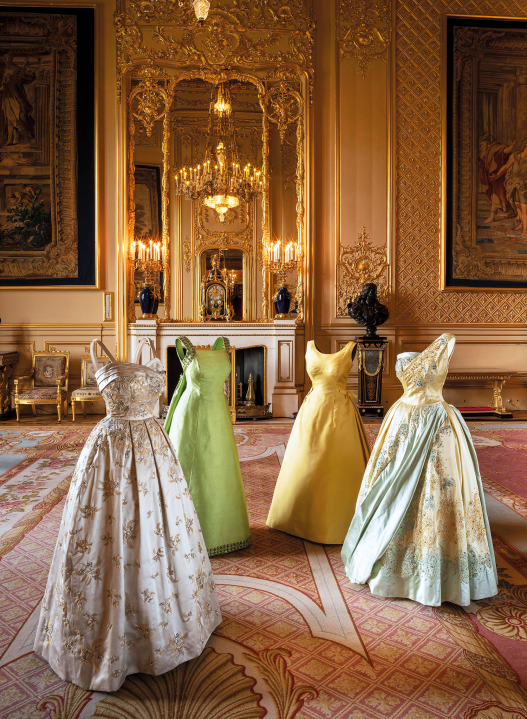
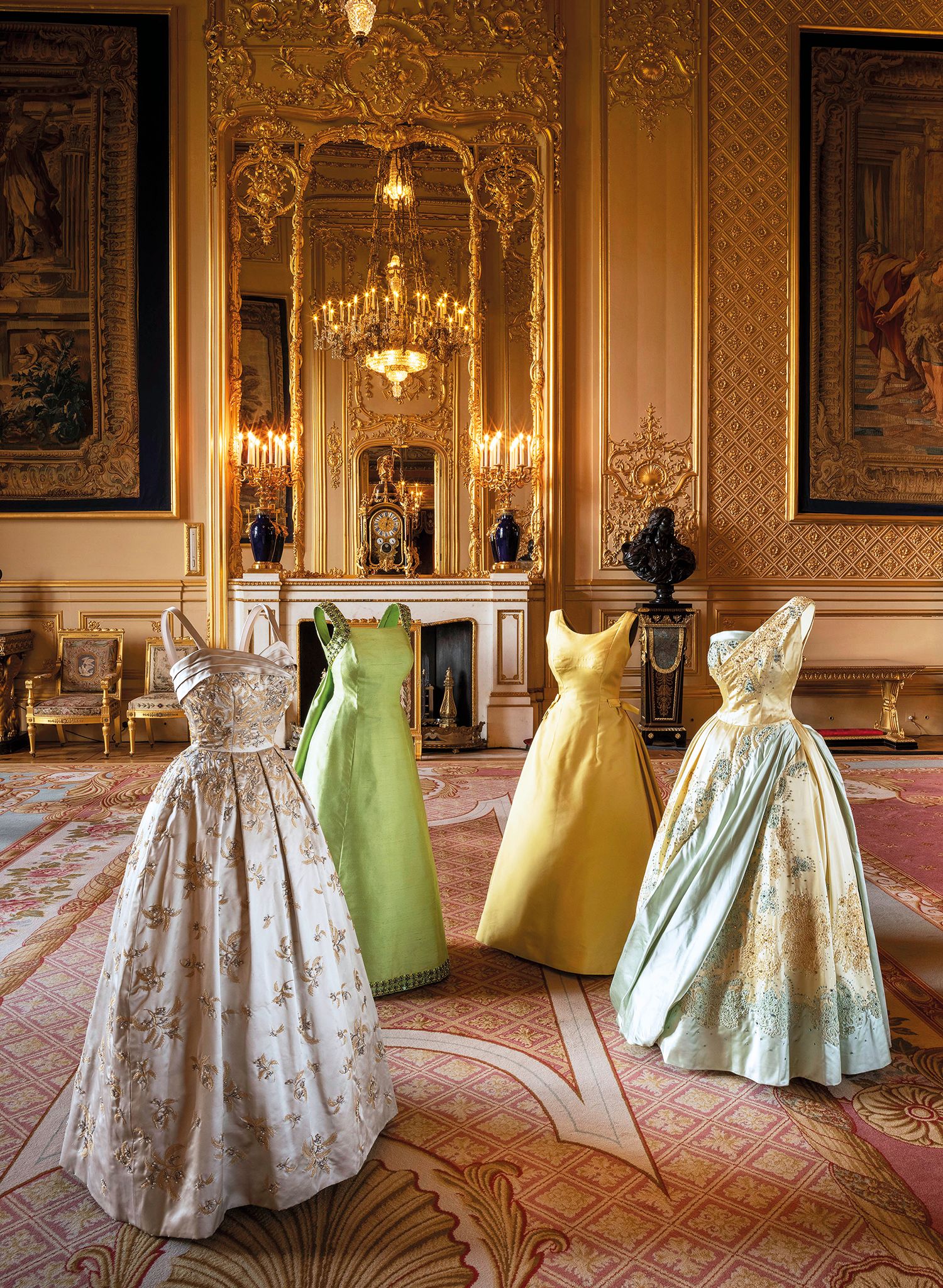
The problem with exhibiting costumes is well known. Should the mannequins be lifelike with human features, or faceless? What about trying a more surreal approach with Perspex or metals? This show of her late Majesty’s wardrobe opts for something more ghostly: hundreds of shoulderless, neckless, wristless, legless figures, floating magically in space, presented in cases at eye level, with others, higher, in serried ranks, like some gorgeously arrayed terracotta army. The unifying factor is that instantly recognizable royal silhouette – from the youthful wasp waist to the later fuller frame.
There were few people of taste in the early years of her reign to guide her
That Queen Elizabeth was a lifetime model of clothes which were exactly appropriate to her proportions and her job is made abundantly clear. Her words “I have to be seen to be believed” also meant that, once seen, she was always believed. Her appearance made you feel simultaneously remote from and close to her. Her great knack was never to dress à la page, meaning her clothes could never date her. Instead the Queen cannily established her own unique image, which, with a few tweaks, could appear the dernier cri. A headscarf instantly turned housewife into princess.
There were few people of taste in the early years of her reign to guide her. English fashion in postwar years was pretty dire, and there was no question of dressing in Paris. She inherited Norman Hartnell from her parents. (Hartnell told me her father, King George VI, would take him to see paintings – Winterhalter, Töpffer, Sargent, etc. – in galleries and palaces and say: “This is how you should dress my wife.”) He gave Princess Elizabeth a much sleeker, unfussy look.
Hartnell was followed by Hardy Amies, who said that, far from being uninterested in clothes, the Queen would study the designs presented to her intensely and say things like: “Thank you, Mr. Amies, I’ll have this skirt but with that top and those sleeves slightly higher set.”
A major problem in dressing a queen is that – except for a papal audience and state or family funerals – black is never an option; though, as on the occasion of her return from Kenya on accession, she always traveled with a black ensemble. (Anne Glenconner assures me that she can’t recall the Queen, or Princess Margaret for that matter, wearing black at even the most informal gatherings.) Seeing the vibrant clothes assembled here, one feels that she must have had moments where she longed to slip into every woman’s staple, the little black dress.
Some of the most touching exhibits are the things she wore in infancy and childhood. Male monarchs of previous generations were, as children, dressed in female attire for several years, and female ones as tiny adult women. (The expression is, in fact, “Pink for a boy, blue for a girl.”) This display reveals a cathartic change from all that. The young princess had the plainest, almost Chanel-simple daytime wardrobe and a doll-like, sashed white organza for gala parties. Shown with these are perfectly coordinated accessories – gloves and hats, shoes and tiny pearls – which suggest that the beloved (and later cruelly dismissed) Crawfie had a fine eye as a stylist.
Alongside the dresses are several examples of the outfits needed for the Queen’s lifelong love of horses and racing. No queen since Alexandra (1844-1925) had ridden en parade, so earlier male regimental uniforms had to be found and adapted, each heavy with frogging, epaulettes and insignia. Looking at the Queen’s uniform, one wonders if perhaps some subtle metal web was inserted to keep that narrow back ramrod for four hours as her mare Burmese trotted along at walking pace. Her riding kit is no less fascinating and beautifully conceived: jodhpurs and tweed for Windsor, green serge and tartans for Balmoral. The faintly Tyrolean twist suggests it was surely handed down from Prince Albert.
The Queen’s hats became less formal, even camp; wonky double-tier toppers Boy George would kill for
As the years passed, younger designers – principally Stewart Parvin – tempted her into more contemporary colors and cuts: longer-jacketed suits, more coatdresses in jewel-like shades that were eyecatching and supremely serviceable for her role. Some of the evening wear is truly audacious: the T-shirt of fauvist jazziness in primary-colored sequins; those extravagantly embroidered bell sleeves, bling enough that you can imagine Madame Marcos wearing them to a California dinner. Hidden away in all this sumptuous broderie was always a subtle diplomatic message: a country’s national flower or national emblem. During this time the Queen’s hats became less formal, even camp, shallower-brimmed, wider-crowned, swirls suggestive of the Guggenheim in New York, wonky double-tier toppers Boy George would kill for.
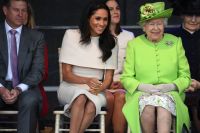
These were, of course, as the wearer became smaller, for added height. Her dresser, the much-feared Angela Kelly, took over the wardrobe, putting her boss in sugary pink, green, lavender blue – distinctive but unshowy, spot-on for an aging icon. And always the white gloves, the same black bag, the sensible shoes. This deity may never have worn Prada, but the exhibition shows that the Queen wore her calling with pride – and her heart not merely on her sleeve.



Comments