Clothes

The secret to dressing exceptionally well

As I scribble these words on a train to London, I’m wearing a lightweight Italian wool suit, a shirt from Gieves & Hawkes, a silk spotty tie and a pair of Church’s suede brogues. You might mistake me for a prosperous Neapolitan gentleman of a certain age. But in fact, I’m a charity-shop dandy – my outfit came to less than £60. That’s less than a pair of new trainers for my teenage daughter. I’m particularly pleased with the shoes, which I picked up locally for £30. A new pair would set you back £700. If you’re not too grand to buy secondhand, it’s actually far easier and cheaper for men to dress smartly than to be slovenly. I learned this important fact in my early twenties.

How to dress a queen

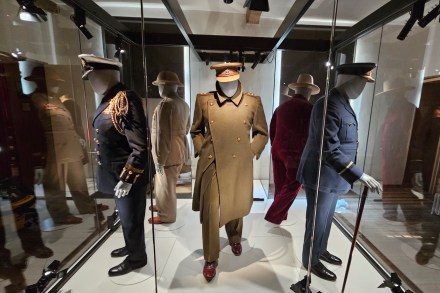
The problem with exhibiting costumes is well known. Should the mannequins be lifelike with human features, or faceless? What about trying a more surreal approach with Perspex or metals? This show of her late Majesty’s wardrobe opts for something more ghostly: hundreds of shoulderless, neckless, wristless, legless figures, floating magically in space, presented in cases at eye level, with others, higher, in serried ranks, like some gorgeously arrayed terracotta army. The unifying factor is that instantly recognizable royal silhouette – from the youthful wasp waist to the later fuller frame.

queen

How to dress a queen

The problem with exhibiting costumes is well known. Should the mannequins be lifelike with human features, or faceless? What about trying a more surreal approach with Perspex or metals? This show of her late Majesty’s wardrobe opts for something more ghostly: hundreds of shoulderless, neckless, wristless, legless figures, floating magically in space, presented in cases at eye level, with others, higher, in serried ranks, like some gorgeously arrayed terracotta army. The unifying factor is that instantly recognisable royal silhouette – from the youthful wasp waist to the later fuller frame.

A short history of the kimono

From our UK edition

'Fashions have changed', said the Japanese writer Ihara Saikaku in 1688. 'Certain shrewd Kyoto people have started to lavish every manner of magnificence on men’s and women’s clothes. By then, everyone in Japan was wearing a kimono. But it was the new, eye-catching, sumptuous ones wrapped around a flourishing breed of fashionistas that Saikaku was talking about. How to show off your wealth and status in Edo-era Japan? Wear the latest kimono. This was the starting point for the V&A’s exhibition Kimono: Kyoto to Catwalk, which opened, then hurriedly closed just days before the lockdown. Those of us lucky enough to catch it can tell you it would’ve been the museum’s summer blockbuster.

Why now is the time to (re)visit Chartwell

From our UK edition

There has always been something really rather magnificent about Chartwell, Winston Churchill’s beloved country home in the Weald of Kent. Sure, it’s no Blenheim or Chatsworth; in fact – say it quietly – from certain vantage points this redbrick Tudor house is verging on unremarkable. It’s even, at a pinch, conceivably the sort of place that Kirsty or Phil might claim lacks kerb appeal. But they, just as any visitor does, would immediately recognise that the true appeal of Chartwell is not in its architecture (although all those walls Churchill built when he modernised it are handsome). No, it’s in the property’s connection to its former owner, and the view – over a seemingly unspoiled Kent arcadia which stretches for as far as the eye can see for some 40 miles.

It’s time to buy a British jumper

From our UK edition

When did you last bump into the words ‘Made in Britain’ on a jumper, shirt or pair of trousers? There’s a chance, if you’re under 40, that you’ve never actually seen those words printed in an item of clothing – ever. And that’s quite a problem, particularly when you consider that we find ourselves in an era when the Prime Minister’s favourite two words are ‘national resilience’. The simple fact is that when it comes to clothes we aren’t resilient. In fact quite the reverse: in the past year Britain imported something like £15 billion-worth of textiles and clothing (compared with clothing exports of around £3 billion).

This old thing: the new fashion brag

From our UK edition

The skirt I’ve worn most often recently is long, blue and as comfortable as it is flattering. ‘Why, thank you,’ I reply with a satisfied smile when I’m complimented on its delicate floral print and the way it swishes as I walk. ‘It’s Dorothy Perkins, 2011.’ I may not be able to distinguish Dolce & Gabbana from Dior or have set foot in a clothes shop fitting room since 2020, but when it comes to the newest form of fashion bragging, I excel. Nowadays, you see, it’s not the number on the price tag that counts, but the number of years you’ve owned the garment you’re wearing – and my wardrobe is stuffed with clothes that predate Megxit, Brexit, Instagram and half of Madonna’s children.

Even the Queen’s clothes evoked her sense of duty

Queen Elizabeth II was a bright spot in the world in more ways than one. She was, by all accounts, a warm and gracious monarch who led her country through storm after storm with “timeless decency and an enduring calm,” as Australia’s prime minister put it. Yet despite her reserved demeanor and steadfast sense of duty that harkened to a much more modest age, the Queen had what appeared on the surface to be a surprising sartorial sense. Do a quick Google Image search for “Queen Elizabeth style” and you’ll see what I mean. Her outfits were often brightly colored and recognizable. Despite this, though, she wasn’t known, as Princess Diana was, for being a trendsetter, exciting fashion magazines and red-carpet commentators with “look what she wore!” moments.

The language of lounging around

From our UK edition

At the Austrian embassy in Naples, a German diplomatist asked the great beauty Madame de Ventadour if she had been in the Strada Nuova that morning. ‘What else have we to do with our mornings, we women?’ replied Madame de Ventadour. ‘Our life is a lounge from the cradle to the grave.’ How true. The observation comes in Bulwer Lytton’s novel Ernest Maltravers (1837). I was put in mind of lounging by remarks that Anne McElvoy made on the wireless about the use of video-conferencing and broadcasting allowing people to attend to their visible top half while wearing lounge pants below. I wasn’t too sure what lounge pants were. I don’t wear them and my husband certainly doesn’t.