

Margaret Mitchell has narrated this article for you to listen to.
Should we hop on a call? Let’s touch base. Let’s take this offline. Let’s circle back to your last slide deck. Let’s get those action items actioned by close of play. We need stakeholder buy-in. We need deliverables. We need to make sure you’re aligned with company culture. We’re concerned you’re not leveraging your core competencies. After careful consideration, management has made the difficult decision to terminate your contract. We’re committed to helping you with this transition.
Corporate jargon is zombified language. These euphemisms and elisions are the soulless husks of words, meant to blunt the sharp edges of human emotion (sorry – “maintain professionalism”). And they often leave you feeling a sneaking sense of dread.
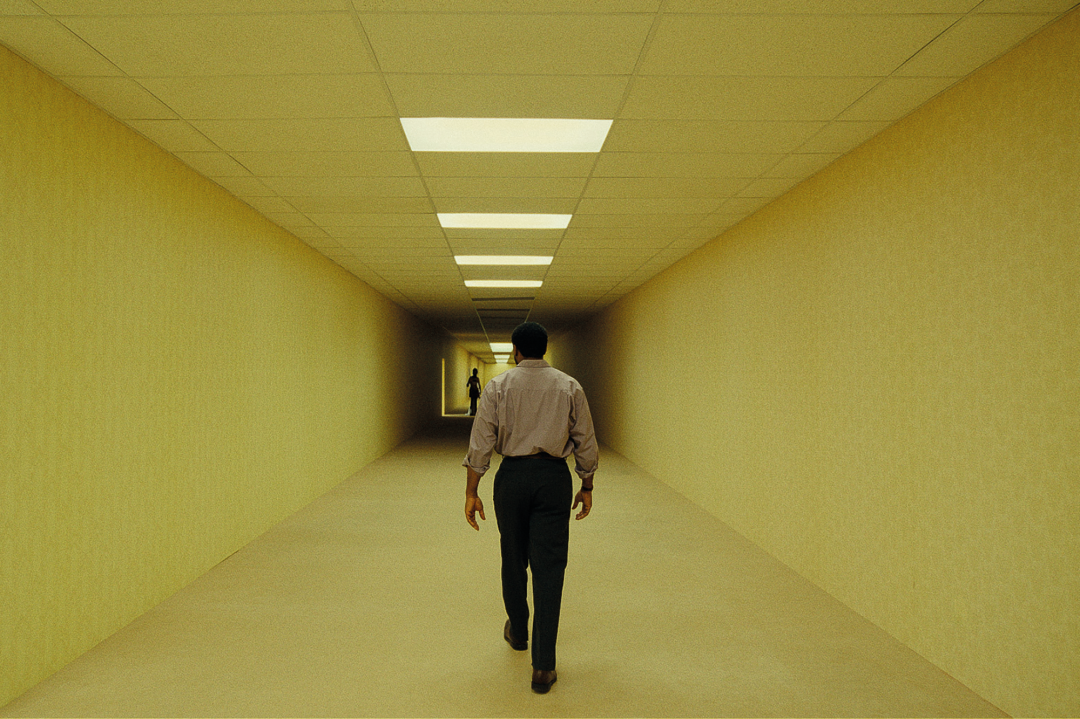
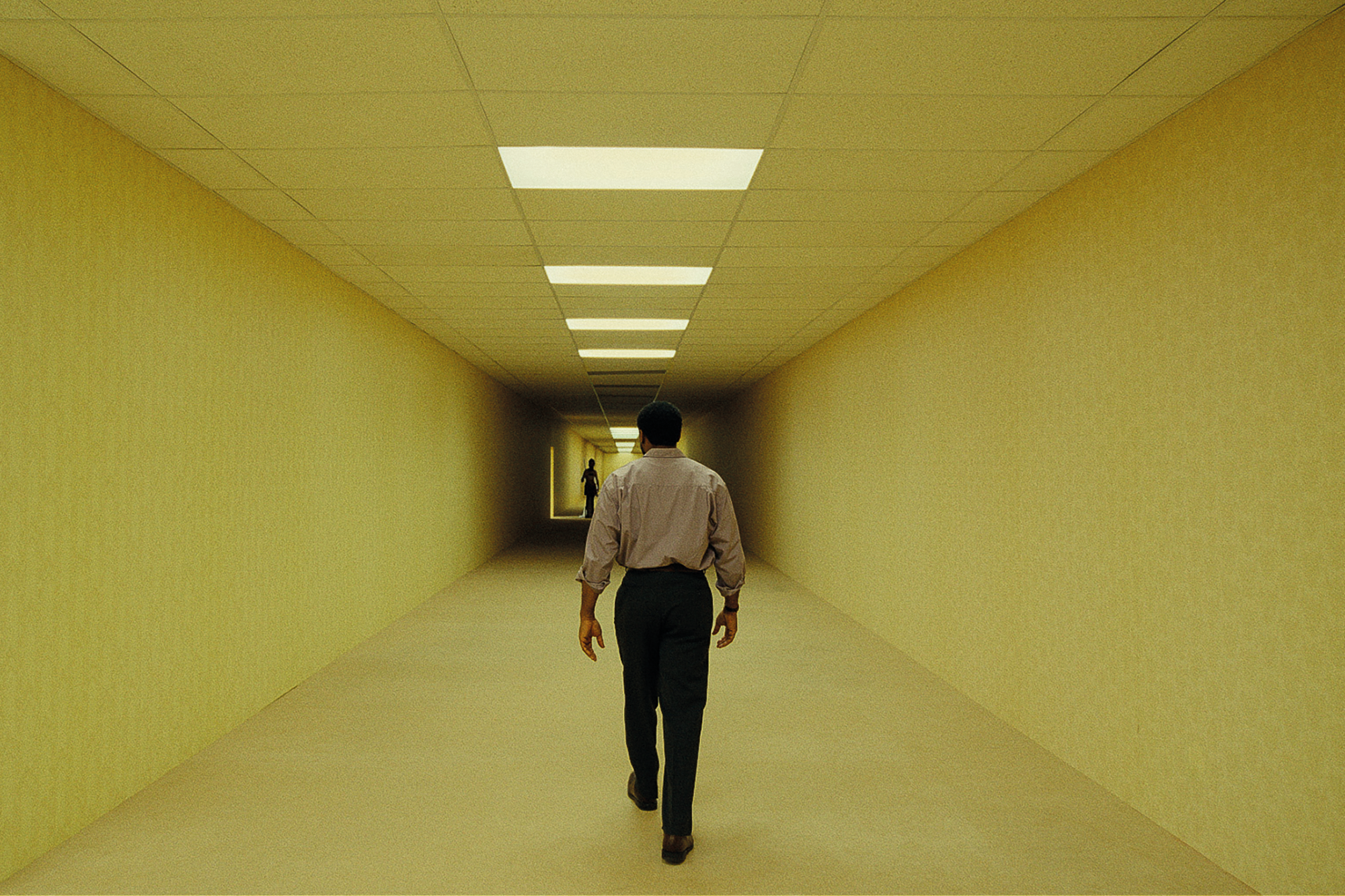
This dread has been distilled into A24’s latest psychological-horror film, Backrooms. Failed architect-turned-furniture dealer Clark (Chiwetel Ejiofor) finds a portal in his showroom, leading to an infernal labyrinth of office space. The idea came from a disconcerting photo of empty retail space posted to the online messaging forum 4chan. A user described the place as “the Backrooms”: “It’s nothing but the stink of old moist carpet, the madness of mono-yellow, the endless background noise of fluorescent lights at maximum hum-buzz.” The image epitomizes the “liminal space”: those in-between places – empty hotel corridors, shuttered malls, vacant offices – devoid of human presence.
Corporate dread depends on the office to unsettle us as much as the gothic relied on ruins
Was it inevitable that offices would come to haunt us? The modern office came about in the 18th century to process the vast amounts of paperwork involved in running, first, empires and, later, railroads. The multiple new levels of management that the rail companies spawned dictated the need for new organizational spaces, explains Nikil Saval in Cubed, his history of the office.
But already in 1906 there was an attempt to humanize these dehumanizing spaces. The Larkin building, in Buffalo, New York, marked a significant innovation in office design in emulating a domestic setting. The building – designed by Frank Lloyd Wright to house the administrative offices of the Larkin Soap Company – appeared rigid and fortress-like from the outside, but an atrium over the workspace let in natural light and created a sense of spaciousness. Wright wanted an atmosphere of “family-gathering under conditions ideal for body and mind,” and the office provided workers with space to eat, a library, a gym, picnics, concerts, break rooms, a roof garden.
Why ever leave? In Sinclair Lewis’s satirical novel The Job, the totalizing office is described as “an unreasonable world, sacrificing bird song and tranquil dusk and high golden noons to selling junk – yet it rules us. And life lives there” – albeit in a controlled, artificial, uniform fashion. One memo from the Larkin office described how a clerk asked for permission to replace his “very uncomfortable” chair designed by Wright (an unstable, three-legged thing dubbed the “suicide chair”). The clerk’s request was denied.
In the mid-century, under the influence of sociology, psychology and management-consulting bunk-merchants, designers began to experiment with the relationship between a worker’s environment and his productivity. The furniture company Herman Miller hired Robert Propst in 1958 to reinvent the workplace. He found the modern office to be a stagnant wasteland: “It saps vitality, blocks talent, frustrates accomplishment. It is the daily scene of unfulfilled intentions and failed effort.”

Propst developed the Action Office, a set of modular components: adjustable desks, movable panels, telephone booths on wheels. Office design, Propst believed, must be “forgiving” – receptive to change and not overly prescriptive. Great in theory, but in practice it was a disaster. Cheap imitations quickly flooded the market, and the movable panels became fixed into 90-degree cubicles. Thus the nightmarish ‘cubicle farm’ was born. His original partner in designing the Action Office, George Nelson, later criticized the project: “It is admirable for planners looking for ways of cramming in a maximum number of bodies, for ’employees’ (as against individuals), for ‘personnel,’ corporate zombies, the walking dead, the silent majority. A large market.”
Backrooms belongs to a broader genre that is not quite horror, but something more subtly terrifying, which you might call ‘corporate dread’. It depends upon the aesthetics of the office to unsettle us as much as the gothic relied upon castles, ruins and ghosts. Corporate dread is about being haunted by another kind of chilling presence: bureaucracy, management, “the system.”
That strain of darkness appeared in the earliest depictions of white-collar workers. In “The Overcoat” by Nikolai Gogol, a government clerk’s tattered coat is the butt of his colleagues’ jokes. He buys a new coat, starving himself to pay for it, only for it to be stolen. When the clerk approaches a police commissioner without first filing a petition and consulting a host of functionaries, he is kicked out into a snowstorm, dies of a fever and haunts St Petersburg as an overcoat-stealing ghost.
Herman Melville’s “Bartleby, the Scrivener,” published in 1853, is about a Wall Street clerk driven to madness and total inertia. Bartleby stares at a blank wall, refusing even to leave the office, and responds to requests by simply saying: “I would prefer not to.” The narrator is reminded of a story about another clerk, who hatcheted a bookkeeper to death over a minor office dispute. That murder could not have happened elsewhere: “It was the circumstance of being alone in a solitary office, up stairs, of a building entirely unhallowed by humanizing domestic associations.” By the time American Psycho and Fight Club were filmed around the millennium, apparently little had changed.
As office buildings rapidly expanded during the 20th century, they appeared in film as something like human battery farms. In Orson Welles’s adaptation of The Trial by Franz Kafka, K’s office is a vast, concrete expanse filled with the incessant clacking and gnashing of typewriters. Billy Wilder pulled a trick of perspective in The Apartment to make the office (of a company called “Consolidated Life”) appear endless: the desks became smaller and smaller towards the back of the room, and were filled with children and dwarves. Behind them, the back wall was painted with desks reaching towards an infinity point. Even the protagonist’s home is absorbed into the office, as he rents his apartment out to his bosses to conduct their extramarital affairs in return for promotions.
A reprieve from on-screen dread came in the 2000s and early-2010s, when sitcoms moved from the domestic sphere to the office. Parks and Recreation and the American version of The Office presented the total work environment with the same sentimental optimism that television had previously reserved for the home. The drama of life – friendships, love triangles, romance, marriage – could be found there. Even Taylor Swift fantasized over an imagined workplace romance: “I could see you in your suit and your necktie/ Pass me a note saying, ‘Meet me tonight’/ Then we kiss and you know I won’t ever tell.” Phwoar.
Work was set free from the office block only to be dispersed to all corners of our lives
Both Parks and Recreation and The Office were often cited as “comfort shows,” which people would watch over and over to try and forget their own workaday lives. The offices we see on television in the 2020s are much more hellish, perhaps a result of disillusionment with the unfulfilled promises of more “human-centered,” “purpose-driven” or “family”-like companies. It’s now the chaotic, shouty trading floor in Industry; the depressed, David Fincher blues of a newsroom in Succession; or the windowless corridors and fluorescent lighting of the office sci-fi Severance, in which employees undergo a lobotomy-like procedure to have their memories of work severed from their personal lives (much like the experience of watching The Office).
Meanwhile, the “office siren” fashion trend indicated that the office, and its accompanying dread, had escaped containment. Miu Miu’s Fall/Winter 2023 collection popularized a particular style of thick-rimmed, oval glasses, which became central to this look. It resembles office fashion – monochrome, kitten heels, pencil skirts, sensible eyewear – but more tarty, and arrived at a time when the Covid pandemic had blown up the 20th-century notion of the office. Work was set free from the office block only to be dispersed to all corners of our lives, and office-wear was transformed into something nostalgic and kitsch. The “office siren”-style looks designed to be worn in a TikTok video rather than while working – but to be fair making TikTok videos is now what many people do for work.
And isn’t that wonderful? Why should we feel dread about any of this? We’re told, and tell ourselves, that we are in a new era of discovery and previously unthinkable opportunities (if that’s what you call making big bucks on OnlyFans and getting Claude to write your emails). We’re living in the golden age of work, where AI is going to make you a gazillionaire – as long as you start using it right now and avoid becoming a casualty of the white-collar bloodbath. There’s nothing to fear. You don’t even have to leave your home to go to work. Imagine it – someday, we won’t even know the meaning of the word “office.” It will just be called life.
Backrooms is in cinemas nationwide from 29 May.



Comments