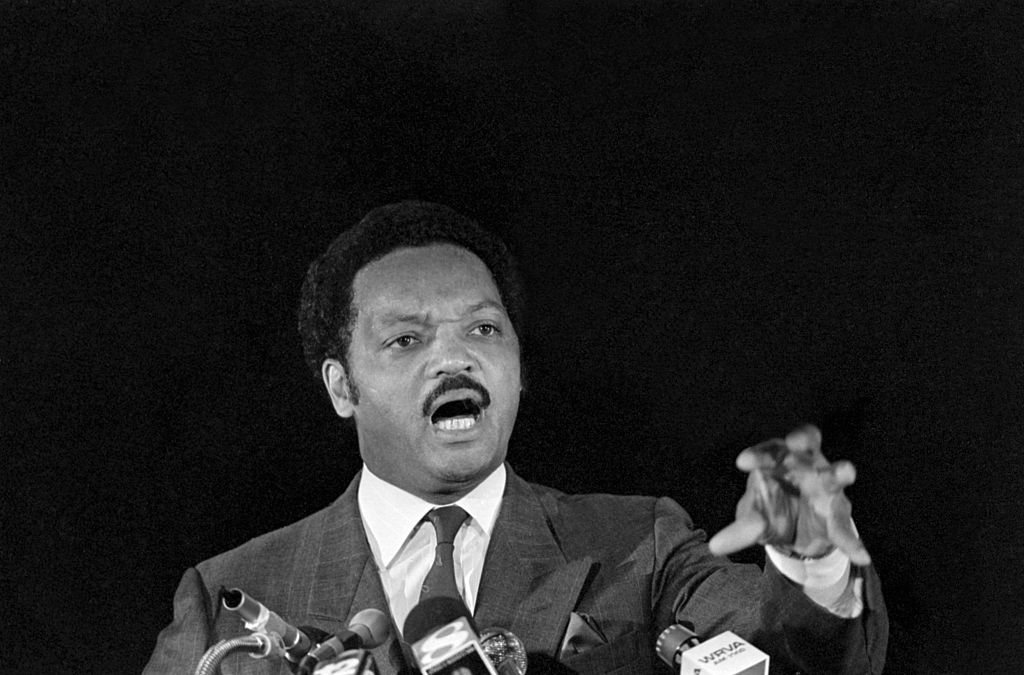
During a visit to Zimbabwe in 1989, Jesse Jackson was walking down the dirt trail leading to Victoria Falls when a group of three African men hunkered in the shade of a scrubby tree stood up to point at him. One asked, “Is this… is this the great Reverend Jesse Jackson?”
His fame was global. He popped up in the most unlikely places: negotiating the release of hostages in Lebanon, lobbying for earthquake relief in Armenia, criticizing factory conditions in Japan. A photo spread of his career would show him face-to-face with Fidel Castro, Saddam Hussein and Slobodan Milošević. He hosted Saturday Night Live and appeared on Sesame Street, and he had a talk show on CNN that ran for eight years.
Jackson knew that assassination was a very real possibility in his line of work
By the time of his death, the world seemed to have passed Jackson by. The multiracial “Rainbow Coalition” that he championed – “Red, yellow, brown, black and white, and we’re all precious in God’s sight,” as he said at the 1984 Democratic National Convention – was replaced by a Democratic party that holds “Black Lives Matter” as a sacred phrase never to be modified by reference to lives of any other color.
Barack Obama bears much of the blame for marginalizing Jackson, although his reasons were as much personal as ideological. Back in Chicago, the Obamas and the Jacksons had been close. Jesse’s daughter Santita was maid of honor at Michelle and Barack’s wedding. But during the 2008 presidential campaign, Jackson was critical of Obama’s handling of racial issues, and those frustrations became disastrously public when Jackson was heard, on a Fox News hot mic, saying he wanted to “cut [Obama’s] nuts off.” Jackson apologized for the remark, but he was effectively banned from the White House during Obama’s presidency.

Jackson came from truly humble beginnings. He was born in Greenville, South Carolina, to a high-school student who had an affair with her much older neighbor. She soon married another man, Charles Jackson, who adopted Jesse. But as soon as they had a child, Jesse was packed off to live with his grandmother in a house around the corner. Twice rejected before the age of ten.
At a dinner party in 1987, Democratic grandee Arthur Schlesinger Jr. asked Bill Clinton what he thought of Jackson, and that trauma was what Clinton focused on: “Jesse, he observed, was an illegitimate child. His father lived next door where he had a son the same age as Jesse. Every day Jesse saw his father come home and play with his half-brother.” His incredible drive to make something of himself sprang from that.
Jackson had nothing going for him when he moved to Chicago at the age of 23. His only connection to the city was a letter of introduction to mayor Richard Daley from the white Democratic governor of North Carolina, Terry Sanford, for whom he had done some work as a college student in Greensboro. Daley looked at the letter and offered Jackson a job as a toll booth attendant, which he declined.
He got his first big break from magazine publisher John H. Johnson, founder of Ebony and Jet. “My mother came to me and said, ‘Son, there’s a young man at our church who needs a job,’” Johnson recalled. The only job available was in the warehouse. “But when he arrives, he’s a very tall, striking, handsome young man, and when he begins to talk, very articulate. The first thing I’m saying to myself, I cannot have him unloading trucks.” He gave Jackson a job in sales.
This gave Jackson a chance to build a personal network of contacts across every black neighborhood in Chicago, which he put to good use as an organizer for Martin Luther King Jr.’s Southern Christian Leadership Conference. In 1966, the SCLC was pivoting to an economic message after its civil-rights victories. Word reached headquarters in Atlanta that a young activist in Chicago was racking up success after success persuading local businesses to hire black workers – 44 jobs at Country Delight Dairy, 184 jobs at High Low Foods. King ordered that Jackson’s salary be doubled.
On the day King was assassinated, his associates gathered in the Lorraine Motel and agreed that no one would talk to the reporters gathered outside. Minutes later, one of them saw Jackson addressing the television cameras and heard him say, “Yes, I was the last man in the world King spoke to.” That wasn’t true, but the false image of Jackson cradling the slain leader’s head would be repeated in the press until a 1975 book by an investigative reporter decisively proved that Jackson had been nowhere near King when the shots were fired.
In 1984, there was a sense that the time had come for a black person to run for president. The press had plenty of possibilities to propose: Atlanta mayor and former ambassador to the UN Andrew Young, Chicago mayor Harold Washington, Los Angeles mayor Tom Bradley. But none of them wanted to do it. Only Jackson stood up and launched a national campaign, coming third behind Walter Mondale and Gary Hart.
Most novelty campaigns lose steam the second time around, but Jackson won more votes and primaries in 1988 than in 1984. When he unexpectedly won the Michigan caucuses, he was briefly the front-runner.
It took bravery for Jackson to run for president. He might not have cradled King’s head, but he knew that assassination was a very real possibility in his line of work. Vice-presidential nominee Geraldine Ferraro warned her children not to stand near Jackson in public, and photographers covering him wore bulletproof vests.
His character appealed to Donald Trump. The President issued a statement when Jackson’s death was announced on February 17. “He was a good man, with lots of personality, grit, and ‘street smarts. Despite the fact that I am falsely and consistently called a Racist by the Scoundrels and Lunatics on the Radical Left, Democrats ALL, it was always my pleasure to help Jesse along the way.”
Obama’s statement, in comparison, sounds like an AI wrote it. “For more than 60 years, Reverend Jesse Jackson helped lead some of the most significant movements for change in human history,” he posted on X. If you are going to honor the Reverend Jesse Jackson, the great master of anaphora and chiasmus the least you can do is put a bit of rhetoric into it.




Comments