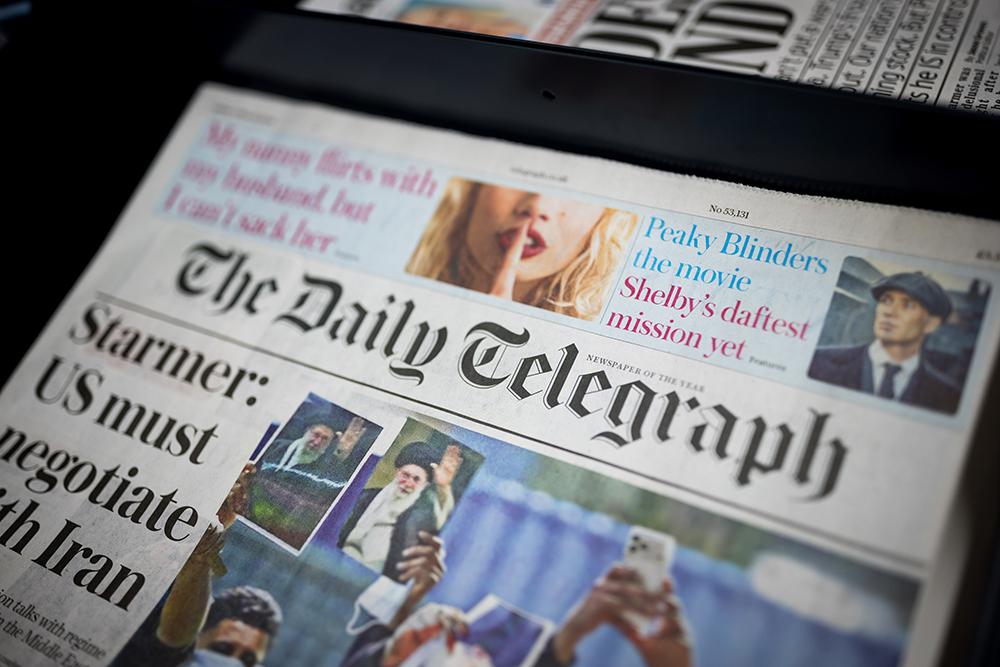


I spent my last year as editor of this magazine trapped on an auction block, hunting for a new proprietor. It was agony. There was a list of about 20 bidders for both The Spectator and the Daily Telegraph: the good, the bad and the really quite ugly. The ugliest of all – the government of the United Arab Emirates – ended up cutting a backroom deal for both titles. But parliament intervened and this magazine escaped, snapped up by a suitor who has been as good as his word on investment. The Telegraph, meanwhile, was left standing at the altar.
Last week, after nearly three years of waiting, she was finally swept up by her own Mr Darcy – or, rather, Döpfner. The Berlin-based media giant Axel Springer has paid a handsome £575 million in cash for the newspaper. The deal has raised understandable questions. Should a German company really own His Majesty’s Daily Telegraph? Can a Europhile like Mathias Döpfner, its 6ft 7in chief executive, be trusted with the flag-bearer of Brexit? Having seen the sale process from the inside, I can explain why I see it as a great escape.
Döpfner believes artificial intelligence can, if properly deployed, take newspapers into a new golden age
Newspapers around the world are in a bad way. Failures are everywhere, successes are rare. But while they may lack financial prospects, they retain political and cultural influence. To be a proprietor still opens doors, especially in politics. This attracts so-called ‘corrosive capital’, money from dodgy regimes that seek to buy influence in democracies by snapping up their assets: wind farms, airports and – the final frontier – newspapers.
This is why, under the last government, parliament ruled that ‘foreign powers’ should not be able to buy papers. When Lisa Nandy became Culture Secretary, she partially reversed this, allowing them to own stakes of up to 15 per cent. It was to secure investment, she said. Her implication was that the only money left for newspapers was funny money. The Telegraph seemed doomed to be co-owned by a regime that imprisons rather than supports journalists. George Osborne, as you might expect, was acting for the Emiratis. The days of press freedom – the only definition of which is freedom from government – seemed to be over.
Those of us who wanted to avoid UAE ownership or part ownership tried to see if Döpfner might be interested in putting in a bid for ‘Sparta’ or ‘Triton’ (the bizarre codenames the financiers gave The Spectator and Telegraph) but he didn’t bite. He had tried to buy the Telegraph when it was last up for sale in 2004, but was pipped by the Barclay family at the 11th hour. Since then, its value had halved. We assumed he wanted the Wall Street Journal and wouldn’t settle for anything smaller. The newspaper industry seemed to have run out of people with the money or inclination to bid.
After The Spectator’s sale a year and half ago, I had a drink with my friend Madeline Grant, then a political sketch writer for the Telegraph (and now for this magazine). ‘It’s like we’re two children up for adoption,’ she sighed. ‘You’re being whisked off in the millionaire’s limo and we’re being left to be picked up by the nonces.’ And yet the Telegraph’s performance in this limbo period, with scoop after scoop, was extraordinary.
Perhaps Döpfner was hanging about in the background all the time, waiting to swoop, determined not to be pipped again. I’m told that he emerged out of nowhere and sealed it all in three days, paying 50 per cent more than other offers.
He believes that artificial intelligence can, if properly deployed, take newspapers into a new golden age. His plan is audacious – and logical. My time in the bowels of media business made me see how the proper handling of boring stuff like logins and credit card renewal can make the difference between growth and decline. Svenska Dagbladet, a Swedish paper I occasionally write for, uses AI to choose most articles on its homepage, tailoring them to the readers’ interests. Its sales are surging.
The idea that Döpfner would force Europhilia on the Telegraph (or move it to the left) is laughable. The titles he owns – Politico, Die Welt and Bild – are centre-right but, in any case, successful publishers know that publications serve their readers and no one else. If Axel Springer had an agenda to push, we’d have seen it in the extensive coverage of Politico. If you think, however, that every publisher has strong beliefs, you’d be right. Unusually, Springer admits this and publishes its values for full transparency.
Springer’s mission statement indicates what kind of hands the Telegraph has fallen into: ‘We stand up for freedom, free speech, the rule of law and democracy. We support the right of existence of the state of Israel and oppose all forms of anti-Semitism. We advocate the alliance between the United States of America and Europe. We uphold the principles of a free market economy. We reject political and religious extremism and all forms of discrimination.’
You may think these declarations are clichés, but they show a clear support for the free press. Could Sheikh Mansour have made a similar commitment? How could an Arab autocracy have come so close to taking ownership of a British newspaper, or even part-ownership? The Telegraph drama has exposed a major vulnerability in our democracy. Corrosive capital is already at work. The boundaries that ought to separate business, politicians and the press are being tested and eroded. They require a defence.
Döpfner has pledged to double Axel Springer’s market value in five years. To critics, his tech talk (‘digital is the new print, AI is the new digital’) sounds hyperbolic. But is it so crazy to think that the free press can enjoy a renaissance? My new newspaper, the Times, is stronger now than at any point in its 241-year history. The Spectator’s sales are at a 197-year high. The digital age has not replaced the authority of great titles but has, if anything, made them more valuable. After years of uncertainty, the Telegraph has at last found a digitally savvy owner willing to bet on its future. Vorsprung durch Technik, as they say in Germany.
Fraser Nelson is a former editor of The Spectator and a Times columnist.





Comments