
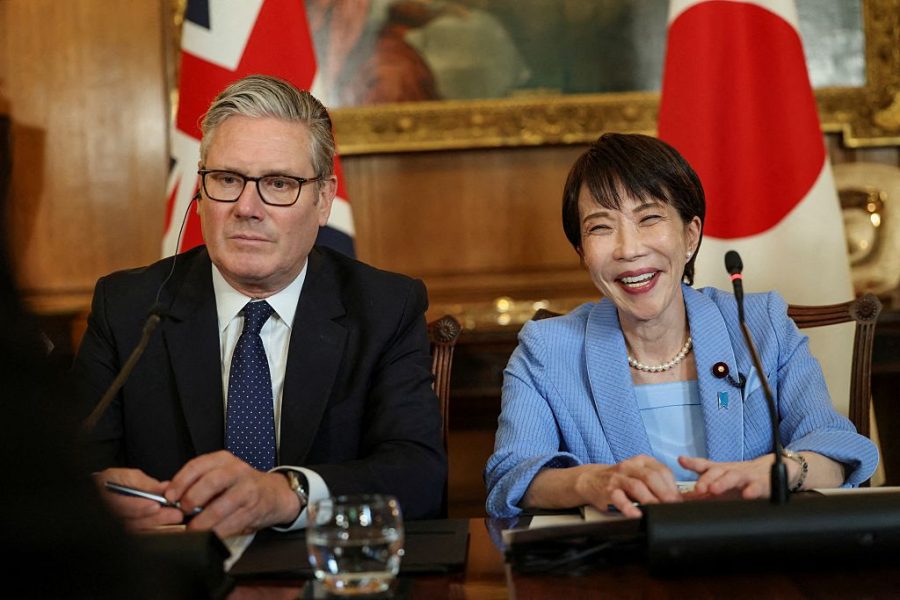
It was all smiles for the press when Japanese prime minister Sanae Takaichi visited Keir Starmer at No. 10 on Sunday for trade and security talks. But how friendly it all was behind the scenes is another question.
Doubts have been growing about the true state of the much-trumpeted new dawn of defence cooperation between Japan and the UK, and especially the future of the GCAP fighter jet project (a tripartite initiative with Italy to develop a sixth-generation stealth jet fighter by 2035). Such concerns have only intensified since the dramatic resignations of defence secretary John Healey and veterans minister Al Carns last week.
Takaichi remains bullish for now. Speaking through a translator, she said the UK and Japan had agreed to ‘accelerate the progress of GCAP’ and that the UK and Japan were in a ‘quasi-alliance’. Starmer, more obliquely, said only that the two would ‘confirm’ their shared commitment to the project and ‘discuss’ the launch of the next phase.
A transitional ‘bridging’ contract was signed on 2 April (to last until 30 June) between GIGO (GCAP International Government Organisation) and the trilateral joint venture Edgewing. A new longer-term contract is supposed to be signed at the end of the month, but Starmer gave few deatils about what that would look like or its exact duration. And he didn’t say how much money the UK would commit to the project. It was all a bit vague…
GCAP has much more urgency for the Takaichi government than the Starmer administration
The difference in tone and clarity is telling. GCAP has much more urgency for the Takaichi government than the Starmer administration. For a man seeking a legacy (in a hurry), it has limited appeal (it was launched by Ben Wallace under Rishi Sunak’s leadership after all). And Starmer has more immediate concerns than a fighter jet project due to be realised in 2035 – like staying in office beyond the summer.
For Japan, though, GCAP is a landmark initiative. It marks the country’s first major international defence project not to include the USA. Security issues increasingly dominate the news there. The Japan-China-Taiwan situation is a recurring nightmare, as is North Korea’s incessant bellicosity. And President Trump’s insistence that Japan wean itself of its reliance on US military support has focused policymakers’ minds on real, not theoretical threats.

GCAP may not be the answer to these dangers, but even if it doesn’t transform aerial warfare, as the hype has it, it holds significant symbolic and political importance for Japan. Takaichi needs to project an image of strength, of a Japan backed by powerful international allies and capable of cooperating in a cutting-edge multinational military technology initiative. She needs to look busy, like she has a plan. For credibility’s sake, all must appear well with GCAP.
It is not surprising, then, that not everyone in Japan has been entirely reassured by Starmer’s carefully crafted endorsement. Especially seeing as it comes so soon after the departure of Healey and Carns and with reports that the Chancellor sees GCAP as the military’s version of HS2 and wants direct control of the project’s funding.
Nobody in Japan has gone on the record yet, but it has been reported that doubts have been expressed in high places about the UK’s true commitment, not just to the GCAP project but to overall reliability as a defence partner. If that weren’t the case, why would Takaichi require Starmer’s reaffirmation of support?
Someone who has gone on the record is former defence secretary Ben Wallace, who believes the government secretly wants out of GCAP. He posted on X on 2 June:
It has been a consistent block by the Treasury that the MoD can have AUKUS subs or GCAP or major reductions in the Army. But they can’t have all three… The government is preparing to push GCAP to the right and string it out with incremental work and no clear guarantees to commit to it. They will be hoping that Japan (which cannot tolerate an extended timeline) will pull out, and blame can be avoided.
If that is the plan, it is a pretty desperate one. Japan has already committed 500 billion Yen (£2.3 billion) to the project, and apart from the security importance, it holds considerable prestige value for Takaichi. An Anglophile who cites Margaret Thatcher as an inspiration, it would be a heavy blow to have to report the failure of a major Anglo-Japanese initiative.
It would be a heavy blow to the UK defence industry too. Lancashire Business Review notes that more than 4,000 defence workers (BAE, Rolls-Royce and Leonardo) are currently engaged on GCAP projects in the UK. The defence workers’ union Unison has complained about how delays to the Defence Investment Plan and uncertainty about GCAP has put contracts and jobs at risk.
For Starmer, his discomfort is palpable. Beset with immediate funding issues and a seemingly immovable Treasury, not to mention a day-to-day struggle just to stay in office, stringing along the Japanese until their patience snaps or some other solution presents itself might look like the least worst option to a man with few alternatives and little power.




Comments