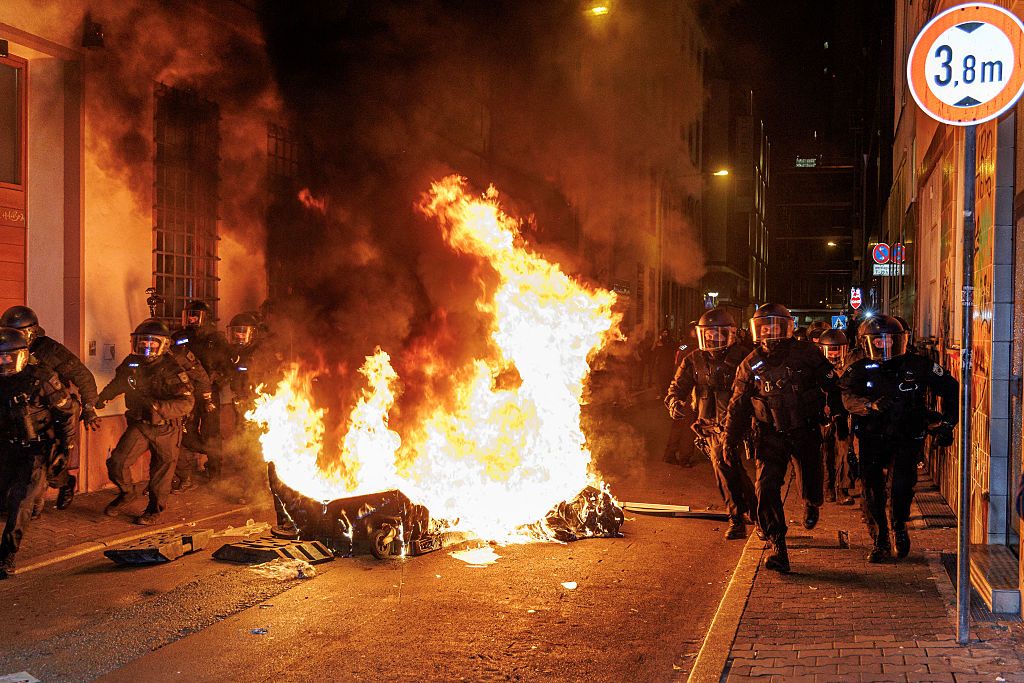
On Halloween it is traditional in Germany to greet trick or treaters with the cry of ‘sweet or sour?’. This year, in Frankfurt, the night was definitely more sour, as Germany’s financial capital lit up for all the wrong reasons.
It began as the ‘Gen Z regelt’ (Gen Z takes charge), a march by young left-wingers demanding more funding for schools, financial support to deal with living costs and an end to politicians discussing reintroducing conscription. Yet as the dark winter night fell, the march turned into the looting of shops.
Mass immigration has created ghettos of poorly assimilated migrants in bad jobs across Europe
In Die Zeil, the major shopping street in Frankfurt, hooded youths threw rocks, fireworks and bottles. Seventeen shops were damaged and five looted, among them stores selling trainers and guns. More than 1,000 police officers had to be deployed, with around 100 injured. One officer lost his teeth after a stone was thrown at him.
The police have now arrested over 50 people aged between 13 and 29. Most of them have German nationality but Roman Poseck, the interior minister of the state of Hesse, bluntly said that most are also from a ‘migration background’. That’s the polite German way of saying that their names are more likely to be Abdul or Ahmet than Armin or Andreas.
Although the young left-wingers who began the march had mostly melted away by the time the rioting began, around 100 left-wing extremists are said to have been among those who engaged in violence. Federal interior minister Alexander Dorbrindt blamed ‘violent left-wing groups and troublemakers from migrant communities’.
The inspiration for the marches, which attracted tens of thousands in Cologne, Berlin and Hamburg, were the recent school protests in France. Although nominally about a lack of funding for schools in France, they quickly descended into an orgy of opportunistic looting and wanton property damage. Rather than a protest, this felt much more like another violent spasm as part of what the author Andrew Hussey called ‘The French Intifada’.
Similarly, copycat looting in Milan was notable for its lack of political direction. Italian Prime Minister Georgia Meloni noted afterwards that nearly half of those detained were of migrant origin. There have been similar clashes in Spain, Portugal and Belgium.
The common thread is not concerns about the cost of living or public sector funding, but rather the anger felt by many young people, especially those of migrant origin. Although some commentators attempted to link the French riots to the long history of French protest, the latest disturbances featured far more stealing of luxury goods to resell on Vinted than they did passionate speeches at the barricades.
It suits many left-wing commentators to present these as political struggles, allowing them to feel they are riding a wave of popular anger and representing legitimate demands. The lack of manifestos from those actually doing the looting shows that the cause of the rioting is more prosaic. These young people aren’t rebelling against capitalism as they steal the latest style of trainers.
On the contrary, they are rebelling against a society from which they feel alienated, often due to their own faults. Mass immigration has created ghettos of poorly assimilated migrants in bad jobs across Europe. The opportunities are there, and indeed there are highly successful migrants in all these countries, but many seem to prefer a half-life caught between the place where they live and the country they came from, too comfortable with European welfare to leave but aware of their own relative failure. It isn’t unusual to find Germans of Turkish origin who still speak poorly accented German, even after three generations living in the country.
It was positive therefore that minister Poseck was willing to point to the involvement of those of migrant background and say there ‘must be no false taboos’. His party, the CDU, has failed to tackle Germany’s problems with migration and crime. Although the number of asylum seekers in Germany has dropped, legal migration remains high and many crimes only lead to a slap on the wrist.
In one infamous case, an intoxicated 15-year-old girl was gang-raped in a park in Hamburg at night by multiple young men, many of them migrants. Only one, an Iranian, actually went to prison. Under Germany’s generous youth sentencing laws, the others who were convicted only received suspended sentences.
Tougher sentencing would go a long way to preventing future lawlessness, whether from the far-left, migrant criminals or the far-right. Yet Germany also needs to have a tougher debate: what to do with alienated migrant communities. Assimilation can only work with low volumes of migrants, strong pressure to conform, and consequences for those who break the rules. If not, then Germany will find that terror doesn’t only come to the streets on Halloween.





Comments