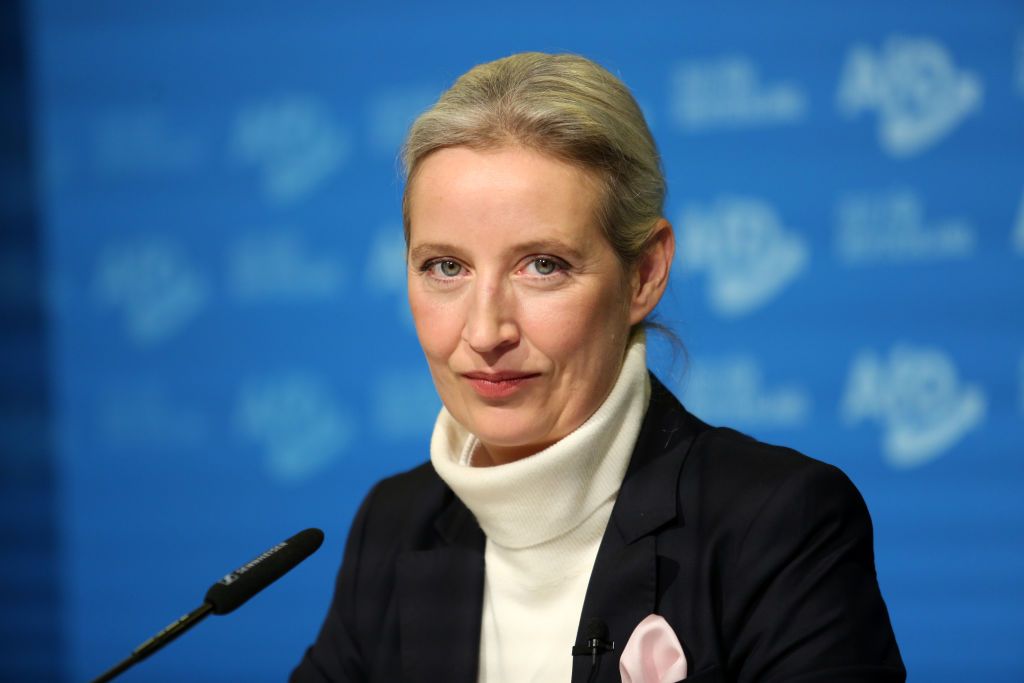
Hundreds of thousands of private emails from Germany’s Alternative for Germany (AfD) party have been hacked and published online, exposing the inner workings of the party and raising the possibility that members could be harassed.
The party has confirmed that unidentified hackers had accessed their private information, which allegedly consists of 421,179 emails, amounting to 281 gigabytes of data, according to the tabloid newspaper Bild.
Other hacked documents allegedly include copies of identity cards, invoices, bank statements, membership applications and lists of party members
Among the material is said to be correspondence which includes the party’s leader, Alice Weidel; former party chairman, Alexander Gauland; and a member of the German parliament, Leif-Erik Holm.
The AfD has said that the hackers targeted an external hosting provider, rather than hacking its own central systems. A spokesman claimed that only a “small number of email accounts” were affected and that most “had not been used for years.”
However, Bild journalists who obtained limited access to the hacked files found a photo of the identity card of Markus Frohnmaier, the AfD’s deputy parliamentary group leader in the German parliament.
Other hacked documents allegedly include copies of identity cards, invoices, bank statements, membership applications and lists of party members in local branches in the important state of North Rhine-Westphalia.
As well as the danger that such information could be used for information or financial fraud, it also represents a personal risk for the local members involved. Being part of the AfD still carries a strong stigma and can lead to discrimination or harassment.
Earlier this year Martina Müller, who had worked in a hospice for 15 years, was dismissed from her job after standing as an AfD candidate in Jever in Lower Saxony. Her employer argued that standing for the AfD was incompatible with its Christian values.
Other AfD members have faced physical attack, such as the state parliament member Michael Meister, who was attacked by two men at his home in Rostock at night. He suffered a cut to his arm. The attackers called him a Nazi. Bolts on the family car were also loosened and another two members of the AfD in Rostock were allegedly attacked by Antifa this year.
According to Tagesschau news, the attack also affected Alternita, a company associated with the AfD, as well as email accounts linked to regional party organizations in North Rhine-Westphalia and Mecklenburg-Western Pomerania. At least one such email account was still in use.
The stolen information is being hosted on a website which was registered in mid-October and is supposedly hosted from Wyoming. It provides what seem to be AI-generated summaries of the emails, with the emails stored on a separate server. Attempts by journalists to contact the website’s owners received no response.
AfD sources have confirmed that the published material appears to be authentic but say that the AI summaries omit context and make misleading connections.
This isn’t the first time that a German party has been hacked. The center-right CDU has been previously targeted as part of a phishing attack, while the center-left SPD was targeted by what German security services said was an attack by a hacking group linked to the Russian GRU.
This attack appears more politically focused, however, on causing domestic harm to the party. It is reminiscent of the leaking of the British National party’s membership in the late 2000s, which led to calls for some members to be fired from their jobs.
Although the party is regularly accused of extremism, efforts to ban the party have so far failed. A dossier prepared for the Interior Ministry under the last government was leaked, revealing the evidence gathered on the party to be of a low quality.
With the party consistently leading in recent polls, this may reflect a determination to destroy the party by non-democratic means. Although the identity of the hackers is unknown, some link it to Germany’s extensive far-left scene.





Comments