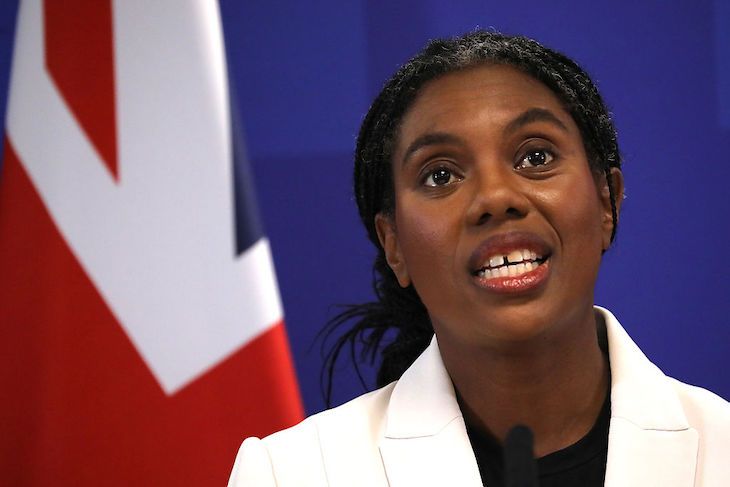
Most voters have no idea they are happening, but party conferences can set the tone for what follows. Last year’s pledge by Kemi Badenoch to abolish stamp duty, for example, led to a change in tone of coverage of the Conservative leader, as observers started to realise that there were indeed signs of political life in the Tory party.
It’s easy to forget how close to wipeout the Conservatives were after the July 2024 election
In that context, it’s striking to compare the polls this conference season with last year. Back then, Reform UK was averaging around 30 per cent, with Labour on 19 per cent and the Conservatives 17 per cent. This week has seen two YouGov polls, one of which is an MRP analysis (a statistical modelling technique in which pollsters combine a very large poll with other sources of information). Both are good news for Badenoch.
A poll published on Tuesday had Labour on 23 per cent and the Tories and Reform UK tied on 21 per cent. That’s quite a contrast with polls from last September, the lowest for Reform UK since January 2025, and the first time in eighteen months that the Tories have been level with them.
Given that all three parties are within the margin of error, the overall lesson is that there is everything to play for. But its most striking feature – because it chimes with other aspects of the past few months – is surely the Conservative figure. On one level, 21 per cent is obviously terrible. It’s not even close to indicating that the party is heading for power. One could argue that it shows quite the opposite.
But that would surely be a flawed argument. Look at the other YouGov poll this week, Thursday’s MRP analysis. This seat by seat poll has the Tories again on 21 per cent, while Labour are on 24 per cent. In seats, that works out as a hung parliament, with Labour on 241 seats, the Tories second with 130 seats and Reform third with 123 seats.
It’s easy to forget how close to wipeout the Conservatives were after the July 2024 election. Last year’s YouGov MRP analysis gave a very different result, estimating that Reform would take 373 seats and the Conservatives just 41. In November, a poll by Stack Data Strategy, found the Tories hol,ding on to just 14 seats on a 17 per cent share of the vote. In 2025 YouGov recorded the party at 16 per cent on several occasions, the lowest share ever recorded for the party.
In that context, both Tuesday and Thursday’s polls are good news for the Tories. If all Badenoch had done was to keep the Conservative Party alive as a going political concern, that alone would have been a huge achievement. But as the polls show, she has done much more than that. She has restored a foundation on which the party can now build.
That new foundation rests, it’s clear, on Badenoch’s own personal support, which is far ahead of her party’s. Her YouGov net favourability has risen 20 points in a year. It went from -35 in September 2025 to -15 this month. YouGov’s own write-up says attitudes to her “have improved markedly over much of the last year” and uses the word “Keminaissance”. She was ahead of every other party leader in Opinium’s July poll, which put her net approval at -3. Ed Davey was on -5, Andy Burnham -8, Zack Polanski -16, Nigel Farage -27 and Keir Starmer -45. Farage’s net favourability has fallen 14 points over the same year in which hers rose by 20.
Labour now faces a series of challenges which could hole it below the waterline. On 1 September, the 30-year gilt yield (the interest rate on government debt) reached 5.89 per cent, the highest since 1998. The OBR’s rule of thumb is that a one-point rise in yields adds just over £10 billion to annual debt interest in the first year. And that’s just interest.
The welfare bill is forecast to reach £409 billion by 2030/31. More than four million people in England and Wales now claim PIP, the main disability benefit, roughly double the 2019 number. The two government reviews of disability benefits and young people out of work (the Timms and Milburn reviews) are due to report in the autumn, so decisions can’t be put off much longer. Labour MPs rebelled over £5 billon of welfare cuts in 2025, and the party would push back again.
Then there is defence. The current plan gets defence spending to 2.68 per cent of GDP by 2030. Getting to 3 per cent costs about £10 billion a year more. Meeting Nato’s 3.5 per cent target by 2035 costs about £25 billion a year more. Where is the money coming from? Or will it not come at all – from a Chancellor who resigned because it wasn’t coming when he was defence secretary? Badenoch, on the other hand, has already put forward her own funded three per cent pledge, paid for by £10 billion of welfare savings.
What about spending Andy Burnham actually wants to plan? Somehow the government has to raise money it has promised not to raise in the usual way, in front of a bond market already selling British debt. Burnham has ruled out raising income tax, National Insurance or VAT, which brought in 65 per cent of all tax revenue in 2025/26. What’s left are taxes that hurt middle England: property, inheritance, capital gains and wealth. That is an open goal for the Tories – and, as she has shown repeatedly at PMQs, Badenoch is an expert goalscorer.
Then there are the other ‘known knowns’, decisions which will definitely be unpopular. Early prisoner release under the new sentencing law starts on 1 October with about 700 prisoners that day, and then about 4,500 across ten monthly batches to June 2027. Prepare for the drip, drip, drip of mounting anger.
Moving asylum seekers into wealthier areas is Burnham’s own policy and it has already caused a row over Piddington, a village in Oxfordshire of about 350 people allocated around 1,250 asylum seekers. His VAT cut on electricity is calculated as saving the average household about £45 a year. But rising gas prices mean bills will still go up about £49 net this October. So the government’s first cost-of-living measure will go unnoticed.
This should all be meat and drink to Badenoch, whose clear-sighted honesty about the problems we face and the need to take serious action over spending may soon start to reap political dividends. Add to that Reform’s polling troubles, which mirror the party’s political slide from error to disaster to error and back again – and the prospect of Nigel Farage packing it all in and walking away.
Badenoch’s achievement in bringing the Tories to 21 per cent may seem small beer at the moment, but in a year’s time the difference may be as dramatic as this year is from last.






Comments