
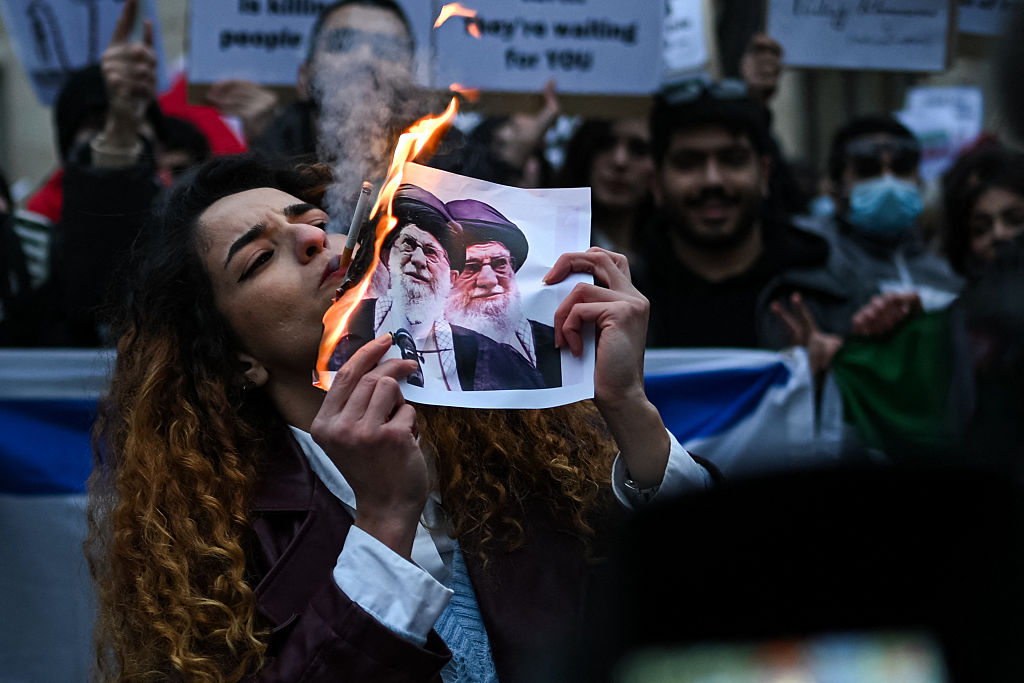
Benjamin Netanyahu, the Israeli Prime Minister, was presented with irrefutable evidence yesterday, including footage, confirming the death of Iran’s so-called ‘Supreme Leader’: Ayatollah Ali Khamenei. He was killed in a targeted Israeli airstrike on his compound in Tehran, marking a pivotal blow to the Islamic republic regime. Initially Netanyahu only hinted at the fact that he was dead, but as the evening progressed more and more sources confirmed it until President Donald Trump eventually took to Truth Social to declare ‘Khamenei, one of the most evil people in history, is dead.’
Israel may have killed its leader, but the regime will ultimately be toppled by the Iranian people
The strike unfolded as part of Operation ‘Lion’s Roar,’ a meticulously coordinated assault involving approximately 200 Israeli fighter jets – the largest airstrike formation in the history of the Israeli Air Force. These jets unleashed hundreds of munitions on roughly 500 targets across western and central Iran, dismantling missile arrays and defence systems. Defence Minister Israel Katz this articulated the rationale with unflinching clarity: ‘The State of Israel did not wait for the moment when the threat would materialise. We acted to prevent an extremist and murderous regime from possessing capabilities that endanger Israel and the entire world. Those who threaten to destroy Israel will not receive immunity. Every element of the Iranian regime is a target. Any of our enemies who try to intervene will pay a very heavy price.’
Katz emphasised that this is not a war against the Iranian people but against the regime, which he described as a source of terror and oppression. He urged the Iranian populace to seize this ‘historic opportunity, for the first time in 47 years, to free themselves from the oppressive regime.’

The Israel Defence Forces (IDF) has officially confirmed the elimination of several of Iran’s top security leadership during the strikes, dealing a severe blow to the regime’s command structure. Among those neutralised were Ali Shamkhani, Khamenei’s personal security advisor and secretary of the Supreme National Security Council; Mohammad Pakpour, commander of the Revolutionary Guards and architect of the ‘Plan to Destroy Israel,’ who oversaw missile systems, proxy support, and domestic protest suppression; Saleh Asadi, head of intelligence at the Supreme Headquarters and key strategist against Israel and the U.S.; Mohammad Shirazi, Khamenei’s military office chief since 1989, bridging armed forces and regime leadership; Aziz Nasirzadeh, former defence minister and air force commander responsible for missile production and the SPND organisation advancing nuclear, biological, and chemical weapons; Hossein Jabal Amelian, current SPND chairman driving those illicit programmes; and Reza Mozaffarinia, his predecessor focused on nuclear development. This targeted decapitation underscores Israel’s precision in dismantling Tehran’s terror apparatus.
Netanyahu echoed this resolve in his statement, framing the operation as a joint U.S.-Israel endeavour to neutralise an existential threat. ‘This morning, in a powerful surprise attack, we destroyed the compound of the dictator Khamenei in the heart of Tehran,’ he declared. ‘For three and a half decades, this cruel dictator has sent terror throughout the world, made his people miserable, and has been working constantly, relentlessly, on the plan to destroy Israel. This plan is gone. And there are many signs that this dictator is gone too.’ Netanyahu praised Trump for his ‘historic leadership’ and for elevating the alliance to unprecedented heights, noting, ‘An alliance for peace and an alliance in war. And this war will lead to peace. Real peace.’ He appealed directly to Iranians – Persians, Kurds, Azeris, Abkhazians, and Baluchis – to unite and overthrow the regime, assuring them, ‘Help has arrived.’
This audacious strike represents yet another triumph in Israel’s protracted war, now spanning over two years, ignited by the barbaric Hamas invasion on October 7, 2023. That assault, which claimed 1,200 lives and saw 251 hostages taken, was orchestrated under Iranian auspices through proxies, as noted by Sagiv Asulin, a former senior Mossad official: ‘What began then, in an Iranian plan through its proxies, is now reaching the stage of closing the circle. This opening strike is not accidental; it is a well-planned and coordinated move.’ Israel’s response has been a masterclass in strategic dismantling, methodically eroding Iran’s ‘ring of fire’, a network of proxies encircling Israel, including Hezbollah in Lebanon, Hamas and Islamic Jihad in Gaza, Shiite militias in Syria and Iraq, and the Houthis in Yemen.
One by one, these elements have been neutralised or severely weakened. Hezbollah, once a dominant forward force, is now preoccupied with survival, its operational capacity curtailed. Hamas has been confined to pockets in Gaza, with half the territory under Israeli control, rendering it a shadow of its former self. Syria’s role as a land bridge in the ‘Iranian crescent’ has evaporated, fracturing the territorial continuity from Tehran to the Mediterranean. The Houthis persist as the lone active external proxy, but the overall encirclement has collapsed. Iran’s direct capabilities – air defences, missile infrastructure, and nuclear progress – have been decimated, leaving it exposed and impotent. And now the leader of the evil regime is dead. This process is the beginning of a wide regional event, with the potential for internal upheaval in Iran driven by its disillusioned youth.
Israel may have killed its leader, but the regime will ultimately be toppled by the Iranian people.
Comments