
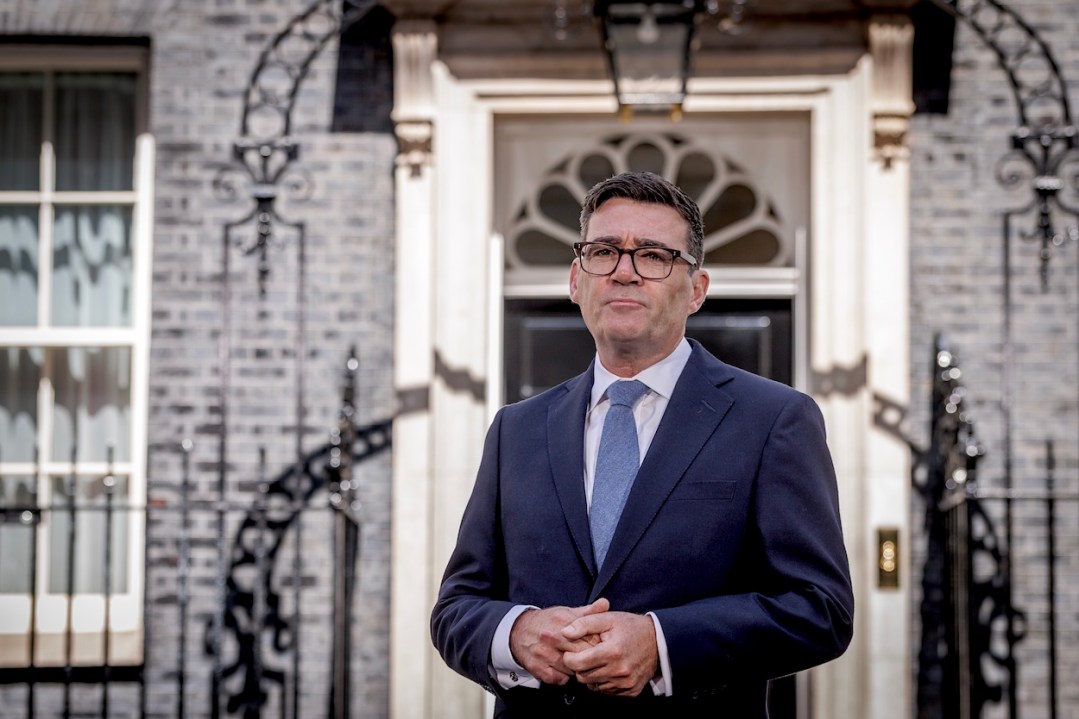
What is Andy Burnham really going to do that’s different from his predecessor? When he made his first address to MPs as prime minister yesterday, Burnham did promise ‘substantial change’, and suggested that this change would have to involve correcting ‘a series of wrong turns’ made from the 1980s onwards. Those wrong turns were substantial: ‘Political power was centralised, economic power privatised and the country deindustrialised. Austerity followed, hollowing out councils and depriving them of the agency to act to reverse any of it, and then Brexit compounded the damage, ushering in a decade of low growth and stalled regeneration.’ That’s quite a list: one that also conveniently skips over the Blair and Brown Labour governments of which Burnham was a part. He presumably thinks those administrations kept going in the wrong direction after the turns taken by Thatcher and co.

The Tories were obviously delighted that Burnham was continuing Labour’s increasingly pointless obsession with the Thatcher era: as Kemi Badenoch pointed out: ‘he is talking about a woman who became prime minister before I was born’ – and Badenoch is 46. A lot of voters have no memory at all of the Thatcher years. Labour spent much of that time navel-gazing, so it’s a wonder the party noticed what was going on at the time, either. Burnham, though, doubled down on the reference when he replied to the leader of the opposition, saying: ‘The right hon. lady mentioned the 1980s, the legacy of which, I have to say to her, we are still struggling to reverse. Well, let us have the argument in this house. Why are people paying such high water bills, while the infrastructure is crumbling before our eyes? Why are energy bills in this country the highest in Europe?’ He went on, suggesting that all these problems arose in the decade of privatisation. He did not, though, pledge renationalising these utilities, instead telling the chamber that he wanted ‘stronger public control over these essentials, making them work for people and places again’. These ideas are a break from Starmer, who actually praised Thatcher at one point in his quest to win over Tory switchers.
But when Burnham used that ‘substantial change’ line, he was referring to the pitch Starmer made in 2024. He said: ‘When it comes to the biggest issues facing the country – the economy and the cost of living crisis – people are looking for much more substantial change, as promised in our manifesto, and that is what I will bring.’ So what he is essentially saying is that the difference between him and Starmer is that his predecessor promised change, and Burnham will actually deliver it.
But Burnham barely talked about delivery in his session yesterday. Mind you, Starmer went through a phase of banging on about it all the time, and precious good that did him. He ended up being about as notable for delivery as someone who pontificates about the benefits of a gym membership while never taking one out themselves.
The other difference, of course, is that Burnham wants to bring hope to the world, or something along those lines, whereas presumably Starmer was the one who brought gloom. The weakest part of his statement came when Burnham tried to summarise what he’d just said: ‘This is what I have outlined today: a clear, coherent and credible approach to growth that can unlock a feeling of positivity and possibility in every postcode in Britain.’ His summer has largely been about the vibes, but presumably he is planning to do more than make people feel positive in their postcode: prime ministers do have a bit more power than an upbeat Instagram account offering affirmations.





Comments