I approached this exhibition like a conscientious critic, poring over the catalogue, the signage, making notes… And then, about halfway through, I drifted. I dawdled. I stopped thinking and gave in to the aesthetic rapture, the rhyming half-tones, the ‘breath-like softness’ of Whistler’s paint. I was a disciple, briefly, of art for art’s sake, even though I wasn’t wearing white, nor carrying a peony.
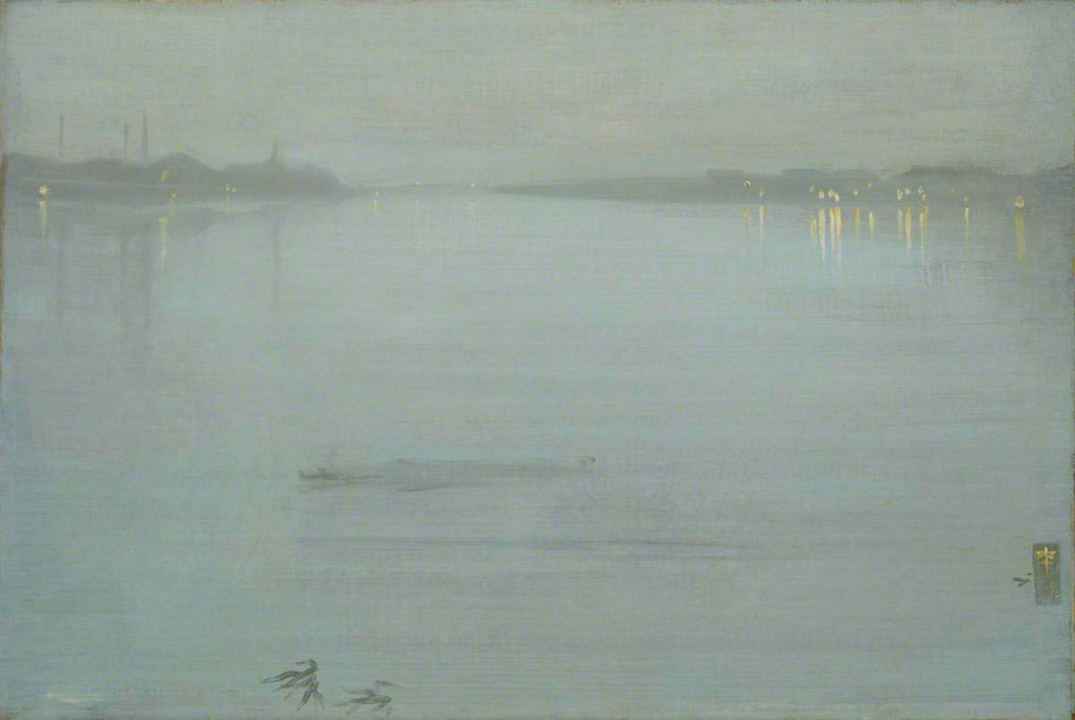
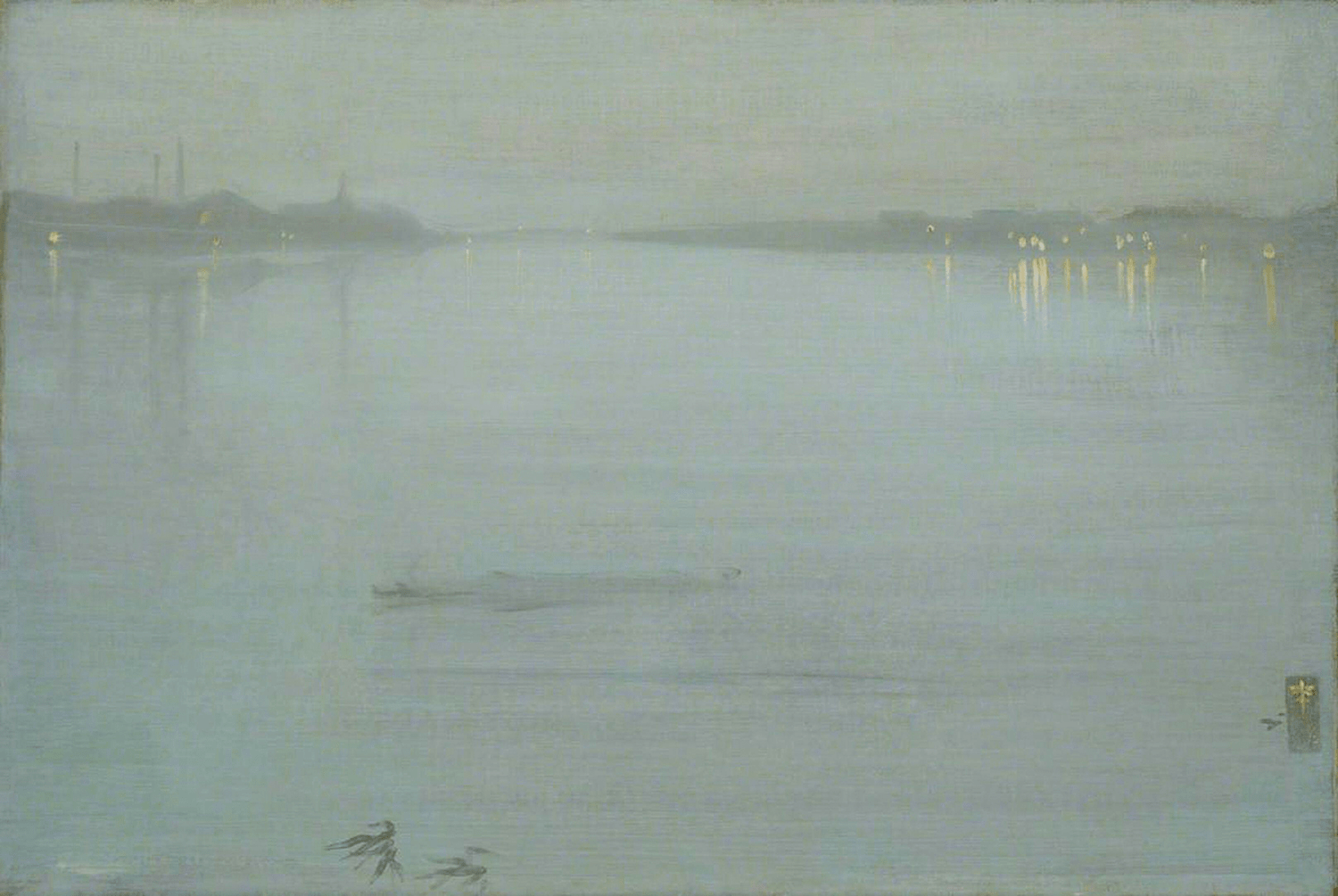
It was the room full of Nocturnes that sent me. Their opiate-like gloomth put me right beside the Thames at dusk. No, that’s too pedestrian. Not beside the Thames; with the Thames. Whistler lived on Cheyne Walk, but watching the river was not enough; he would take a boat out at night to prepare for his paintings. His ferrymen – satisfyingly enough for anyone trying to trace a line through the history of British art – were brothers Walter and Henry Greaves, also artists, and sons of Turner’s boatman.

It was the room full of Nocturnes that sent me
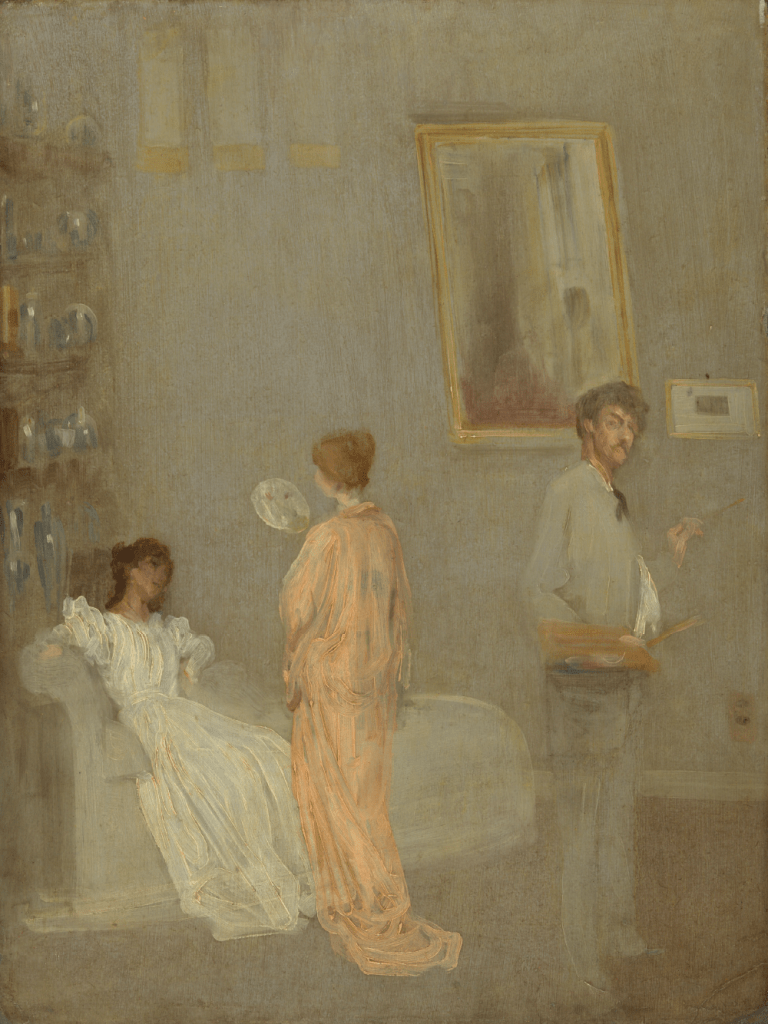
Apparently Whistler would chat away, describing the scene with a view to painting it later. He had a trademark bushy white forelock, and in one portrait his pugnacious yet sensitive face looks strikingly like the actor Donald Sutherland. His Nocturnes have Yeats’s savour of night and light and the half-light. They are profound yet touched with decorative gaiety, like the butterfly cypher he uses as his signature, or his wishful sprig of Thames-side bamboo, in the foreground of ‘Nocturne: Blue and Silver – Cremorne Lights’ (1872).
‘Night has no form,’ Whistler wrote, ‘gloom no length or breadth.’ And so he worked ‘by feeling, not by sight’. Perhaps this is why the Nocturnes are moving – because they so peacefully accept the loss of perception that the inevitable crepuscule brings. As with Chopin, their sadness is exquisitely light.
Ruskin was completely wrong when he dissed ‘Nocturne in Gold and Black – The Falling Rocket’ (1875), writing that Whistler was a ‘coxcomb’ having us all on by asking for 200 guineas for ‘flinging a pot of paint in the public’s face’. The insulted indignation of Ruskin’s tone is like a post on X you regret in the morning. Ruskin believed that colour was the least important element of painting – imagine what he would have made of Rothko. Whistler brought a sensational case against him in the High Court for defamation. Ruskin, too ill to attend, sent the attorney general in his stead; William Powell Frith and Edward Burne-Jones spoke against Whistler. Jurors were taken to the Westminster Palace Hotel to view the Nocturnes as an aide to their deliberations. The art critic’s freedoms were roundly defended during the trial; nevertheless, Ruskin lost. Whistler wrote it all up, wittily, in The Gentle Art of Making Enemies; to his butterfly monogram, around this time, he added a sting.
He was a fighter. He preferred to destroy work if commissioning patrons offended him. He even fell out with his best patron and friend Frederic Leyland, over ‘The Peacock Room’ (1876). It’s re-created in full in the exhibition, via ingenious use of digitally printed wallpaper, and there is even audio of actors reading the letters between Leyland and Whistler, so you can really step inside the story. When the original architect for the room fell ill, Leyland asked Whistler to finish it off instead, expecting to come back from his trip abroad to a nicely conventional dining room. But in Leyland’s prolonged absence Whistler got truly carried away, creating a magnificent den of glittering maximalism, fit for a gold-addicted emperor. Leyland can be forgiven for some surprise. But, like so many in Whistler’s lifetime, he sadly failed to appreciate the worth of Whistler’s creation, and refused to pay the full amount for the ‘disaster of the decoration’.
The insulted indignation of Ruskin’s tone is like a post on X you regret in the morning
Poor Whistler. George Du Maurier sent him up in Trilby; Gilbert and Sullivan parodied him in Patience in 1881 where Bunthorne, recognisably Whistler with a white shock in his hair, admits his artistic credo is all an act: ‘I’m an aesthetic sham… I do not care for dirty greens/ by any means…’
But in this show – the first major Whistler survey in London since 1994 – his sensibility is given due honour. Curator Carol Jacobi tells a wonderfully full visual story, leading your gaze through his influences with Hokusai prints and blue-and-white China; furniture he designed, and even digitised sketchbooks, so you can turn the pages with a swipe. By the time you get to the apogee of the Nocturnes, you really have your eye in. A feast.




Comments