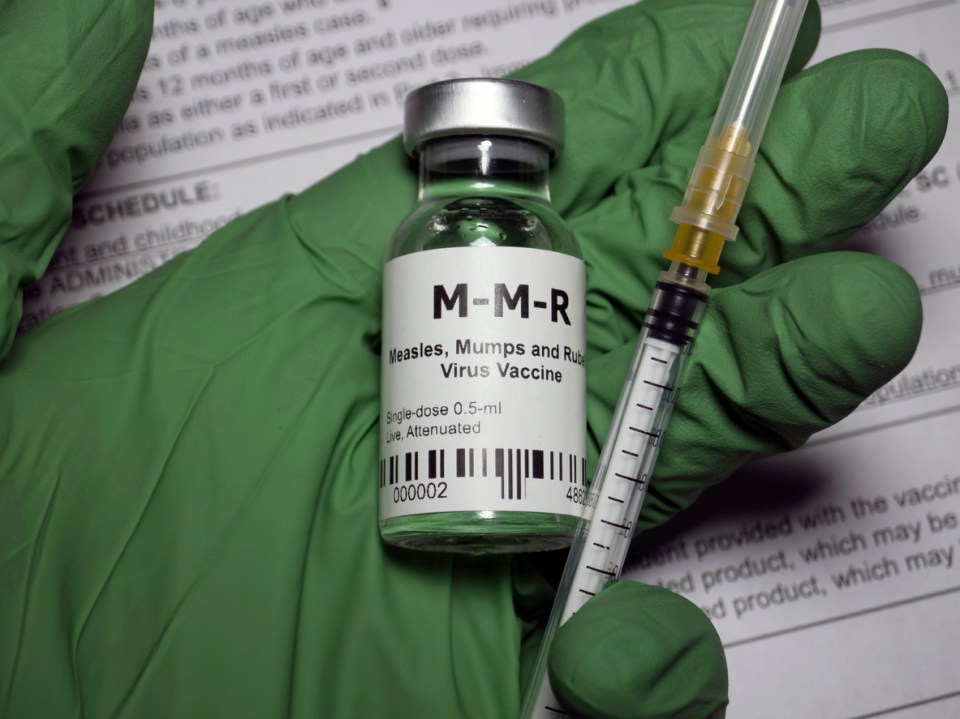
Last month the World Health Organisation removed Britain from its list of countries where measles had been effectively eliminated. The disease has been circulating continuously since late 2023. Last year there were almost a thousand cases, and a child died in Liverpool. Now there is a measles outbreak in Haringey and Enfield. So far it has affected fewer than a hundred, with no deaths. That could change at any moment.
If you want to warn people that travelling to certain countries is high risk, you name those countries. The fear that doing so is racist is not only misplaced, it is harmful to the people you need to protect
A third of children in those boroughs aren’t protected against measles, mumps, and rubella. Other boroughs are as bad; most only a little better. The pool of unvaccinated children is huge and measles is highly infectious. We are a developed country with a national health service free at the point of use. We are the nation that invented vaccination. How did we get here?
We have always had vaccine phobia. From the moment vaccines became common – first they were encouraged, soon they became compulsory – there were antivaxxers. Jenner’s first vaccine was derived from a cow, and cartoons showed the people receiving it becoming cows themselves. Rational argument had to fight against irrational fear. Vaccines were poisons. They were crimes against God. They were unnatural. They were unsafe.
The objections are still familiar and each contains a grain of truth. Nothing in medicine is completely safe, but nor does it need to be. We need to know benefits outweigh harms in the ways that matter. In medicine, some vaccines are as good as it gets.
The Lancet caused huge harm in 1998 by publishing Andrew Wakefield’s paper suggesting the MMR vaccine caused autism. The journalist Brian Deer later showed that his paper was a fraud. Wakefield was struck off and the Lancet issued a retraction, but the damage was lasting.
Slowly, vaccine uptake recovered. Then in the last few years it fell. Early Covid jabs saved millions of lives but governments (not just ours) oversold their benefits and underplayed their harms, and pushed them in situations where they saved no lives at all. That has come at a cost. When you say that everything is vital, people stop listening to you about the things that really are.
Public health doctors like the euphemism of vaccine hesitancy, and possibly they’d be more successful if they didn’t. Some of the distaste for vaccines in Haringey and Enfield will be the same suspicion that has been there for centuries. Some will be a fashionably America-brained import. Much else won’t be. Only a third of people in Haringey and Enfield say they’re white British, and vaccination rates are lower amongst ethnic minorities.
The location of the outbreak, in an area where white British are themselves a minority, is no coincidence. The BBC restricts itself to quoting a public health doctor saying those travelling abroad should ‘check’ their vaccination status because ‘measles is widespread in some countries with close links to the UK’. If you want to warn people that travelling to certain countries is high risk, you name those countries. The fear that doing so is racist is not only misplaced, it is harmful to the people you need to protect. To solve a problem you need to be clear about what the problem is. Saying people need to ‘check’ their vaccination status pretends that possibly they’ve just forgotten; that’s not truthful and it’s not a serious response.
Measles outbreaks don’t just threaten those with luxury health beliefs, who are protected from the consequences of their choices by the herd immunity of others. Vaccines aren’t a hundred per cent effective even for the healthy. Chemotherapy and immunosuppression for a transplant can make them unviable. And it’s herd immunity that protects babies in the months before their jab. We have a duty to act and a right to intervene. You do not have to have buried one of your own children to wish to spare others from doing the same.
Various agencies in London and around the country will be furiously encouraging vaccine uptake. Some will continue to labour when the outbreak is over and the news cycle has forgotten. Community outreach, public persuasion, making vaccination accessible – all of this matters.
In the long term, other things matter more. Studies show that vaccine uptake is lower where there is poverty, where there is a lack of education, and where there is unemployment. NHS England found it is lowest amongst black people and those from Pakistan and Bangladesh. These are risk factors, but they are modifiable. Even in these groups, most people get vaccinated.
If it seems ambitious to suggest the state should try and increase vaccine uptake by creating wealth, and jobs, a culture of education, and the shared values that allow for trust in science, it’s important to note that these are what count, and not just for vaccines. Life expectancy rose in this country, and infant mortality plunged, back when the medical profession overall still did more harm than good.
Today we can help hugely, but not those who refuse our care because they lack the understanding or the trust. Public health campaigns and outreach matter. The creation of wealth and the pursuit of education matter more. Being a rich, cultured, high-trust society, with no underclass, is the best public health intervention possible.





Comments