
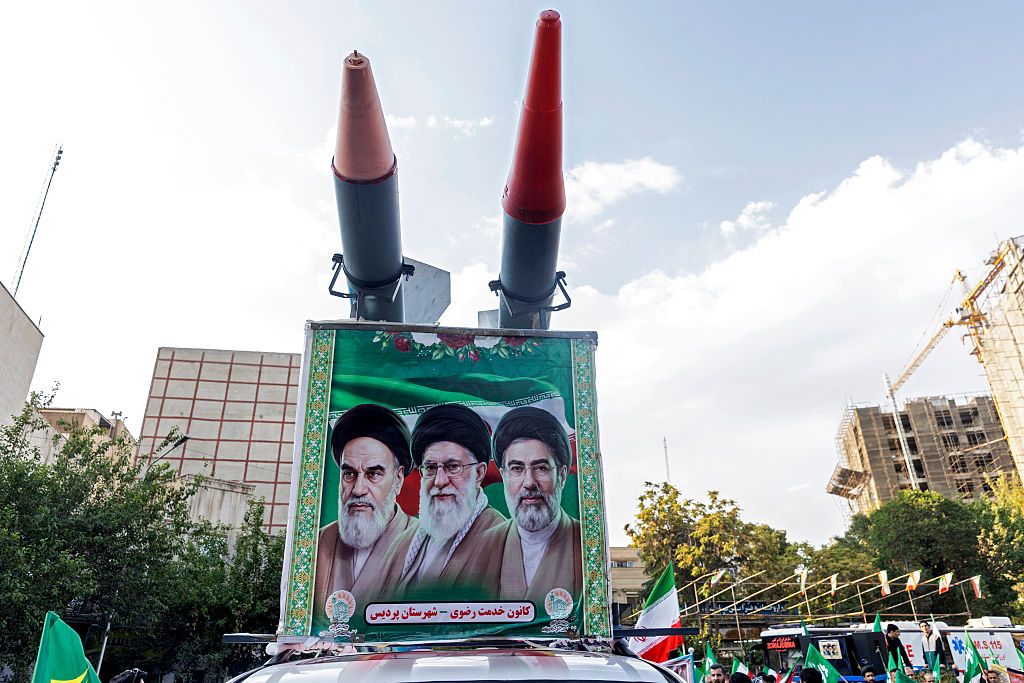
If you control the world’s largest economy, as the US does, and if your enemy depends on exports to the West, as Iran does, it should hardly be a surprise when the big economy decides to use its commercial and financial leverage.
That is exactly what the US is doing – and this week it announced it would ratchet up the pressure substantially. Some sanctions were already in place, most notably restrictions on Iran’s oil exports, enforced by the US Navy. What’s new is that those sanctions will be supplemented by a full range of additional sanctions on commercial and bank transactions routed through third countries.
The sanctions themselves are not surprising. What is surprising is that the US had not implemented them long ago. Still, the Trump administration must feel “better late than never.” And better to try these economic tools than to resume major combat operations. That, at least, is the White House calculation.
What precipitated the increased pressure? Most likely it was President Trump’s recognition – and public acknowledgment – that negotiations with Iran had proved fruitless. Rather than resume a full-scale bombing campaign, Trump decided to turn the economic screws.
What remains unclear is whether this harsher pressure is designed to get the IRGC back to the negotiating table (Trump’s stated goal for months) or precipitate full-scale regime change, which will require more than economic pressure. Neither goal precludes more military action. A US bombing campaign could resume at any time, but that is most likely to be triggered by a major Iranian attack.
In exerting more economic pressure, the key American policymaker is Treasury Secretary Scott Bessent, who has emerged as one of the two stars in Trump’s cabinet, along with Secretary of State Marco Rubio.

Bessent said Thursday that America would hold to account all countries that continue to do business with Iran. His message was direct and blunt: this is war, and you are either for us or against us. We will hold you to account for your actions. Words of support are not enough.
Trump himself had already made that position clear when he cut back a joint military exercise with South Korea after it refused to assist in the war against Iran. He was flipping a giant middle finger at Seoul’s left-wing government. He did so again with his other hand when he added some nice words about North Korea’s noxious ruler, Kim Jong-un.
This public criticism of South Korea is a message to all American allies: we demand help now, and we will impose costs on any state or business that won’t provide it. That strategy is entirely consistent with Trump‘s way of doing business. Short-term calculations dominate long-term relationships.
What do secondary sanctions again Iran mean? They will be imposed on any parties who do business with the Islamic Republic, not just on Iran itself. Hitting these secondary targets is designed to cut off all Iranian imports and all export revenues that are used to pay for the regime’s military, paramilitary, internal police and terror proxies across the Middle East.
The United Arab Emirates has already offered Trump full-throated support. The UAE has long been the conduit for about 20 percent of Iran’s imports and exports. Now, however, they have announced that all business with Iran is over. That includes banking transactions.
The UAE’s decision is more than the result of US pressure. It is also the bitter fruits of Iran’s decision to send missile after missile into the Emirates, a strategy that has now completely backfired.
Harsh as this combined economic pressure is, few analysts believe that such pressure alone can topple the regime. And few are optimistic that the Iranians will negotiate from a position of weakness. They are too committed to their theological hardline and their geopolitical goal of dominating the region.
What that means is that Iran is likely to step up its military attacks as the US election draws near. They know that the war is unpopular with the US electorate. They know, too, that Democrats are leading the charge against Trump on this issue and every other one. If they win control of the House or Senate, they could well limit Trump’s war policy.
Iran’s real lever here would be much higher gas prices in the US, if they could achieve them. So far, prices are about a dollar a gallon higher than before the war, but far from the catastrophe that had been feared. That’s partly because Gulf Arab states have managed to get a lot of petroleum out of the region and partly because China’s demand for fuel has collapsed.
What Iran might do to jack up the price for US consumers is attack key refineries across the Persian Gulf. It was fear of those attacks that led Saudi Arabia, Kuwait and Qatar to press Trump not to resume his planned bombing of Iran earlier this month. Trump’s agreement with the Gulf Arabs and the failure of negotiations with the IRGC are what set the stage for this renewed economic pressure on Iran.
That pressure will almost certainly be accompanied by covert US efforts to arm resistance groups inside Iran and along its borders. The goal is to overwhelm an already-weakened Iranian regime, which can no longer pay its forces of internal repression or fund (and arm) its regional terror proxies.
The US is in an increasingly strong position, and Trump has convincingly shown that he will not be rushed into action. But the zealots in Iran still have some lethal cards of their own to play. They will surely play them over the next three months, as the US election nears and the Islamic Republic faces the grim prospect of its own mortality.





Comments