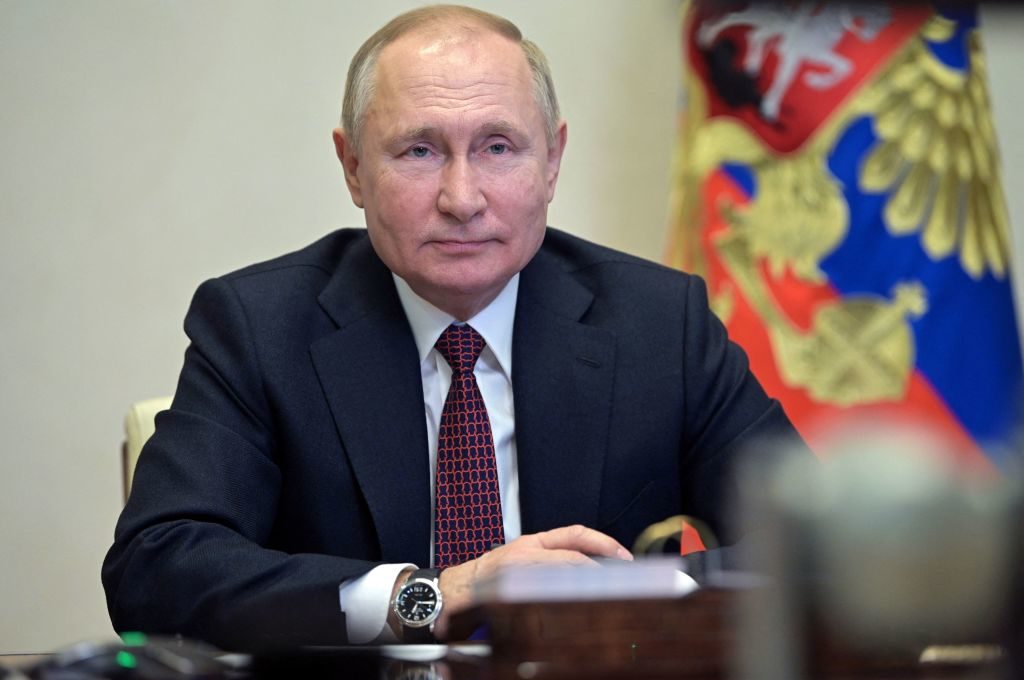
Get real on Russia
To listen to some voices in Washington’s foreign policy debates, the United States is on the brink of a ground war with Russia in Eastern Europe. The claim tends to come from self-styled realists and restrainers, that is to say, those who claim a hard-nosed focus on national interests and inoculation against the utopianism and wishful thinking that has got America into trouble overseas in the past.
“America can’t and mustn’t go to war with Russia over Ukraine,” argues Sohrab Ahmari in the Washington Post, swinging at a straw man with the ferocity of a five-year-old demolishing a piñata at a birthday party. Rod Dreher senses an “eagerness for war with Russia among Americans.” Really?
Writing for The Spectator, Jacob Heilbrunn calls the Ukraine crisis “springtime for liberal interventionism” and worries that the political upside of a confrontation (not necessarily war) with the Kremlin will be too much for Biden to resist.
Biden certainly faces a very serious headache, one in which he must balance American commitments to Ukraine with other priorities, find ways of maximizing leverage over an unpredictable and formidable foe in Vladimir Putin and try to build something approaching a united front among Western nations among whom there has been no shortage of squabbling.
The difficulty of the situation is why unforced errors, like Biden’s press conference last week, are so regrettable. It’s also why the glibness with which some on the realist side of the debate treat the crisis is so frustrating.
Of course, there is muddled and over-simplified thinking on both sides of the argument. Some incorrectly view Russia, not China, as America’s biggest geopolitical threat. And those who tend towards a more hands-on approach would be more persuasive if they could go more than thirty seconds without mentioning Munich and calling their opponents appeasers. But just as Putin is not Hitler and the year isn’t 1938, not every foreign policy problem is Iraq, in which an overzealous band of neocons need to be stopped from a disastrous overseas adventure.
If you’re relaxed about what Russia can get away with in Europe, then I’m skeptical of how realistic your assessment of America’s interests really is. As Biden himself put it last week, war in Eastern Europe would be “the most consequential thing that’s happened in the world in terms of war and peace since World War Two.” Add to that the backdrop of a rising superpower of formidable economic and military might, as well as the fact that, given their increasingly close relationship, the Russia and China threats cannot be fully disentangled, and you have the makings of a very grave situation indeed. To make matters worse, the West is hardly united. Germany is blocking its allies from sending German-made arms to Ukraine. France seems determined to freestyle rather than act in lockstep with the United States. Biden has failed to conjure the kind of consensus that would send a clear message to Putin about the consequences of invasion.
In other words, Russian subjugation of Ukraine is about much more than Ukraine. Doing what America can to disincentivize a Russian invasion is surely something that even those with a pared back vision of America’s role in the world should favor. American power may be a finite resource, but its assiduous deployment to deter a major American foe from having its way with Eastern Europe hardly seems like extravagant adventurism. Flexing America’s financial muscles, deploying troops to NATO allies, sending arms to Ukraine: between a shooting war with Russia and capitulation exist many realistic options.
*** Sign up to receive the DC Diary in your inbox on weekdays ***
Will Klain cling on?
The White House chief of staff is feeling the heat at the end of a terrible first year for the Biden administration. Of a slew of articles pointing the blame at Ron Klain, my colleague Cockburn writes: “These kinds of press attacks are almost always coordinated by those who have a vested interest in seeing the target slimed. In this case, it appears that centrist Democrats are looking nervously towards November, and view the progressive Klain as an obstacle to the sort of consensus-oriented legislative achievement that could boost their chances in the midterms.”
But if the moderates are coming for Klain armed with miserable poll numbers and ill-advised tweets, Prime Minister Ron has a secret weapon: sweet treats. According to Politico’s West Wing Playbook, Klain marked the administration’s one-year mark by sending boxes of Krispy Kreme donuts to White House teams. It’ll take more than that to save his skin, of course. And the muted on-the-record endorsements of Klain’s performance hardly bode well. Connecticut senator Richard Blumenthal says of the second most powerful man in the White House: “I think that, by and large, he’s making the trains run on time — even though some of the boxcars may seem to be empty some of the time.”
Doocy takes Biden’s outburst in his stride
Yesterday, the president called a reporter a “stupid son of a bitch”. Fox News’s Peter Doocy asked Biden whether he thought that inflation was a political liability ahead of the midterms. “No, it’s a great asset — more inflation. What a stupid son of a bitch,” snarled Biden. Doocy took the insult in his stride, eschewing the kind of portentous grandstanding that some in the media indulged in after dust-ups with Biden’s predecessor. “Nobody has fact-checked him yet,” Doocy joked on air soon after the incident. Later, the president called Doocy to “clear the air.” “It’s nothing personal, pal,” he said to the Fox reporter. “I don’t need anybody to apologize to me,” Doocy told Sean Hannity. “He can call me whatever he wants as long as it gets him talking.
College admissions head to the Supreme Court
2022 was already set to be a major year for the Supreme Court. A lynchpin of Biden’s Covid policy has already been struck down by the justices. It’s possible that, within months, they will deliver the most politically consequential ruling in years by overturning Roe v. Wade. Now add college admissions to the list of issues on which the court is expected to have a decisive say this year. Justices yesterday agreed to hear two cases that challenge racial preferences in admissions. One, concerning Harvard’s admissions system, is the subject of an excellent feature by Kenny Xu in The Spectator’s February issue (subscribe for access). The justices’ previous comments on the question of affirmative action mean defenders of the status quo should not be optimistic. In a previous case Chief Justice John Roberts offered a blunt suggestion: “The way to stop discrimination on the basis of race is to stop discriminating on the basis of race.”
What you should be reading today
Jacob Heilbrunn: Springtime for liberal interventionists
Kelly Alkhouli: Will the old world order end in Ukraine?
Bill Wyman: The moment I fell in love with music
Eric Levitz, New York: Was Larry Summers right all along?
Clayton Fox, Tablet: The dissidents
William Galston, American Purpose: Whose good, anyway?
Poll watch
President Biden Job Approval
Approve: 41.1 percent
Disapprove: 55.0 percent
Net approval: -13.9 (RCP Average)
Generic congressional ballot
Republicans: 53 percent
Democrats: 47 percent (Harvard/Harris)