
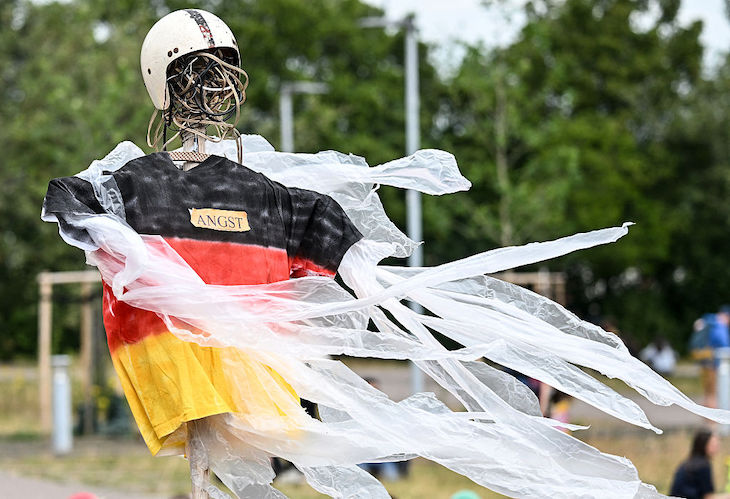
In Germany, the trains have stopped running on time, bridges have been shut over safety fears, and the country’s largest carmaker, Volkswagen, is cutting a sixth of its workforce. The government’s response amounts to a shrug, dressed up as reform. It seems like Germany is on a bad streak – and the AfD looks set to reap the rewards.
Why does a country that still thinks of itself as Europe’s engine room seem to have lost the ability to fix its own bridges?
Take the railways, the infamous Deutsche Bahn. A few weeks ago, they ground to a total halt. Every train in the country stood still, because the radio system that lets drivers talk to signal boxes – a system that appears to date, in spirit if not in silicon, from the Kaiserreich – simply stopped working. For several hours, nothing moved on the tracks of Europe’s largest economy.
Stranded passengers shrugged at reporters when asked how they felt about it. This is just what Deutsche Bahn does, several said, with the weary resignation of people describing the weather rather than a national infrastructure failure. That reaction tells you more about the current German mood than the failure itself does. It is not anger. It is fatalism.
Transport minister, Patrick Schnieder, responded with the platitude every politician reaches for in a crisis: he demanded “comprehensive clarification”. It is a mark of quite how unglamorous his brief has become that Schnieder – a man nominally responsible for one of the most consequential portfolios in government – remains almost entirely unknown to the German public. Nobody expects him to fix anything. Nobody, really, expects anyone to.
Consider the rest of the news from the past month. The new Stuttgart railway station, a project that has been under construction for more than two decades, will now open in 2031 – a decade later than originally planned, and that is the optimistic scenario. This barely made headlines, because nobody in Germany still believes Stuttgart 21 will ever actually finish on schedule; they have simply stopped counting.

Then the Rhine bridge carrying the Autobahn A565 near Bonn – a critical east-west artery through one of the country’s busiest regions – was shut without warning because it was structurally unsound. In North Rhine-Westphalia, the industrial heartland of the Bundesrepublik, one in three motorway bridges is now judged to need repair. True to form, the work is delayed until the danger becomes so acute that bridges are occasionally closed on the very day the inspectors find the fault. The public receives this news with a shrug too.
Meanwhile, Volkswagen, the company whose name is practically synonymous with German industrial identity, is reportedly preparing to cut 100,000 of its 600,000 jobs worldwide, with four domestic factories on the chopping block. The unions and the SPD blame management. They might more usefully blame a decarbonisation timetable so aggressive, and a combustion-engine ban so rigid, that it left German carmakers with nowhere to hide when cheaper Chinese electric alternatives arrived. Naturally, nobody in government will admit as much. The correction, when it comes, is grudging and half-hearted.
It is worth dwelling on what all this represents, because it is not merely a bad month. “Vorsprung durch Technik” was not just an Audi slogan; it was the self-image of an entire nation – a country that ran on the twin pillars of relentlessly capable infrastructure and an industrial base that fused engineering excellence with genuine innovation. The Institute for German Economic Research has tracked, for over a decade, how many companies feel held back by crumbling roads and rail. In 2013, 59 per cent said yes. Today it is 84 per cent, with the share reporting severe disruption rising sharply since 2018. Every delayed train and closed bridge is, in the driest possible sense, a tax on German growth.
Berlin’s answer to all this, delivered with much self-congratulation, was a package of pension and tax reforms that the governing parties have spent the past fortnight applauding themselves for, with the press obligingly joining the chorus. The reforms are overdue; they modernise a welfare system that, like the rail network’s signalling, has rather too much Kaiserreich still baked into it. But updating the redistribution of German prosperity is not the same thing as generating any. And generating it is precisely the problem nobody in Berlin wants to confront.
Look closer at the package and the ambition thins out fast. The centrepiece tax relief amounts to barely more than the inflation adjustment the constitutional court had already ordered. A promised cut to red tape is genuinely welcome – fewer reporting obligations, faster permitting – but it sits alongside a new state-owned housebuilding company and an expanding subsidy regime, which rather undercuts the idea that Berlin is serious about shrinking its own footprint in the economy. On energy prices, the single biggest drag on German industrial competitiveness, the package says almost nothing.
Take Lower Saxony’s minister-president Olaf Lies, whose state owns a stake in Volkswagen. As Chinese manufacturers take a huge chunk of market share from VW, his solution is protectionism: keeping Chinese carmakers out of Europe rather than asking why German ones can no longer compete on their own merits. It is the same reflex every time: more regulation, more state, less market, less competition. It is an approach that has served Germany rather well for explaining decline, and rather poorly for reversing it.
The country that exported “Vorsprung durch Technik” to the world is now struggling to keep its own trains running
Chancellor Friedrich Merz came to office promising, in his own words, a “great leap forward” for German competitiveness – a phrase whose previous owner, Mao, drove his country into famine, though one assumes Merz meant it more kindly. What he has delivered so far is a reform package built on the smallest common denominator between two reluctant coalition partners: welcome, as far as it goes, but nowhere near the scale of the structural crisis Germany is in – arguably its deepest since the Republic’s founding.
None of this is without political consequence. The AfD, which held its party conference this weekend, looks, by common consent, unstoppable. It is not hard to see why: a country that watches its trains stop, its bridges close and its flagship manufacturer shed a sixth of its workforce, while its government congratulates itself on a tax tweak barely larger than inflation would have delivered anyway, is primed to reward whoever promises to notice the rot.
Yet the more pressing question is simpler and more damning: why does a country that still thinks of itself as Europe’s engine room seem to have lost the ability to fix its own bridges? It seems to be symptomatic for Germany’s current state.
The country that once exported “Vorsprung durch Technik” to the world is now struggling to keep its own trains and bridges functioning – and its government is coming up with a reform package that doesn’t deserve to be called as such.
Until Berlin’s political class stops treating that as an inconvenient footnote and starts treating it as the central story, the shrugging fatalism on Germany’s platforms and building sites will keep finding somewhere to go. And Germany will continue to fall apart quietly.



Comments