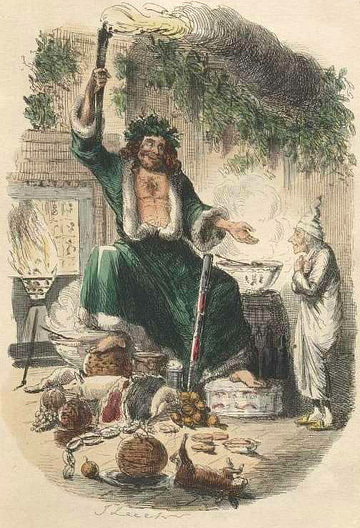
 It is the bicentenary of Charles Dickens’ birth in February, and Christmas Day today; so
a sterling occasion to reproduce The Spectator’s original review of A Christmas Carol from the archives. It was written for our issue dated 23 December 1843, and differs from most modern
reviews in quoting extremely liberally from the text, to the extent that there is more Dickens than Spectator in what follows. But, on this morning of all mornings, I thought few would complain
about that:
It is the bicentenary of Charles Dickens’ birth in February, and Christmas Day today; so
a sterling occasion to reproduce The Spectator’s original review of A Christmas Carol from the archives. It was written for our issue dated 23 December 1843, and differs from most modern
reviews in quoting extremely liberally from the text, to the extent that there is more Dickens than Spectator in what follows. But, on this morning of all mornings, I thought few would complain
about that:
‘The object of this seasonable and well-intentioned little book is to promote the social festivities and charities of Christmas, by showing the beneficial influence of these celebrations of the season on the bestowers as well as the recipients of this sort of hospitality. And Mr Dickens has done this in his own peculiar way: instead of preaching a homily, he tells a “ghost story” – not a blood-freezing tale of horror, but a serio-comic narrative, in which the ludicrous and the terrible, the real and the visionary, are curiously jumbled together, as in the phantasmagoria of a magic lantern. The ghost-seer is one Ebenezer Scrooge – a crabbed, close-fisted, miserly old hunks, of strong Anti-Christmas-keeping principles. Let him speak for himself. “Once upon a time – of all the good days of the year, on Christmas Eve – old Scrooge sat busy in his countinghouse. It was cold, bleak, biting weather; foggy withal; and he could hear the people in the court outside go wheezing up and down, beating their hands upon their breasts, and stamping their feet upon the pavement-stones to warm them. The City-clocks had only just gone three, but it was quite dark already; it had not been light all day; and candles were flaring in the windows of the neighbouring offices, like ruddy smears upon the palpable brown air. The fog came pouting in at every chink and keyhole, and was so dense without, that although the court was of the narrowest, the houses opposite were mere phantoms. To see the dingy cloud come drooping down, obscuring everything, one might have thought that Nature lived hard by and was brewing on a large scale. ‘A merry Christmas uncle! God save you!’ cried a cheerful voice. It was the voice of Scrooge’s nephew; who came upon him so quickly that this was the first intimation he had of his approach. ‘Bah!’ said Scrooge, ‘Humbug!’ He had so heated himself with rapid walking in the fog and frost, this nephew of Scrooge’s, that he was all in a glow; his face was ruddy and handsome, his eyes sparkled, and his breath smoked again. ‘Christmas a humbug, uncle!’ said Scrooge’s nephew. ‘You don’t mean that, I am sure.’ ‘I do,’ said Scrooge. ‘Merry Chistmas! what right have you to be merry? what reason have you to be merry? You’re poor enough.’ ‘Come, then,’ returned the nephew gayly. ‘What right have you to be dismal? what reason have you to be morose? You’re rich enough.’ Scrooge, having no better answer ready on the spur of the moment, said ‘Bah!’ again; and followed it up with ‘Humbug!’ ‘Don’t be cross, uncle,’ said the nephew. ‘What else can I be,’ returned the uncle, ‘when I live in such a world of fools as this? Merry Christmas! Out upon merry Christmas! What’s Christmas-time to you, but a time for paying bills, without money; a time for finding yourself a year older, and not an hour richer; a time for balancing your books, and having every item in ’em through a round dozen of months presented dead against you? If I could work my will,’ said Scrooge, indignantly, ‘every idiot who goes about with “Merry Christmas” on his lips, should be boiled with his own pudding, and buried with a stake of holly through his heart. He should!’ ‘Uncle!’ pleaded the nephew. ‘Nephew!’ returned the uncle, sternly: ‘keep Christmas in your own way, and let me keep it in mine.’ ‘Keep it!’ repeated Scrooge’s nephew: ‘but you don’t keep it.’ ‘Let me leave it alone, then,’ said Scrooge. ‘Much good may it do you. Much good it has ever done you!’ ‘There are many things from which I might have derived good, by which I have not profited, I dare say,’ returned the nephew; ‘Christmas among the rest. But, I am sure, I have always thought of Christmas-time, when it has come round – apart from the veneration due to its sacred name and origin, if any thing belonging to it can be apart from that – as a good time; a kind, forgiving, charitable, pleasant time; the only time I know of, in the long calendar of the year, when men and women seem by one consent to open their shut-up hearts freely, and to think of people below them as if they really were fellow-passengers to the grave, and not another race of creatures bound on other journies. And therefore, uncle, though it has never put a scrap of gold or silver in my pocket, I believe that it has done me good, and will do me good; and I say, God bless it.’” Old Scrooge is nevertheless converted to the genial observance of Christmas, the enjoyment of its good cheer and kindly feelings, and the diffusion of its bounteous liberality – just in time to share his nephew’s feast, and to astonish his clerk with the present of a prize turkey: in short, the grasping, grudging money-muck, is transformed into a merry-faced, open-handed, warm-hearted old fellow. This metamorphosis is effected in one night, by a succession of ghostly visitations and revelations, of a most portenteous kind. Scrooge is disturbed at his solitary supper of gruel, by the apparition of his deceased partner, girt with a chain of cash boxes, padlocks and ledgers, which he is doomed to drag about through the scenes of his past misdeeds: and the spectre conveys the pleasant intelligence that Scrooge will be haunted by three spirits in succession, whose visits are necessary to warn him of his danger. The first that appears is the fair spirit of “Christmas past” – who transports the old man back to the scenes of his childhood and youth; the second is the jolly “Christmas present” – who takes Scrooge to the home of his poor clerk, and of his nephew, where he sees their homely comfort and happiness, but hears some unpleasant allusions to himself; the third is “Christmas to come” – a grisly phantom, who shows the trembling mortal what will follow on his death. These various scenes are depicted with vivid force and humourous pleasantry, dashed with pathos, but not unalloyed by exaggeration. The more lively scenes are the truest, as well as the most agreeable: not that they are altogether free from the fault of excess, but mirthful exuberance has a licence that is not allowable in graver moods. Here is a pair of Christmas pieces, redolent with the savoury fragrance of the festive season. A DANCE ON CHRISTMAS EVE In came a fiddler with a music-book, and went up to the lofty desk, and made an orchestra of it, and tuned like fifty stomach-aches. In came Mrs Fezziwig, one vast substantial smile. In came the three Miss Fezziwigs, beaming and loveable. In came the six young followers whose hearts they broke. In came all the young men and women employed in the business. In came the housemaid, with her cousin, the baker. In came the cook, with her brother’s particular friend, the milkman. In came the boy from over the way, who was suspected of not having board enough from his master; trying to hide himself behind the girl from next door but one, who was proved to have had her ears pulled by her mistress. In they all came, one after another; some shyly, some boldly, some gracefully, some awkwardly, some pushing, some pulling; in they all came, any how and every how. Away they all went, twenty couple at once, hands half round and back again the other way; down the middle and up again; round and round in various stages of affectionate grouping; old top couple always turning up in the wrong place; new top couple starting off again, as soon as they got there; all top couples at last, and not a bottom one to help them. When this result was brought about, old Fezziwig, clapping his hands to stop the dance, cried out, “Well done!” and the fiddler plunged his hot face into a pot of porter, especially provided for that purpose. But, scorning rest, upon his reappearance he instantly began again, though there were no dancers yet, as if the other fiddler had been carried home exhausted, on a shutter, and he were a bran-new man, resolved to beat him out of sight, or perish. There were more dances, and there were forfeits, and more dances; and there was cake and there was negus, and there was a great piece of cold roast, and there was a great piece of cold boiled, and there were mince-pies, and plenty of beer. But the great effect of the evening came after the roast and boiled, when the fiddler (an artful dog, mind! – the sort of man who knew his business better than you or I could have told it to him) struck up “Sir Roger de Coverley.” Then old Fezziwig stood out to dance with Mrs Fezziwig. Top couple too; with a good stiff piece of work cut out for them; three or four and twenty pair of partners; people who were not to be trifled with; people who would dance, and had no notion of walking. But if they had been twice as many – ah, four times – old Fezziwig would have been a match for them, and so would Mrs Fezziwig. As to her, she was worthy to be his partner in every sense of the term. If that’s not high praise, tell me higher, and I’ll use it. A positive light appeared to issue from Fezziwig’s calves. They shone in every part of the dance like moons. You couldn’t have predicted, at any given time, what would become of ’em next. And when old Fezziwig and Mrs Fezziwig had gone all through the dance – advance and retire; hold hands with your partner; bow and curtsey; corkscrew; thread-the-needle, and back again to your place – Fezziwig “cut” – cut so deftly that he appeared to wink with his legs, and came upon his feet again without a stagger.” THE CITY STREETS ON CHRISTMAS MORNING “The house fronts looked black enough, and the windows blacker, contrasting with the smooth white sheet of snow upon the roofs, and with the dirtier snow upon the ground; which last deposit had been ploughed up in deep furrows by the heavy wheels of carts and wagons; furrows that crossed and recrossed each other hundreds of times where the great streets branched off, and made intricate channels, hard to trace, in the thick yellow mud and icy water. The sky was gloomy, and the shortest streets were choked up with a dingy mist, half-thawed, half-frozen, whose heavier particles descended in a shower of sooty atoms, as if all the chimnies in Great Britain had by one consent caught fire, and were blazing away to their dear hearts’ content. There was nothing very cheerful in the climate or the town, and yet was there an air of cheerfulness abroad that the clearest summer air and brightest summer sun might have endeavoured to diffuse in vain. “For the people who were shovelling away on the house-tops were jovial and full of glee; calling out to one another from the parapets, and now and then exchanging a facetious snow-ball – better-natured missile far than many a wordy jest – laughing heartily if it went right, and not less heartily if it went wrong. The poulterers’ shops were still half open, and the fruiterers were radiant in their glory. There were great, round, pot-bellied, baskets of chestnuts, shaped like the waistcoats of jolly old gentlemen, lolling at the doors, and tumbling out into the street in their apoplectic opulence. There were ruddy, brown-faced, broad-girthed Spanish onions, shining in the fatness of their growth like Spanish friars, and winking from their shelves in wanton slyness at the girls as they went by, and glanced demurely at the hung-up mistletoe. There were pears and apples clustered high in blooming pyramids; there were bunches of grapes, made, in the shopkeepers’ benevolence, to dangle from conspicuous hooks, that people’s mouths might water gratis as they passed; there were piles of filberts, mossy and brown, recalling, in their fragrance, ancient walks among the woods, and pleasant shufflings ankle-deep through withered leaves; there were Norfolk biffins, squab and swarthy, setting off the yellow of the oranges and lemons, and, in the great compactness of their juicy persons, urgently entreating and beseeching to be carried home in paper bags and eaten after dinner. The very gold and silver fish, set forth among these choice fruits in a bowl, though members of a dull and stagnant-blooded race, appeared to know that there was something going on; and, to a fish, went gasping round and round their little world in slow and passionless excitement.”



Comments