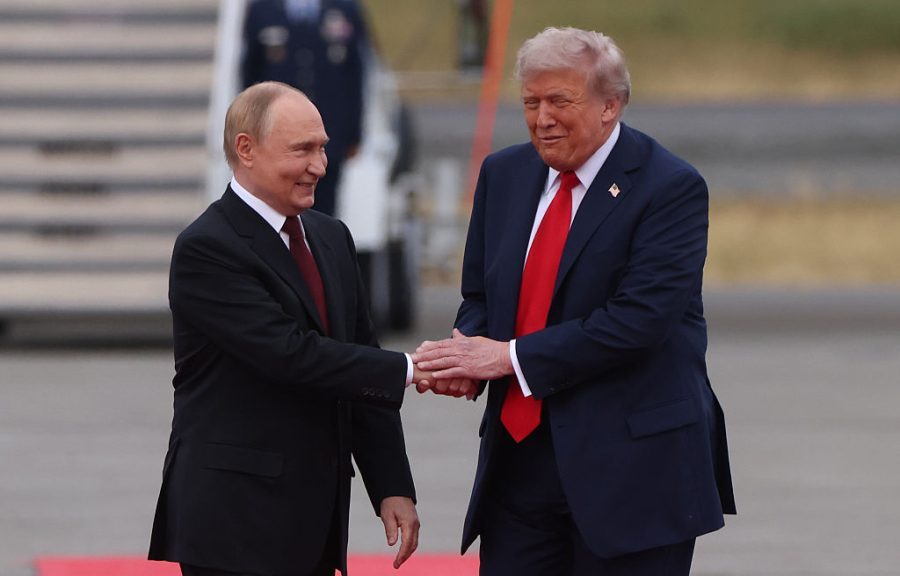
The diesel deal between Vladimir Putin and Donald Trump has finally broken the relationship between Washington and Kyiv. If the Republicans perform as badly as predicted in the midterms, Trump will blame Ukraine for triggering high diesel prices through his attacks on Russian refineries and could pull the plug on intelligence support and weapons sales to the country.
For Putin, this is a dream come true. It promises to rescue him from a war that he began in the expectation of quick victory and has become a noose around his neck as Ukraine has fought back with increasing effectiveness.
Its long-range drone and missile attacks over the past six months have brought the war home to the Russian population that was previously insulated from it. Strikes on the Russia’s largest oil refineries, its largest online retailer and, most recently, its main data centres have caused anger and disbelief across wide sections of society. These attacks have shown that Russia cannot defend itself against a much smaller and weaker adversary that combines resolve with courage and ingenuity.
To maintain discipline in the elites and society, the Kremlin is resorting to increased repression. It worries that war fatigue could lead to mass public support for a ceasefire and questions about the purpose of Putin’s ‘special military operation’ that has cost half a million lives on the Russian side and left around a million wounded soldiers.
Putin has good reason to believe that he has Kyiv on the ropes
Nevertheless, well before the diesel deal, Putin had persuaded himself that he was winning the war even if the situation on the front did not correspond to what he claimed. With Trump now sharing his personal antagonism towards Ukrainian president Volodymyr Zelensky, he has good reason to believe that he has Kyiv on the ropes and can deliver a knockout blow this winter.
Unable to break through in Donbas, Putin has switched in recent weeks to devastating the Ukrainian economy to the point where it can no longer support the war without hugely increased European support. He has forecast three economic crises in Ukraine: a currency crisis caused by sharply reduced exports, a budget crisis resulting from reduced economic activity and a banking crisis brought about by unserviceable debt leading to a run on the banks.
Over the past two months, Russia’s air campaign against Ukraine has dramatically increased both its range of economic targets and its intensity. Ukrainian exports of grain, iron, iron ore and steel – the mainstay of its export economy – can no longer pass through the Black Sea. The electricity grid is being systematically degraded to the point where a complete breakdown is conceivable.
In addition to energy and port infrastructure, Russia has recently hit Ukraine’s major steel plants – crippling their production – as well as warehouses, railways, bridges and border crossings with Moldova and Romania. Petrol stations are coming under increasing attack. And more recently, data centres and mobile communications installations have been struck in Kyiv.
Water infrastructure is also a target. It is not hard to see a scenario unfolding where major cities become de-populated and larger numbers of people flee the country.
Further throttling by Washington of Starlink, Elon Musk’s satellite communications system that powers Ukraine’s ability to intercept Russian reconnaissance and attack drones, will also create very serious problems for Ukraine’s defences.
Although Ukraine has started to inflict serious damage on the Russian economy, it is not comparable in scale or impact. In particular, it has not been able to degrade Russia’s drone and missile factories.
Ukrainian defence intelligence believes that Russia has increased its monthly production of attack drones this year from around 2,700 to 5,800. It is now producing more than 200 cruise and ballistic missiles a month – in some cases exceeding production targets. True, the Russian economy is increasingly hurting as a result of heavy defence spending and western sanctions, but it has proved highly adaptable and retains its underlying resilience.
The scenario of Russia’s economic collapse that inspired western policymakers at the outset of the full-scale invasion shows no signs of materialising. Putin also senses that the tide is turning in Europe as governments wake up to the fact that the US has switched sides and they alone are responsible for supporting Ukraine.
This is happening against the background of the far right and the far left raising questions across Europe about the logic of continued support for Ukraine. As the Kremlin sees it, fighting talk from today’s leaders in Berlin, London and Paris is just words and not backed by the resolve to generate the resources needed to face down Russia. Putin believes that voices willing to grant an old-fashioned zone of influence beyond its borders are poised to grow.
The Kremlin views next year’s presidential election in France as the key event that will lead to a shift of European priorities away from foreign policy issues to domestic ones. Rassemblement National, Marine Le Pen’s party, is far ahead in the polls. While it favours limited defensive support for Ukraine, it opposes large-scale EU financial aid.
Federal elections in Germany are not due until 2029, but Russian strategists have their eye on how to accelerate the erosion of the country’s political centre by fanning the flames of extremism both on the left and the right. The advances of the far-right Alternative für Deutschland and the far-left Die Linke in recent state elections point to a trend that can be highly advantageous to Russia since Germany is currently Europe’s largest provider of economic and military aid. Both parties oppose arms deliveries to Ukraine.
For the Kremlin, this is an ideal storm that is about to engulf Europe and expose its strategic vulnerability in the absence of the US. Europe is in no position, as the Kremlin sees it, to force China to stop its vitally important exports to Russia’s defence industry. Nor does it believe that European countries are able to enforce the technological sanctions that would really hurt the economy or undertake any serious effort to disrupt the ‘shadow fleet’ that Russia is using to avoid sanctions.
Instead, it sees European governments that have not prepared their countries for war and are scared of escalation as a tool to force Russia to de-escalate. It is not difficult to see why Putin has convinced himself that he no longer needs Trump to impose a peace deal on Ukraine when Trump is prepared to create the conditions for Putin to do it himself. For Russia’s president, Trump is the gift that keeps on giving.





Comments