

Willie Donaldson, who died in 2005, has a claim to having had the best obituary sub-heading of any writer I know. ‘Wykehamist pimp, crack fiend and adulterer who created Henry Root and Beyond the Fringe’ was how the Telegraph memorably summed up his life. As readers of his biography, You Cannot Live As I Have Lived and Not End Up Like This, will know, all of the above was true.
Donaldson came to mind this week because of something a mutual friend once told me about him – that is his fondness for using the word ‘dead’ as a pejorative. While practising the vituperative arts, he would occasionally describe a politician whose reputation he had it in for as ‘the dead politician’ etc.
One of the few acceptable ways to dismiss an audience as inadequate is to describe them as ‘ageing’
It is a general rule that to explain a joke is to destroy it. But we live in a literal age and so I suppose that it is worth pointing out that the reason this one works is that it carries the suggestion there is something about dying that can be used against a chap. As though we are in agreement that only an utter loser would go and die on top of all the other mistakes they might have made in their lives.
I thought of Donaldson’s joke because I have been marvelling about the un-humorous use of the word ‘ageing’ as a pejorative.
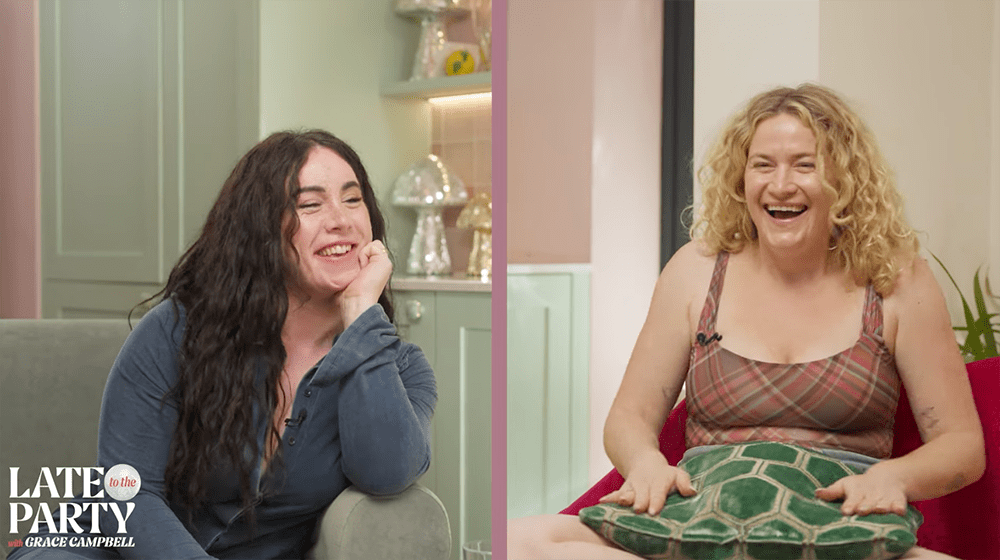
People who do not follow the dementing debate about the meeting point of trans rights and women’s rights may not be aware of the name Grace Campbell. For anyone not in the know, she is the daughter of the celebrated podcaster and lunatic Alastair Campbell. Inevitably enough, she has a podcast of her own, a clip of which has resurfaced this week. It made some impact online thanks to a riff – alongside a male-to-female trans guest – in which Campbell ridiculed J.K. Rowling and other feminists. The two had a grand old time explaining that the women who disagree with them (many of whom happen to be older than them) are – on top of all their thought-crimes – also ugly.

Being a nepo-baby of considerable means, Campbell is often hard to understand. This is because she relies on the words ‘Yah’ and ‘like’ in the same way that other humans rely on oxygen. An average sentence will come out as ‘So like yah, like’ and so on.
Anyway, she and her guest chose to lay into the women celebrating the Supreme Court’s ruling that ‘women’ are defined by biological sex. The fact this case ever came to court, or that our brightest legal minds had to spend even a nanosecond trying to work out what a woman is, itself constitutes a wonder of our age and one that subsequent eras will coo about. But that is a separate matter. Campbell Jnr and her friend chose to ridicule the women who had celebrated the judgment.
It is not possible to provide a transcript of the conversation because it would test my sanity to type it out. But the gist of it was that these women were not the sort of people younger, cooler women should aspire to be. The two agreed, among other things, that their feminist opponents had bad hair. Adding a nice dose of misogyny as well as ageism into the mix, Campbell’s trans guest chose to argue that if the hair on top of the women’s heads was dry and ugly, imagine what it was like ‘down there’.
I mention all this because anyone who follows online debates will notice that ‘aged’, ‘ageing’ and similar epithets are frequently hurled around as insults, especially against those who believe that the boundaries of women’s rights do not extend to allowing men to become women and to go into women’s spaces. Such people, like Rowling, can be called any number of names, but one of the most common charges made against them is that they are getting old.
It is strange that this insult has caught on because it has done so after much of the traditional media dropped it as a term of insult. I well remember the time when a regular source of tabloid clickbait consisted of showing a picture of some rockstar or actress putting the bins out, or some similarly unflattering activity, and placed it alongside a studio photograph of said star two or three decades earlier. ‘What happened to George Michael/Brigitte Bardot?’ the paper asked with faux concern. The more discerning reader could guess the answer, which was that ‘they have got older’.

For some reason this type of journalism seems to have faded away. It is possible that some of the hacks who wrote these pieces, or their commissioning editors, didn’t feel great about the genre. Perhaps they noticed that working for a tabloid does not gift you the elixir of youth, and that even hacks grow old. But it is interesting that in an era that has become sensitive to every type of slight and ‘ism’ the right to insult somebody for having the temerity to age has slipped back in.
You notice it with almost any description of an arts organisation. A particular genre of music or theatre can be denounced for any number of reasons, but one of the few acceptable ways to dismiss a loyal audience as inadequate is to describe them as ‘ageing’. An art is said to be in crisis if its audience is ‘ageing’. It is rare to read that certain art forms are inevitably likely to attract an older, wiser or more discerning crowd. No – everything can be dismissed or said to be in crisis if its audience does not consist, to a man and woman, of Benjamin Buttons.
I would like to suggest we all agree that ‘ageing’ is equally ridiculous a term when used as a pejorative as the word ‘dead’. But I am not sure the people who wield the term so freely would allow themselves to be in on the joke. So for the time being the joke will just have to be on them. And they will have to learn with time that while death is inevitable, ageing is a blessing. Perhaps even a grace.





Comments