
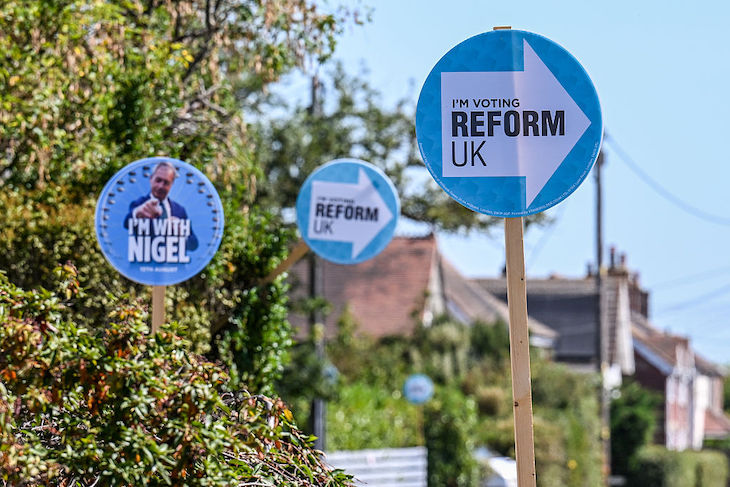
1) Nigel Farage is king of Clacton
The Reform UK leader won the oddest by-election in UK political history. His margin of victory was that usually secured by an Iranian hardliner – 63 per cent of the vote – rather than the full North Korean or Saddam Hussein 99 per cent. Reform will be pretty happy with that as anything over 60 per cent was going to be a very healthy margin of victory.
The turnout also shows this was not a trick of the light. Forty-four per cent is very healthy in a by-election, particularly one which was not a contest, since it can easily fall to 25-30 per cent away from a general election.
Farage’s team is also pleased that his total number of votes, 22,239, was 1,014 more than he secured at the general election in 2024. His majority increased from 8,405 to 12,784. We can safely conclude that the vast majority of the people of Clacton have looked at the furore around Farage’s finances – and the political class dismissing this by-election as a farce – and said to themselves: ‘I don’t care. Nigel is our guy.’
2) A recall vote will fail
No sooner had Farage been crowned victor than the Parliamentary Commissioner for Standards announced he was reopening the investigation into whether the Reform leader had broken the rules by failing to declare a £5 million ‘gift’ from crypto-billionaire Christopher Harborne. Reform insists Farage was not a politician when the money was handed over, though Gabriel Pogrund of the Sunday Times has showed that he was privately plotting a return.
It seems probable that the commissioner finds against Farage. He seems to think so himself, having said he ‘maybe’ neglected to ‘fill in a piece of paper’ about the five big ones. It seems more than possible that Farage will be given a ban of ten days or more from the Commons, the threshold which opens the way for a recall vote. But even then it is not an absolute banker that there would be such a vote – 10,000 signatures are needed to trigger one. I would expect the 9,455 Count Binface voters, plus a few hundred others, to coalesce in order to reach that mark. But given Farage’s dominance, it is hard to see how he loses another by-election.

The Tories would probably be his main opposition. That would likely raise turnout further, towards 60 per cent. However, some left-wing voters would prefer to back Binface than the Conservatives, and even if Rupert Lowe’s Restore Britain steals four or five points from Reform, it is hard to see anyone stopping Farage. The trick the left used to drive Boris Johnson from politics seems doomed to fail against the Reform leader.
3) But tactical voting will be a problem for them elsewhere
It is not all good news for Reform. Count Binface is the most successful joke candidate there has ever been in a British by-election, and the only rival to retain their deposit – a first for Binny. The fact that he got 26 per cent of the vote shows that a significant number of Britons are motivated, even in a resolutely Reform heartland, to turn out for ‘anyone but Nigel’ or ‘Stop Reform’.
This is partly a testament to Farage’s success. The prospect of him becoming prime minister is no longer fanciful – and to some a threat that must be prevented. But it is undeniable that the extent of this tactical voting, which we have now seen in a succession of by-elections, is problematic for Reform. In closer contests than Clacton it is going to cost the party a host of seats and makes it materially less likely that Reform can secure either a majority or close enough to one to form a government. Any ruling against Farage by the commissioner could put off more Reform-curious voters. Which may be why…
4) Farage has pivoted to a core vote strategy
Reform’s response to their win, and Farage’s failure to turn up to the count, was instructive of the party’s current approach, which seems to be to appeal to their core vote, rather than attempt to widen support to the magic 35 per cent, which would all but guarantee a Reform majority at the next election. Farage was the first by-election winner not to turn up to the result since IRA hunger striker Bobby Sands, who was behind bars at the time. Reform made much of a threat to Farage, which Essex Police then denied, saying the force had not advised anyone to stay away from the count.
The truth is that the police did warn Farage there were plans by his opponents to disrupt the count. But not turning up seems partly a security concern and partly a presentational issue. The man himself said: ‘I’m damned if I’m going to stand on a stage, having won a resounding victory, a ringing endorsement of all that I’ve tried to fight for, and you’ve tried to fight for, and be demeaned and humiliated by nobodies, and I will not sadly be attending the count.’
Farage does have legitimate security concerns. But the issue also allowed Reform to weaponise the issue to bash what they see as hostile broadcasters and print journalists. Suella Braverman told the BBC that the police lie and that she trusted them no more than the national broadcaster. Richard Tice slagged off ‘left-wing journalists’ who fail to believe the scale of the threats to Farage’s life. ‘Lefty journalists still don’t get it,’ he wrote on X. ‘Last week Met Police & Counter Terrorism had to admit they messed up over an alleged firebombing at Nigel’s home last year. Now they’re bleating & questioning the judgment of Nigel’s security team on whether to attend count or not. It’s as though they wanted something bad to happen. Sick.’
Reformers think the recent murder of Ann Widdecombe has made their point for them. However, choosing to have a row rather than turn up, as Margaret Thatcher did at the 1984 Tory conference in Brighton after the IRA had come close to murdering her in her bed, is the actions of someone more comfortable campaigning than someone who wants to project an image of national leadership. That seems to have broadly been Farage’s MO for the past few months.
5) Reform has other problems winning Clacton won’t solve
The move away from sunny Nige, the potential PM, towards angry Nige, bemoaning the wicked media, has been notable. It has begun to cause concern in the Reform ranks, most acutely from within the cadre of ex-Conservatives who thought they were joining a government in waiting rather than a grievance machine.
Zia Yusuf, the party’s home affairs spokesman, has put in place a deportations strategy which many think impractical, and his public utterances have become steadily more outspoken. Even Farage publicly said Yusuf had gone a bit too far when he denounced Ben Wallace, the former Tory defence secretary, who served on the front line in Northern Ireland, as a ‘traitor’. Tim Montgomerie, one of the Tory defectors, took Yusuf to task in public last week. Today, he said Farage had got it wrong.
He wrote: ‘This is a good result for Nigel Farage. Very good actually and he’s been the winsome happy warrior of olde on the sun-soaked streets of Clacton during the campaign. He should be on every TV screen this morning – underlining his win – and with that cheeky, trademark smile on his face… But this recently far too dominant aggrieved tone is still with us. It’s not good. You don’t skip your own victory count without a much better explanation. Anger from politicians can work but only if it’s on behalf of others – not yourself. He’s distracting from his victory. Puzzling.’
All this will convince Yusuf, who hates the Tories with a passion, that Reform were wrong to accept these defectors. But not a few inside the party believe Yusuf’s rhetoric is driving away potential middle-class voters. Yusuf, I’m told, privately dismisses the concerns about tactical voting. But as a former Tory No. 10 adviser told me this morning: ‘If you don’t care about tactical voting then you definitely don’t care about winning.’
As our leader said this week, Reform must decide if they want to form a government, or wish to remain the best protest party in the country. But let’s be clear, if Reform solidifies their vote in the 25-28 per cent range, neither Farage nor his party is going away.






Comments