
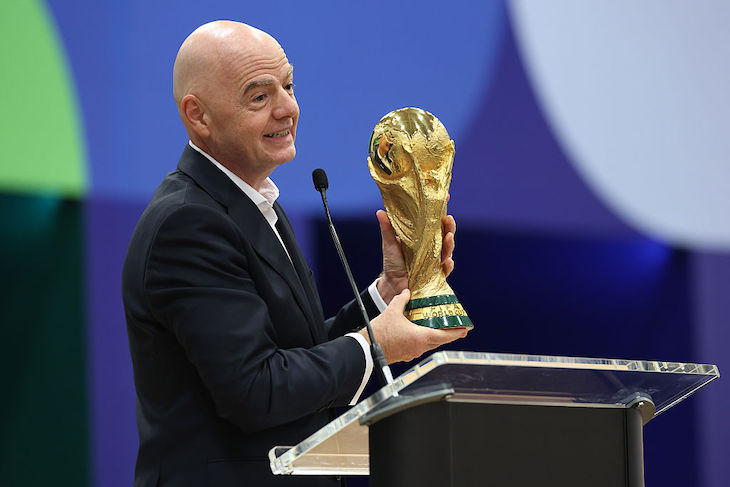
The FIFA World Cup starts tomorrow, and soccer fans and news outlets are complaining that tickets are far too expensive. The England Supporters Travel Club says that following England all the way to the final would cost supporters more than $7,000 in tickets alone. Prices have more than doubled since the last World Cup and the cheapest standard ticket for the final is $4,185. But how much of this is down to FIFA’s greed?
This year's World Cup is jointly hosted by the United States, Canada and Mexico across 16 cities. The United States is holding 78 of the matches, while Canada and Mexico have 13 each. When bidding for the tournament, the host nations used existing events as pricing benchmarks: boxing matches, hockey tournaments and the Super Bowl. After all, why wouldn’t the World Cup, they argued, be in the same category? The cheapest face-value Super Bowl ticket costs $950 while the most expensive $8,500. For the World Cup final, the range is $2,030 to $6,370. The audience gap puts this in context: last year's Super Bowl drew around 200 million viewers globally, while the last World Cup final attracted closer to 1.5 billion.
The comparison holds for group-stage matches too. Tickets for a group game in Kansas City are more than double the equivalent prices in Qatar, ranging from $140 to $410 depending on seat category. However, when compared with a regular NFL game in the same stadium and the same seats, World Cup tickets are actually slightly cheaper.
FIFA has fully exploited this wealthy market. It has expanded the tournament from 32 teams to 48, adding 48 extra matches to the schedule, a move which FIFA president Gianni Infantino said will lead to the "most inclusive" World Cup ever – but really the plan is to maximize revenue. Ticket sales should bring in around $3 billion, while sponsorship income is expected to reach $2.8 billion, up from $1.8 billion in 2022, and broadcasting rights should bring in $4.3 billion, up from $3.4 billion. It’s a 70 percent increase overall.
As ever, FIFA's lack of transparency has irked supporters. It has bungled three separate ticketing phases with an opaque pricing structure, a new "variable pricing" strategy and a resale platform on which FIFA takes a 30 percent cut. Infantino tries to claim that these structures are normal in America, which is sadly true. Given that college football tickets already start at $100 and can reach $500, it is little surprise that World Cup tickets are pricier still. But even Donald Trump said he "wouldn’t pay" $1,000 to watch USA-Paraguay and many fans agree. There are around 4,400 unsold tickets for this game. Across the rest of the tournament, 15,000 tickets remain unsold overall and 180,000 have been put on resale websites and prices continue to increase.
And for a sense of where American sports pricing can go: a resale courtside seat for the New York Knicks play-off game earlier this week was listed at $140,000. This is the reality of the American sports market. FIFA planned for it all along, but the rest of us have only just discovered it.



Comments