
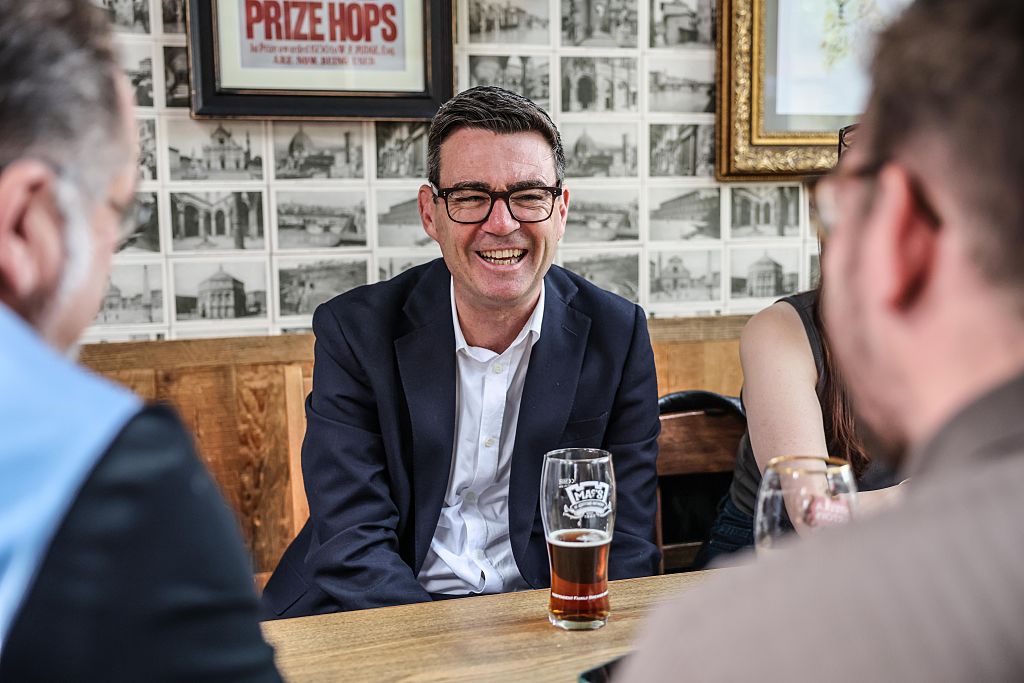
We are approaching the end of Andy Burnham’s first week in power. There are as many questions as answers about where he will ultimately plant his flag on the big macro-economic stuff and on policies which make for difficult politics. But his Downing Street team will be pretty happy with how things have gone for the first few days.
Burnham understands that a large part of the premiership is about communicating and that policy can be a form of communication – something Keir Starmer, Rishi Sunak and Theresa May, of our recent premiers, either denied or deplored
I doubt many ordinary folk will quite grasp why he has proclaimed the opening of No. 10 North today the happiest day of his life, but it is a statement which will be noticed and draw attention to something which is usually only of interest to political hacks and the even more geeky people at the Institute for Government.
Burnham understands that a large part of the premiership is about communicating and that policy can be a form of communication – something that Keir Starmer, Rishi Sunak and Theresa May, of our recent premiers, either denied or deplored. Small interventions on the cost of domestic energy, bus prices and a tax break for pubs will not change the world but they can change voters’ views of Labour now that it is under new management.
Well-organised Downing Street operations have a bully pulpit to dominate the news schedules and Burnham’s team have made the most of that. Starmer, from the off, seemed passive and reactive. Burnham is on the front foot. There will come a time, like a batsman playing forward, when he takes a ball on the chin, but most batsmen thrive when taking the initiative and you’re less likely to get trapped in front of your stumps when the pitch starts to break up.
The flip side of this is that good short-term politics can store up problems. Neither Burnham nor No. 10 has been consistent on whether or not they are looking at raising the income tax personal allowance (the most recent answer was ‘looking at it for the budget but no promises’. I paraphrase). Even today we’ve got another, different signal about rent controls, another will-you-won’t-you policy. Angela Rayner, the on-again, off-again, on-again housing secretary, told the BBC they were not the ‘way forward at the moment’. Well not this week, anyway.
But the indications are that the public is noticing what Burnham is doing and is broadly supportive. An exclusive poll for the Evening Blend, by Scarlett Maguire of Merlin Strategy, shows that 41 per cent of the public thinks Burnham’s first few days have been very or quite successful, with just 10 per cent saying he has been unsuccessful. No. 10 will take that.
Looking at individual policies, 26 per cent think capping bus fares at £2 will have a ‘large impact’ on their lives, with another 36 per cent saying it will have a fair impact. Only 10 per cent say it will have no impact on them at all, which is surprising since around 70 per cent of people nationwide drive a car to work. Burnham’s electricity price VAT cut, which is only worth £1 a week, is nonetheless judged likely to have a big or fair impact by 58 per cent. Throw in those who think it will have a small impact and you get to 89 per cent. Just 11 per cent think it will have no impact. If Burnham does raise the tax-free personal allowance, 96 per cent think it will have an impact on their finances, with 35 per cent calling it a large impact.
All of which suggests that small policies are having an outsize impact. Burnham is getting a lot of bang for his buck. Why is this? In part, it is the result of striking a more optimistic pose and canny use of social media. I’m grateful to Spectator intern Ella Veakins, who has done some useful work contrasting the initial messages of the Starmer and Burnham governments. On 12 July 2024, Starmer tweeted: ‘I’ll make tough decisions to clean up the mess.’ A day earlier his chancellor Rachel Reeves had tweeted: ‘We are already taking the tough decisions to deliver growth and fix the foundations of our economy.’ Both of these interventions stressed the mighty nature of the challenge and the unpleasantness of the task. The tone is negative.
Contrast that with Burnham’s first tweet as PM in which he vowed to tackle rough sleeping, something we’ve been told ‘will take decades or even that it’s impossible – I’m not having that’. Announcing his bus fare plan, he said: ‘I’ve done it before and now I’m doing it again.’ The emphasis is on smaller things which affect daily lives but also projecting a can-do spirit. When influencer Big John Bosh asked, ‘Where is Andy Burnham?’, the PM replied on X, ‘Here mate,’ complete with a laughing emoji.
A smart social media game won’t kickstart growth or create a magic money tree, it won’t change lives or incomes in the long term, but it can have an effect on public morale and the sensation that here is a politician who wants to shape events rather than be buffeted by them is something voters usually warm to and something which might buy Burnham a little goodwill and political space to make all those difficult decisions which lie ahead.



Comments