
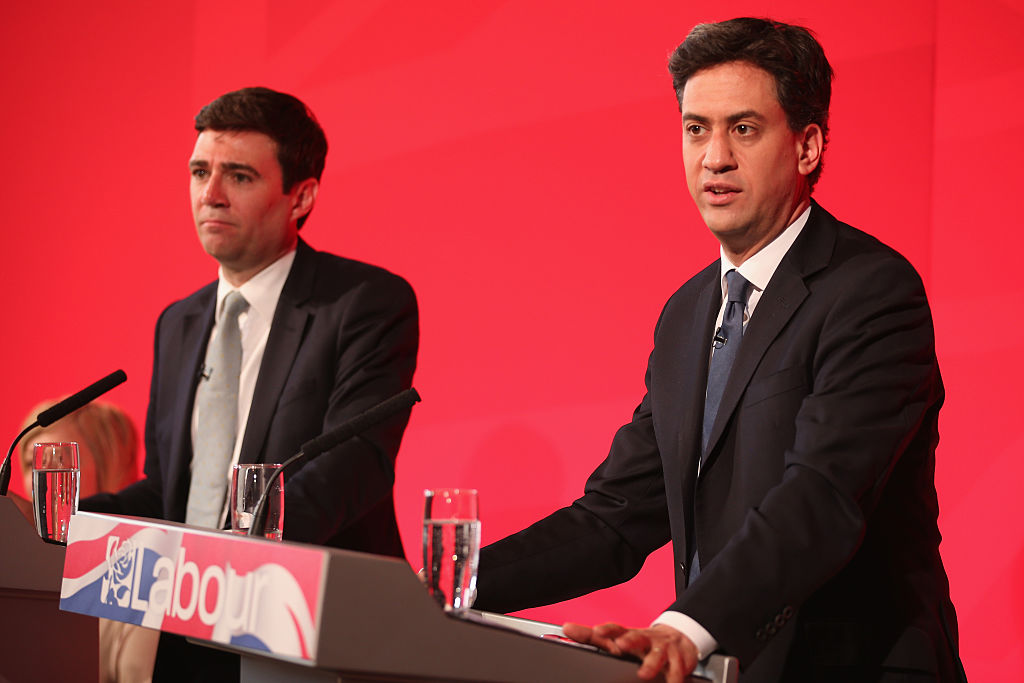
With Sir Keir Starmer’s premiership in perpetual peril, it seems instructive to pay closer attention to his potential successors. On that, there have been two noteworthy interventions this week. The first from Ed Miliband who told the Today programme: ‘I tell you what angers Keir most about this country, it’s class. It’s the class divide.’ Not to be outdone, Andy Burnham then told a Resolution Foundation think-tank event that the focus of British politics needed to switch to lower earners.
They present a Britain where capital exploits cheap labour, resulting in profound and widespread poverty. But that’s not the Britain we’re in
Both men seem to want to focus on a country that does not exist. They present a Britain where capital exploits cheap labour, resulting in profound and widespread poverty. But that’s not the Britain we’re in.
For starters, successive chancellors beginning with George Osborne have focused on tackling low wages. So much so that the minimum wage for those over the age of 21 is now roughly two-thirds of median earnings. Compare that internationally and it’s among the highest in the world: of the 33 OECD countries with a statutory minimum wage, Britain’s is the seventh highest. It’s just plain wrong to suggest government after government has not focused on tackling low incomes – while often ignoring the knock-on effects.
With the minimum wage now so high, it is little wonder that some 219,000 jobs have disappeared since the Chancellor’s first Budget. Hiring workers has become extortionate when companies factor in increased national insurance contributions as well. These policies have exacerbated wage compression, too, with entry-level positions in accounting, law and other professions having an ever-diminishing salary advantage over less skilled work.
Meanwhile, on class and poverty, the politics make perfect sense. If you say a policy measure will reduce poverty, support for it will be undeniable. That is why Gordon Brown (whom I actually have a lot of respect for because of his contributions to the 2014 Scottish independence debate) has gone to some lengths to engrain flawed metrics such as relative poverty into all areas of British policymaking.

The result, as Work and Pensions Secretary Pat McFadden privately puts it, is a sort of ‘spreadsheet socialism’: MPs support costly policies that result only in changes to corrupt metrics without making material changes to voters’ lives.
Those metrics were brilliantly blown apart last weekend by the Times’s Tom Calver. As Tom explained, income figures that define the relative poverty metric on a given year are based on the 16,000 households who respond to the government’s ‘family resources survey’. Participants set out how much they receive in pay, benefits and pensions – giving a sense of the national median income and the number receiving less than 60 per cent of that. However, that survey has managed to underreport benefit payments to the tune of £43 billion. The government is going to switch to using benefits records directly to fix the error. If that number has been underreported and the income measure is therefore dragged up, we could find out that child poverty – even on the corrupt relative metric – is far less bad than claimed.
But, more than that, I think there’s a fiscal argument to be made that Britain has been soft-left for some time. Look at the savings on winter fuel payments and disability benefits that backbenchers stopped Starmer and Rachel Reeves from implementing. But it goes back even further than that. Few talk about this but the Tories created what is actually the most ‘progressive’ taxation system in Europe – whereby the rich are bled dry while middle earners are protected. In fact, the gap between Britain’s top earners and the average worker in terms of the chunk of salary that goes on tax is wider than almost anywhere else. That’s pretty soft-left.
Midway through writing this, the most unlikely person stole my thunder: Angela Rayner. Labour’s princess across the water told a night-time economy conference in Liverpool that ‘business rates, VAT, and yes the minimum wage’ have created a ‘triple whammy’ of challenges for businesses. ‘We’ve got to start looking at the intersectionality of all these challenges and start relieving them,’ she concluded. Perhaps there is hope for economic realism after all.
This article first appeared in Michael’s Reality Check newsletter. Sign up here.
Watch the latest episode of Reality Check on Spectator TV:




Comments