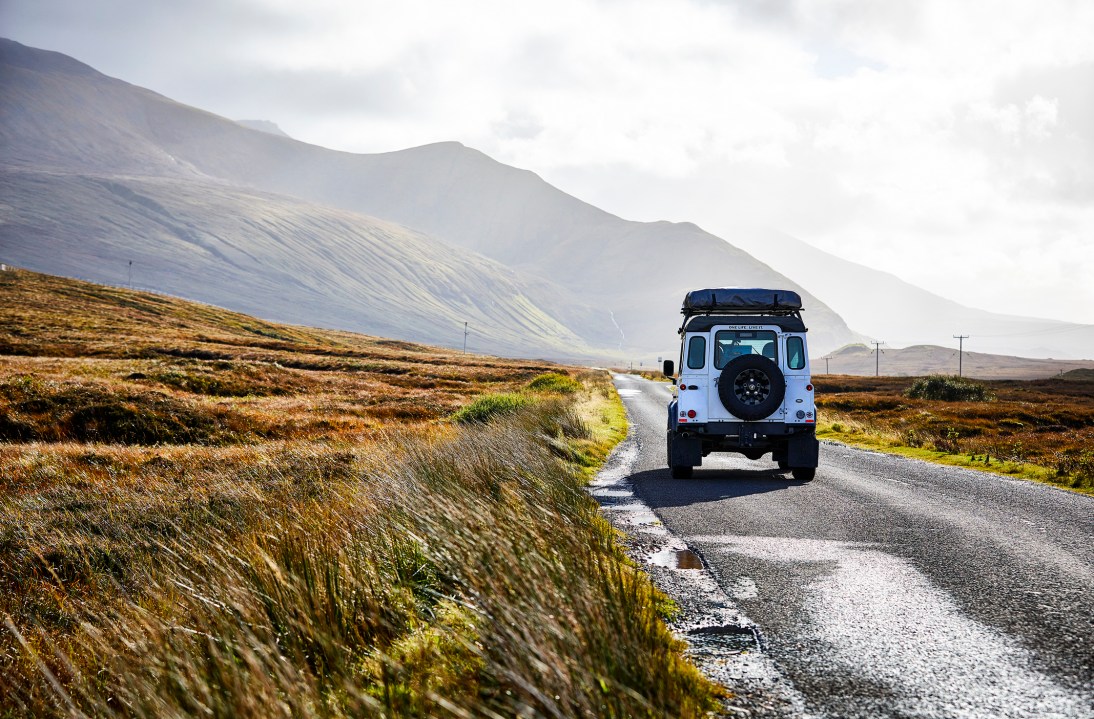
It is almost inconceivable that we used to live in a world where people would ‘go for a drive’. Not to get to a destination, but simply for the pleasure of driving. Sunday afternoons were the time of choice for this activity and would see car owners take to the road simply because it was good fun to be behind the wheel. The idea that driving was anything other than functional now seems absurd.

That world has vanished, partly due to the sheer volume of cars. In 1971 (the year my dad learned to drive), there were roughly 15 million cars on UK roads. Today, on those same roads, there are 34 million. Driving was more pleasurable when there was space to breathe — empty ribbons of tarmac where you might encounter another car every five minutes. Now, the ‘drive’ is spent in a metal conga line, with journeys that should take 15 minutes routinely taking 50.
Motorway driving may be the worst sub-category of driving. These days, the M25 is more a car park than a road, where one can enjoy the experience of watching their fuel gauge descend simultaneously with their will to live. If you’re lucky enough to actually move, you’ll be tailgated by a BMW, cut up by an HGV, and then get stuck behind a Nissan Micra (not overtaking) in the middle lane.
There is also the matter of modern technology. Modern cars come equipped with LED headlights so bright they could double as anti-piracy searchlights. Using your rear-view mirror requires similar precautions to be taken as viewing a solar eclipse. Fail to take these precautions, and you’re subjected to retinal warfare that’s comparable to staring into the detonation of an atomic bomb, leaving you forced to navigate the roads by braille. These lights may well help their users see better, but this is at the expense of temporarily blinding everyone else. We’re led to believe that this is automotive progress.
What’s most peculiar is what cars do to their occupants. The moment some people’s posterior makes contact with a driver’s seat, they undergo a Jekyll and Hyde-style psychological transformation that is actually just as fascinating as it is horrifying. These are ordinary people — the type that would apologise for being bumped into — who become snarling, hostile beasts the moment they’re encased in metal. The car seems to provide a moral soundproofing that renders the normal rules of human interaction null and void, and road rage, the default setting.
Using your rear-view mirror requires similar precautions to be taken as viewing a solar eclipse
This anonymous aggression is driving’s answer to online comment sections. I can only guess that our windscreens create just enough detachment from reality for people to feel comfortable with unleashing behaviour that would be unthinkable in a face-to-face interaction. The problem is, road warriors pilot actual weapons. In the hands of someone in the tight grip of automotive sociopathy, a two-tonne Audi Q7 is considerably more dangerous than an angry tweet.
It doesn’t take long to need a break from driving, forcing road users to descend into what must be the most depressing place on earth and the seventh circle of driving hell: the motorway service station. I stopped at Leigh Delamere Services recently and, on entry, was nearly rendered unconscious by the stench of the lavatories from a good 60 feet. After a wait that was similar in duration to the construction of Cologne Cathedral, I was rudely served a weak coffee and a sandwich that tasted like it had been assembled from materials found down the back of a radiator. For the privilege, I was charged £10. The irony is exquisite, however. The place that was created to provide welcome refuge from the unpleasantness of motorways has become far more unpleasant than the motorway itself. I’d just keep driving if I were you.
And if the current state of things isn’t miserable enough, we can expect the arrival of driverless cars by the end of the year, which will presumably deliver the final blow. Any remaining vestiges of motoring pleasure, dead. Technophiles don’t shut up about how these vehicles will be safer, more efficient, more rational. They will — in other words — remove our autonomy entirely from the equation and take us one step closer to rendering humans completely useless. There will be no more spontaneous decisions to take the scenic route, no more stumbling upon a charming village that you didn’t know existed. Instead, we’ll be passengers in our own cars, transported along predetermined routes by robots that can only ever prioritise efficiency. We’ll be no more than delivered to our destination — like a parcel. The ‘Sunday drive’ will be replaced by the ‘Sunday algorithmic transportation experience’. Even worse, these ‘robo-taxis’ will presumably observe speed limits religiously, making them absolutely insufferable to share the road with.
I don’t expect we’ll see a return of driving for pleasure. There are too many of us out on the roads, and we’re all too unpleasant to each other. But if we could occupy the roads with a touch more courtesy and dim our lights to something short of nuclear intensity, we might salvage some enjoyment from what has become a modern misery.


Comments