
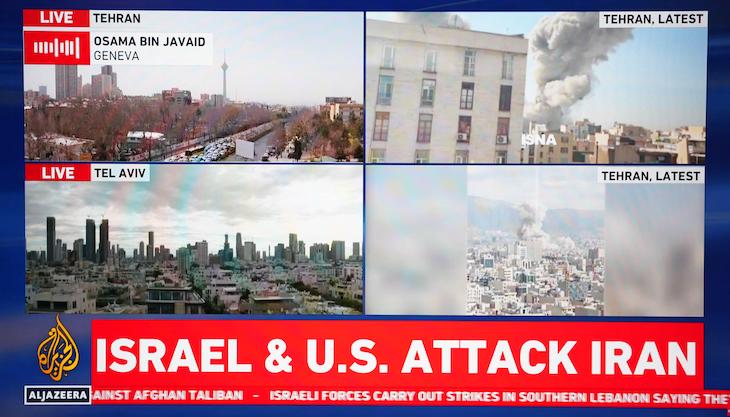
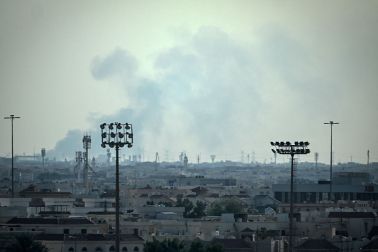
This morning, the long-anticipated Israeli and American strikes on Iran finally arrived. At 08:10 am local time, Israel and the United States began a coordinated military operation against Iran. Dozens of Israeli Air Force aircraft took part in the opening strike. Blasts were heard in Tehran. Within hours, explosions were reported in Isfahan, Qom, Karaj and Kermanshah.
Videos circulated of Iranian citizens laughing and cheering as Israeli and American aircraft crossed the capital’s skies
The news established something that had been contested for months: Donald Trump meant what he said. The thresholds he articulated were fixed and public. Those who accused him of bad faith, those who doubted that he would ever act, now have an answer measured in sorties and detonations.
This was not a surprise. He has spent weeks assembling military weight across the region, positioning aircraft, naval forces and logistics with methodical visibility. There were even angry posts on Truth Social. At the same time, he entered negotiations and sustained them in public, even though we all knew it to be futile. President Trump signalled clearly to Tehran where the lines stood, drawing them over and over in thick, red sharpie. Meanwhile, he pursued diplomacy in good faith while preparing for its failure. The result is an operation that cannot plausibly be described as rash. It was prepared, reinforced and communicated over time.
The stated objective was preemption. Israel declared that it had launched the strike to remove threats to the State of Israel. Defence Minister Yisrael Katz signed a special order imposing an immediate state of emergency across the entire home front under the Civil Defense Law. Citizens were instructed to remain near protected areas and to obey the Home Front Command.
The targets were expansive. Around 30 sites across Iran were reported hit, including the Iranian leader’s residence, the intelligence headquarters of the Islamic Revolutionary Guard Corps, the defence ministry, the intelligence ministry and nuclear sites. The IRGC intelligence directorate was seen in flames in footage filmed from a bus in Tehran. The government complex in central Tehran was attacked. There were reports of an attempted strike around Ayatollah Khamenei’s house. Later, the Iranian military base in Parchin, southeast of Tehran, came under fire. A senior Iranian official has admitted that senior figures in the country’s military and political ranks have been killed. An early Israeli assessment says there is a good chance that Ali Shamkhani, Khamenei’s advisor who was responsible for the nuclear programme, has been eliminated, and there is early optimism in Israel that the massive assassination operation against the leadership may have been successful.
According to a report in the New York Times, in the plan presented to President Donald Trump, Israel would focus primarily on long-range surface-to-surface missile storage sites, production facilities and launchers. US forces were expected to concentrate on the Iranian nuclear project and additional targets linked to the Revolutionary Guards and the government. American officials described the campaign as far more extensive than US strikes last June against Iranian nuclear facilities.
The scale reflected that ambition. Dozens of US strikes were carried out by attack aircraft operating from bases around the Middle East and from at least one aircraft carrier. Seventy thousand Israeli reservists were mobilised. The Israeli operation was given a name: “Roar of the Lion.” This morning, that lion is certainly roaring.
Prime Minister Benjamin Netanyahu addressed the country shortly after the strikes began. He described the Iranian regime as an existential threat and thanked Trump for what he called historic leadership. He said the joint action would create the conditions for the Iranian people to take their fate into their own hands. He called on Persians, Kurds, Azeris, Balochs and Ahwazis to cast off tyranny and bring about a free Iran. Israeli citizens were told to prepare for days of endurance.
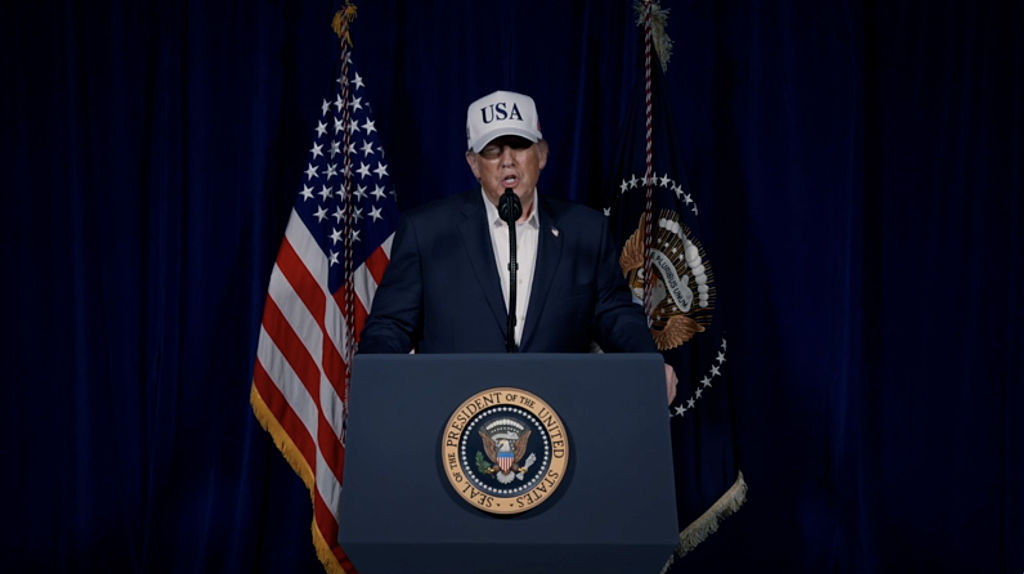
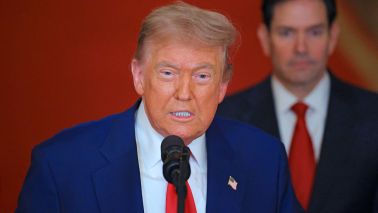
Trump, for his part, spoke in a tough, measured and uncharacteristically disciplined tone. He announced three direct goals: to destroy Iranian missiles, to destroy the Iranian navy and to prevent Iran from acquiring nuclear weapons. He stated that the Iranian people had a chance to gain freedom, an indirect acknowledgement that regime change lay within the political horizon of the operation. Trump and Netanyahu in their respective speeches framed the action as necessary for what they are seeking to achieve – two men who have worked tirelessly together to plan, rehearse and carry out the bold action we are now seeing.
As Israeli and American aircraft struck Tehran, Mossad, through a Farsi-language Telegram channel, called on Iranians to help “return Iran to its glorious days” and to share photos and videos of their struggle against the regime. A resident of Tehran told Israel’s N12 that the noise of the attacks and even the tremors were felt, and that some people went outside and celebrated. Videos circulated of Iranian citizens laughing and cheering as Israeli and American aircraft crossed the capital’s skies.
Iran’s response followed quickly. The Islamic Revolutionary Guard Corps announced the launch of a first wave of missiles and drones under the name “Promise of Truth 4.” The Israel Defense Forces identified missiles launched from Iran toward Israeli territory. Defensive systems were activated. Red alerts sounded in Jerusalem, the north and the centre. The Home Front Command sent precautionary directives directly to mobile phones in relevant areas. Magen David Adom teams searched a reported impact site in the Haifa region; no casualties were known at that stage. Israelis have prepared for this moment for months.
Iran’s response followed quickly
The confrontation widened. Sirens were activated in the Jordanian capital as a result of Iranian launches. Reports indicated Israeli strikes on militia targets in Iraq, including sites associated with Al-Hashd Al-Shaabi in Babil province. There were casualties. Explosions were reported at a US airbase in Abu Dhabi in the United Arab Emirates. An American base in Bahrain was attacked. Iranian launches continued toward Israel, Bahrain, the United Arab Emirates and Qatar.
The tempo and breadth of the exchange suggest long preparation on both sides. In the weeks following the June strikes on Iranian nuclear facilities, discussion had already begun that joint Israeli and US action had not fully eliminated nuclear material. It became clear that Iran intended to rebuild facilities, recover material and resume elements of its ballistic missile programme. Over subsequent weeks and months, escalation appeared increasingly likely.
It is too early to say what might happen next, or how long this may last. Israel has been on a tight fuse for weeks, preparing at every level, from hospitals and air defences to government ministries and civilian drills. It is a country that rehearses contingency as routine and practises civil defence with grim familiarity. There is little here that can credibly be described as sudden. And yet the variables are immense. Among Iranians, inside the country and across the diaspora, there are conflicting emotions: excitement and anticipation alongside fear and anxiety. The same tension runs through Israel and the wider region. What follows will test not only military capacity, but political and civil endurance on every side.

Comments