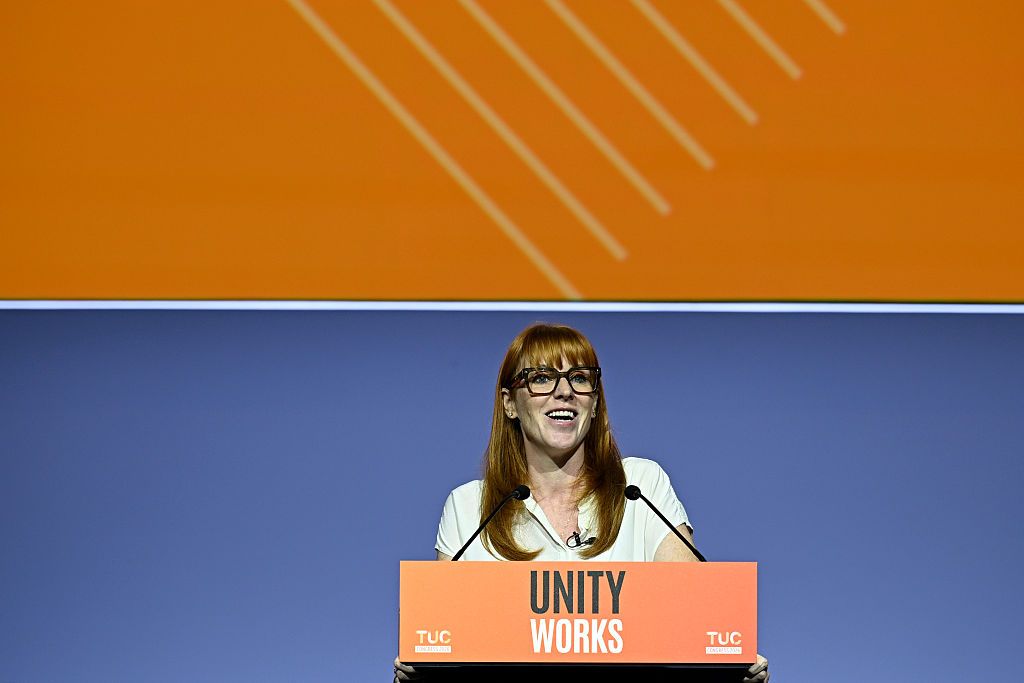
Angela Rayner has used a big speech to the TUC to brand Reform’s biggest donors ‘a couple of off-shore billionaires trying to buy our democracy’. Labour, she went on, would defend that democracy against any ‘fascist oligarch’ who ‘seeks to divide our country and buy our politics.’
That demagoguery is not quite the sort of thing she was preaching ten years ago. Addressing the same TUC Congress in September 2016, in the aftermath of Jo Cox’s murder, Rayner urged delegates to honour Cox through ‘the example we set’, reminding them that ‘we have more in common than what divides us’. What happened Ange?
Calling every right-wing politician a fascist weakens our ability to distinguish and oppose real fascism should it actually rear its ugly head
Does Rayner really believe that Ben Delo and Christopher Harborne are fascists? Or was this purely cynical political oratory? Whichever it is, her language is shameful.
I hesitate before using that word because we have already quite enough tone policing in our politics. Barely a day goes by without the right being accused by progressives of peddling hateful and divisive rhetoric. Charges of ‘irresponsible’ use of language are now par for the course for right-wing politicians.
But we do need to point out the sheer hypocrisy in the way Labour and progressives are resorting to increasingly inflammatory and even violent language to refer to their political opponents, all while continuing to accuse the right of being the peddlers of the language of division and hate.
There is, of course, nothing remotely new about any of this. ‘Everyone I don’t like is Hitler’ is by this point a well-worn social media meme. But we should note that those most insistent that language matters – that highly-charged discourse and slurs can legitimise hatred and even violence – are becoming so comfortable using such incendiary language.
Rayner, of course, has form on this sort of thig. In 2021, she referred to Conservatives as ‘homophobic, racist, misogynistic… scum’. Polanski has called Farage a fascist. Zarah Sultana has stated Farage has ‘all the features of a fascist politician’ and has warned of a ‘fascist Reform government’. Ed Davey has accused Reform of ‘carrying water for the Kremlin’ and said: ’We know who’s pulling his strings.’ I could go on. And this is before, of course, we get to the choice words they and their political bedfellows reserve for Donald Trump.
The Electoral Commission reported this week that harassment, intimidation and threats towards candidates increased again in this year’s local elections. More than half of Reform and Labour candidates reported abuse. The Commission has repeatedly warned that intimidation is changing how people campaign and, in some cases, deterring them from political life altogether. The Commission has said hostility and division in political debate is part of the problem.
As I say, I do not really want to see anyone on any side issuing lectures about what constitutes acceptable political discourse. I am close to being a free speech absolutist. Besides, Farage is hardly a shrinking violet and politicians on the right have themselves used language such as ‘enemy’ and ‘traitor’. Politics should permit anger, ridicule and offence.
But routinely describing democratic opponents as fascists? It is hard not to see that as pretty low and quite possibly dangerous. Charlie Kirk and the attempts against Trump’s life show where this can lead. And of course here Ann Widdecombe’s murder, and the threats against Farage, demonstrate the worrying tendency toward violence in our own politics.
Does the word matter? Well history teaches us that fascism is something to be resisted. Framing the fight as one against fascism enables the rules that ordinarily govern democratic competition to be more easily cast aside. After all, when the alternative is dictatorship, what’s a bit of creativity in legislation – perhaps, I don’t know, using unprecedented retrospectivity to make illegal an opponent’s donations? As for whether Rayner’s deranged diatribe today would interest a defamation lawyer I leave to Delo and Harborne.
Of course this impoverishing of our political debate also causes words to lose their meaning. Calling every right-wing politician a fascist weakens our ability to distinguish and oppose real fascism should it actually rear its ugly head.
Let us remember that Angela Rayner, until her £40,000 stamp-duty underpayment on her £800,000 seaside flat, was the deputy prime minister. As a cabinet minister she still speaks for the government. Not content with labelling Reform’s politics racist, the government has clearly now resorted to calling (at least some of) its supporters fascists. Even if it’s hard to anymore be surprised, it’s still depressing.
Words have consequences, we are forever being told by Labour. Yet, as so often with progressives, it is a case of do as I say, not as I do.





Comments