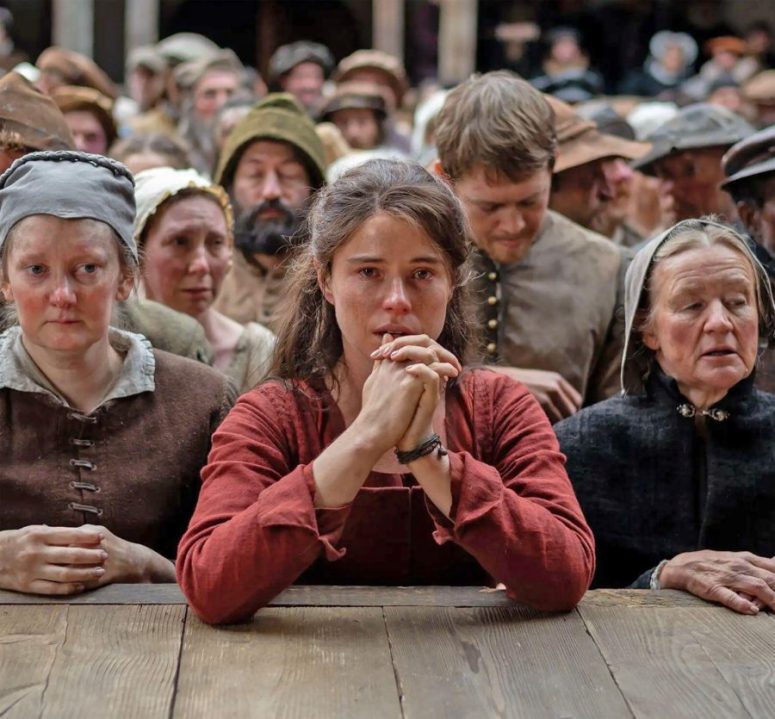
Just as each age refashions Hamlet in its own image, so I suspect we have got our own Hamnet. The 2020 book by Maggie O’Farrell became a worldwide success at the height of the pandemic, then an acclaimed play by the Royal Shakespeare Company and, finally, a film last year, nominated for multiple awards. The actress Jessie Buckley has now won both a Bafta and an Oscar for her performance in it.
But some elements of Hamnet‘s story have been so taken for granted that they have never been questioned. These include the assumption that an exploration of Shakespeare’s family history might be more interesting than the playwright’s own works. That his wife Anne should be the hero of the story and a natural wisewoman mystic; and that there might have been a conspiracy to deny her place and influence in her husband’s work. Or that the death of their son Hamnet must have spilled over into the play Hamlet, performed some five years later, as the names are so similar and indeed often considered identical.
The idea that Hamnet’s death might have influenced Hamlet is not new
The idea that Hamnet’s death might have influenced Hamlet is not new. James Joyce played around with it in Ulysses, where the character Stephen Dedalus is obsessed by the play:
Is it possible that that player Shakespeare, a ghost by absence, and in the vesture of buried Denmark, a ghost by death, speaking his own words to his own son’s name (had Hamnet Shakespeare lived he would have been prince Hamlet’s twin) is it possible, I want to know, or probable that he did not draw or foresee the logical conclusion of those premises: you are the dispossessed son: I am the murdered father…

More recently, the Shakespearean scholar Stephen Greenblatt gave it publicity in a 2004 essay whose title makes the causal link clear: ‘The Death of Hamnet and the Making of Hamlet’. Greenblatt is even quoted at the start of the film Hamnet. He made a claim that I would dispute:
This biographical attention to a work [Hamlet] deriving from recycled materials and written for the public stage would seem inherently implausible, were it not for the overwhelming impression on readers and spectators alike that the play must have emerged in an unusually direct way from the playwright’s inner life, indeed that at moments the playwright was barely in control of his materials.
The rhetoric is doing all the work here. Is there really ‘an overwhelming impression’ on readers and spectators ‘that the play must have emerged in an unusually direct way from the playwright’s inner life’? Rather than just being another brilliant play from someone who consistently delivered them?
One could argue instead that, like the great mass of Shakespeare’s creative work, Hamlet emerged from a cauldron of different impulses. I find the connection between Hamnet and the play a little too glib and the timeline a little too extenuated: Shakespeare wrote plenty of other plays between his son’s death and Hamlet. Indeed, his initial response to Hamnet’s passing was to write some of his most effervescent comedies: The Merry Wives Of Windsor, Much Ado About Nothing and As You Like It, along with the trilogy of Henry IV plays and Julius Caesar. It is also hard to avoid the glaring fact that Hamlet is principally a play about a dead father, not a dead son.
And what to make of ‘at moments the playwright was barely in control of his materials’? Elsewhere, Greenblatt makes the astute general point that ‘Shakespeare was a professional risk taker… He went where his imagination took him’. The excitement of all of his plays is that he is often ‘barely in control of his materials’. A better argument, given the textual confusion that surrounds Hamlet – one published quarto is twice the length of another – is that later editors have themselves struggled to control their materials or assemble a definitive text.
But still, it is of course always enjoyable to see a play within a play. There is a moment towards the end of Hamnet when the excellent Jessie Buckley as Agnes Hathaway (as Shakespeare’s wife is called in the film) has made the journey to London to become a very engaged member of the audience of Hamlet. The actor playing Hamlet looks much like her dead son (played by the brother of that son in a clever casting touch) and dies on stage. And just for a screen second, the disbelief of the ‘Hamlet as Hamnet’ conceit can be suspended. Paul Mescal as Shakespeare playing the ghost of Hamlet’s father, as we have been told he did by contemporary accounts, is also touching.
However, the film version of Hamnet at times hits the nail on the head so hard it is painful. Shakespeare sitting on a dock reciting ‘to be or not to be’ while thinking whether he should throw himself in the waters below is a low point where this member of the audience at least might quite happily have joined him.
A more interesting version of Hamnet might have made Anne Hathaway a bit more of a shrew. She could have been someone whom Shakespeare at times might have wanted to get away from to London. That at least gives a nod to the long tradition regarding Shakespeare’s marriage that, as Joyce put it, ‘the world believes Shakespeare made a mistake… and got out of it as quickly and as best he could’. But that would be against the tenor of our own times when every woman is empowered and every man is less so.
Hamnet is not as bad as the dreadful 2018 film All is True, which imagined Shakespeare’s life after his retirement from the theatre in Stratford and lined up Shakespearean thespians like Kenneth Branagh, Ian McKellen and Judi Dench as if they were appearing in a panto. The film made the tasteless and completely spurious suggestion that Hamnet committed suicide. It was deservedly a box office failure.
A far more enjoyable imagining of Shakespeare’s life – written with great dexterity and considerable scholarship, lightly worn – is David Mitchell’s series Upstart Crow for the BBC. Meanwhile, the best of all must surely be the 1998 film Shakespeare In Love, which won a staggering seven Oscars and remains one of Tom Stoppard’s greatest achievements. Although, rather like some of the bard’s late plays, it’s sometimes unclear how much of it was Stoppard’s, given he shared a writing credit with the screenwriter and novelist Marc Norman. One imagines the witty bits, but perhaps that is unfair.
Still, it might be wise to return to James Joyce, who in Ulysses followed on from his speculations about Hamlet and Hamnet to cast doubt on the whole biographical ambition:
But this prying into the family life of a great man … interesting only to the parish clerk. I mean, we have the plays. I mean when we read the poetry of King Lear what is it to us how the poet lived?
Quite. Particularly as Shakespeare’s biographical evidence is so scant that we are scratching at the earth in the cemetery for clues. Alas, poor Hamnet.




Comments