There are several things wrong with James Vanderbilt’s new film Nuremberg, least of all, some might say, the fact that it fails the Bechdel test. This 1985 metric assesses female representation in film by whether two named women have a conversation on screen about anything other than a man. If you are thinking, ‘So what? All the Nuremberg prosecutors were male, as was every defendant’, then you need to get hold of Natalie Livingstone’s revelatory book. While the public face of the trials was resolutely male, as were the indictments (there was no mention of rape, for instance, within the listed war crimes), the truth is that in the trials, as in the war, women played significant though often hidden roles.
Perhaps the best known image of the trials is the painting that hangs in the Imperial War Museum. It shows the proceedings in courtroom 600, but with the back wall obliterated to reveal the devastation beyond. It is with this image that Livingstone neatly opens her corrective. There is not a single woman in the painting, but it was created in situ by the leading British war artist Laura Knight.

Knight is one of the best known names among the eight women whose stories, both during and after the trials, are revived here in 16 well-marshalled chapters. Also familiar are the exiled German Erika Mann, full of rage against her former nation, and Britain’s Rebecca West, who found the proceedings tedious. Neither of their perspectives was shared by the German journalist Ursula von Kardoff, whose ‘uncomfortable sympathy’ for the defendants at one point caused her to be removed from court. ‘Nowhere is it so painful to be German as it is in Nuremberg,’ she wrote.
Pleasingly, though, Livingstone’s first chapter is dedicated to the brilliant but unsung lawyer Harriet Zetterberg, whose name she discovered ‘in a literal footnote’ in the memoir of a judge. Zetterberg was ‘among the most consequential brains on the American prosecution team’, we are told. With a diligent eye for detail, she compiled the prosecution’s incontrovertible case against Hans Frank, ‘the Butcher of Berlin’.
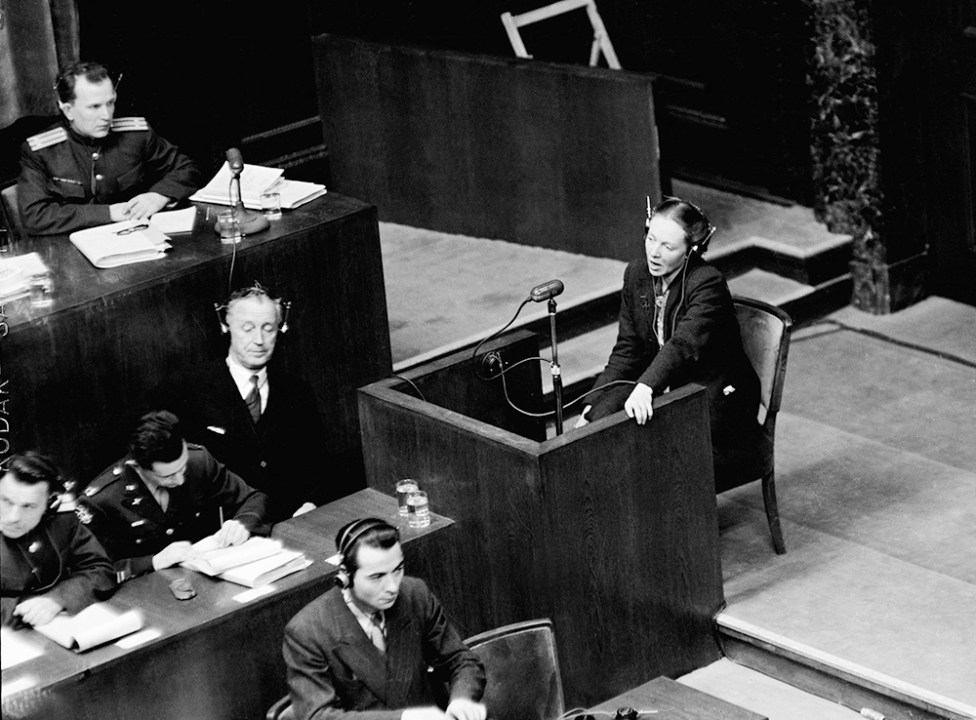
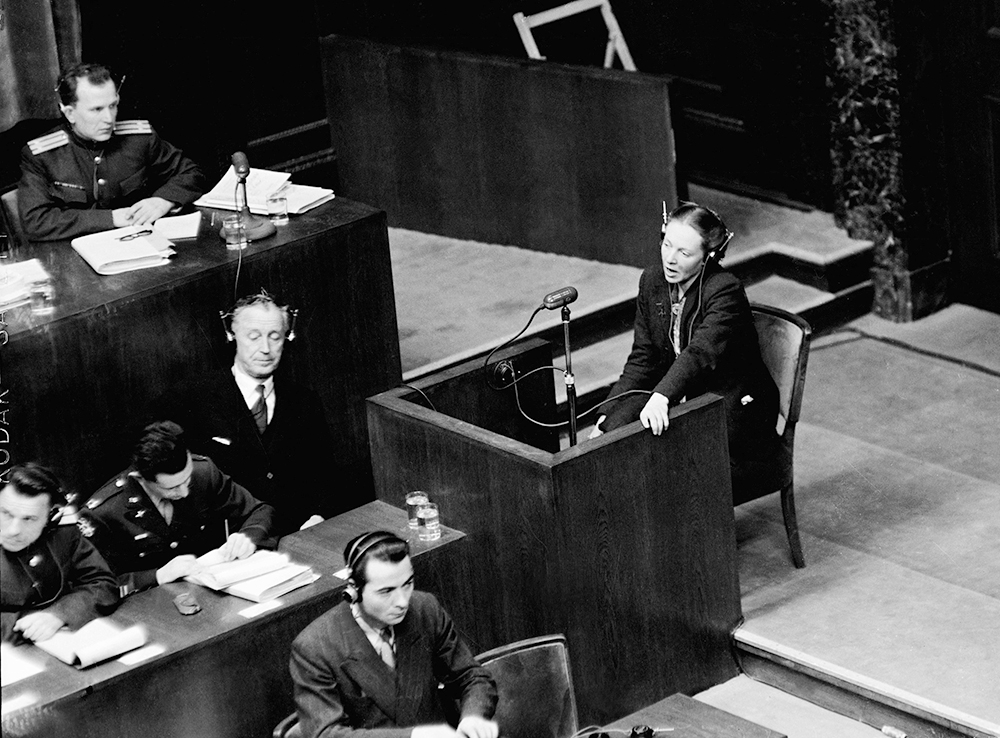
The Hungarian Countess Ingeborg Kalnoky, a multi-lingual refugee, ran the accommodation for trial witnesses – no mean feat, given that the only separation of senior Nazi and Jewish witnesses was when she squeezed a second table into her dining-room. Then there was the courageous Marie-Claude Vaillant-Couturier, a photo-journalist and member of the French Resistance, arrested in 1942, who miraculously survived incarceration at Auschwitz. One of only four female witnesses to take the stand out of more than 100, after coolly giving her testimony she walked along the front of the dock, defiantly gazing at each defendant in turn. Through her eyes she hoped they saw the ‘millions of victims, men, women and children, who… judged them’. Finally, among the translators was the 22-year-old Tatiana Stupnikova, whose devastating memoir later revealed how precarious her role was, balancing Moscow’s agenda with that of the court, as well as how romantic her months in Nuremberg turned out to be.
After giving her testimony, Marie-Claude walked the length of the dock, gazing at each defendant in turn
As Livingstone makes clear, these eight were far from the only women drawn to Nuremberg by the trials. The impressive support cast includes research analysts, secretaries, filmmakers, civilians and Nazi wives. Yet this is not only revisionist history. Livingstone also has an eye for drama and an effortless fluency that keeps the pages turning. ‘Erica Mann drove through the night to meet the 52 most wanted men in the world,’ one early section opens, while Stupnikova is ushered in with the tantalising sentence: ‘On the hotel bed lay the bloody corpse of a high-ranking Soviet prosecutor.’ It was all happening in Nuremberg.
During the three years of cases that followed, known as the Nuremberg Military Tribunals, women would be represented both among the prosecuting counsel and the defendants in the dock. Yet for some, such as Zetterberg, the trials proved not to be the beginning of a stellar career but the end. Her lower-ranking husband remained on the legal team after she was sent back to America, her contract terminated when she became pregnant. Even for those women who stayed, their work was ‘under-credited and out of sight’. If mentioned at all, they were typically disparaged, as when the CBS broadcaster Howard Smith referred banteringly to the ‘rising tide of feminism’ in Nuremberg. All praise then to Livingstone for writing such a fresh and compelling narrative, restoring the forgotten diversity to both the drama and the tedium of the trials.



Comments