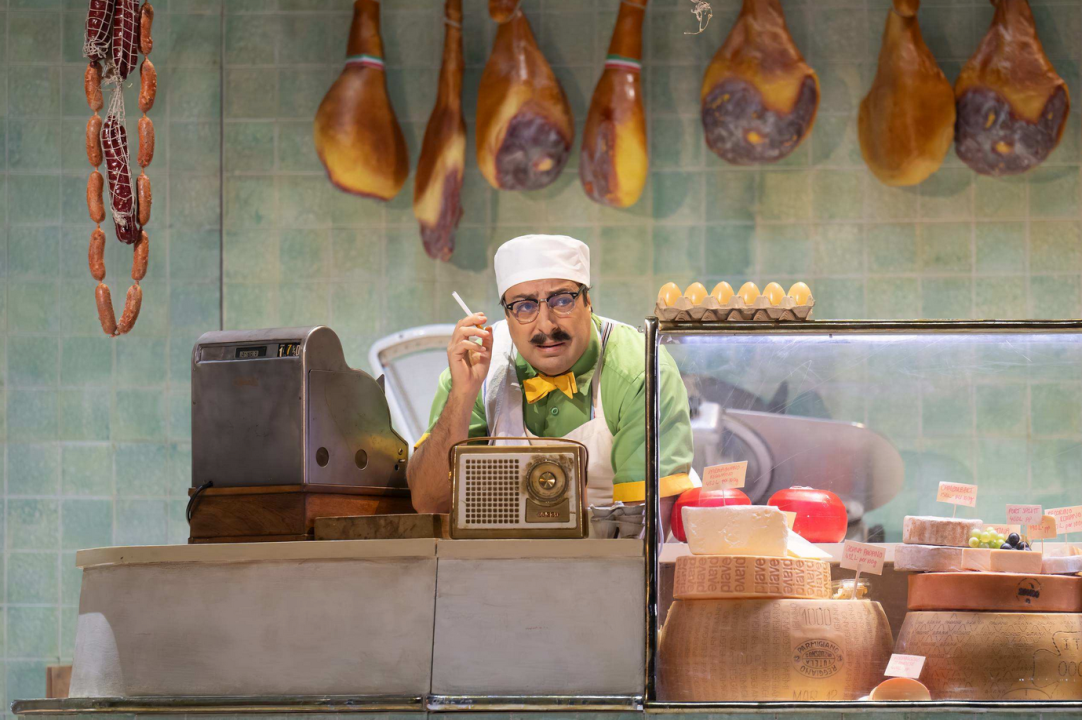
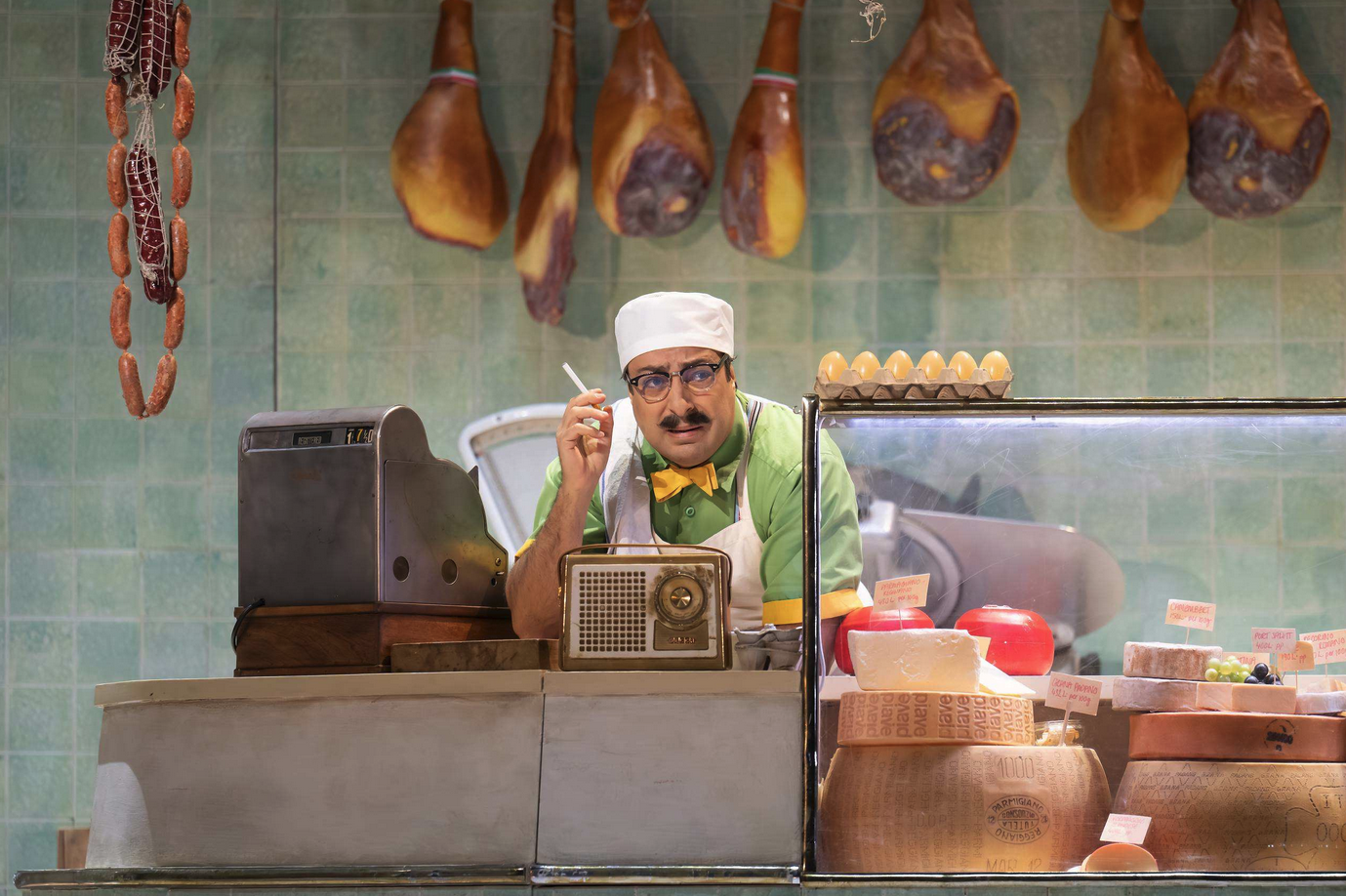
It’s impossible to say what Rossini would have made of Glyndebourne’s production of Il turco in Italia, but you can bet on one thing – he’d have brought the mother of all picnics. His love of food and drink was heroic; it’s believed that more recipes have been named after Rossini than any other musician. He didn’t mess about, either, berating his Paris grocer when a promised consignment of Neapolitan macaroni turned out to be an inferior Genoese product. ‘If he knows as much about music as he does about pasta, he must be a great composer,’ commented the oblivious shopkeeper.
Well, that’s the story, anyway (I thought the source was Stendhal but it turns out to be Ben Trovato). Regardless, he’d have been well placed to pronounce upon Act Two of Mariame Clément’s staging, which is located beneath salamis, hams and strings of sausages in a Neapolitan delicatessen. They don’t stay there for long. They’re swung as lassos, strummed like guitars, and sliced – then slowly, lasciviously ingested – by the Turk Selim (Peter Kalman) as he fuels himself for another attempt on the virtue of the proprietress Fiorilla (Elena Villalon). Funny, sexy, lip-smacking farce, in other words, and the Glyndebourne crowd – never backwards after 90 minutes glugging the Krug – was very much up for it.
Selim’s very tone exudes masculine sweat and onions
And no question, Clément’s staging (originally from 2021, now revived by Ian Rutherford) kicks up a gear in Act Two. The action is framed by the poet Prosdocimo (Matteo Mancini), who nudges and manoeuvres the characters into acting out the material for his new novel. In Act One, Clément seizes upon this to whip up an elaborate metatextual fantasy, with Prosdocimo pounding at his typewriter as his notes and musings ping up on a screen behind him. It’s wittily done, and there’s a certain spice in watching an opera director say the quiet bits out loud. ‘Confront toxic masculinity’ reads one note, in an opera that is driven almost entirely by the entitlement of its cute but selfish heroine. ‘Nineteenth century not very sexy – update to 1950s’ reads another, and the characters instantly change clothes.
It’s not a bad idea, actually, that cartoon-1950s setting. Who doesn’t love a touch of the old dolce vita? By making Selim a beefcake garage mechanic (he encounters Fiorilla when she pulls up in her little red Fiat), any awkward cultural sensitivities are neatly swerved. But you definitely feel the difference – the mental relief – after the interval, when Clément stops setting you puzzles and focuses instead on being silly and in the end rather sweet, though Rossini’s score (elegantly conducted by Bertie Baignet) never lets up.
The cast is delightful throughout. Villalon’s singing is agile, brilliant and juicy, and Aytaj Shikhalizada (as her opposite number, the gypsy Zaida) brings a riper kind of vocal succulence. Between them, they deliver the whole package: raven locks, flashing eyes and high notes to make the ears tingle, as well as a smouldering rapport with Kalman’s moustachioed Selim, whose very tone exudes masculine sweat and onions. His sultry bass-baritone turned out to be surprisingly nimble in a patter song too. Still, it’s good to see Fiorilla reconciled to her cardigan-wearing husband Geronio – warmly (and later defiantly) sung by Rodion Pogossov in a surprisingly sympathetic mouse-to-man portrayal that leaves you wondering whether the butt of every joke might, in the end, have been the hero all along.
That’s the consolation of these commedia dell’arte formulas. Stock characters play out their eternal roles and you can be sure that everything will end as it should. But a Rossini or a Donizetti knows precisely where to give the nudge that makes the puppets spring to life – the single dab of white that makes a painted eye sparkle. Donizetti’s Don Pasquale (a co-production with Opera North) was the only opera in this year’s Nevill Holt Festival, which despite having a beautiful theatre with a perfect acoustic, has radically curtailed its original raison d’être. It’s mostly talks and stand-up now. No judgment here: opera is a financial disaster area, and if you aren’t utterly crazy about it, an evening with Eddie ‘the Eagle’ Edwards is probably the smarter proposition.
But the opera was at least a good one, directed by James Hurley with Michael Papadopoulos conducting the Opera North orchestra, who sounded positively saucy. They don’t do much bel canto up in Leeds, but clearly they should. There was spirited singing too, led by a sunny Harriet Eyley as Norina and Grant Doyle as a Pasquale who looked young enough to be properly mean until the sudden, heart-grabbing moment when he didn’t.
It was set in a postwar Italian movie studio, with Pasquale as the over-mighty mogul and an amusingly choreographed chorus of paparazzi. ‘Nineteenth century not very sexy – update to 1950s’. Works every time.



Comments