
There has always been a section of the establishment which thinks that the solution to populism lies in a great straightening-out of the populace. Populism is happening because people are bored, they say, so conscript them, get them off their phones, give them things to do – especially the young. It is only through collective struggle and sacrifice, it’s thought, that liberal democracy may find coherence and purpose again after 30 years of supposed ennui.
This part of the liberal center is happy enough to wave the flag. Indeed its main tactic is to accuse its opponents of national treason. It affects to agree with the populists that a new age of expediency has now opened, and that the establishment must now meet it with a ruthlessness of its own. There is also a – largely rhetorical – brusqueness towards woke, as an unaffordable luxury in a time of crisis.
France’s Emmanuel Macron pioneered this style. He promised a “Jupiterian” politics that would transcend divides through a renewed sense of common purpose. France would pursue “strategic autonomy.” The right would be won over by a new era of French greatness on the world stage, with as few concessions on, say, immigration as possible.
As principled defenses of diversity and egalitarianism go extinct, this tougher, more businesslike style of establishment politics, this “far center,” is becoming the dominant idea in other western capitals. In Germany, chancellor Friedrich Merz’s central policy has been “military Keynesianism”: €500 billion ($584 billion) in defense spending to revive domestic manufacturing and counter Russia. Britain is mulling a ban on social media for the under-16s to whip the youngsters into shape, and there are dark mutterings about conscription. The turnaround has been especially dramatic in people like the English journalist Paul Mason, once a prominent socialist, who now mainly accuses people of being Russian agents and calls for a conscript “big green army” to heal national divisions.
This style has called forth a new generation of establishment politicians with a taste for striking gestures; a certain showy ruthlessness. These leaders announce themselves as men of pragmatism and expediency who can, to some extent, pay the populists back in their own coin; most of them are non-career politicians. There is Macron, Canada’s Mark Carney and Britain’s Keir Starmer. Each of them take it for granted that reindustrialization, militarization, and a general return to discipline will be the great counter to populism.
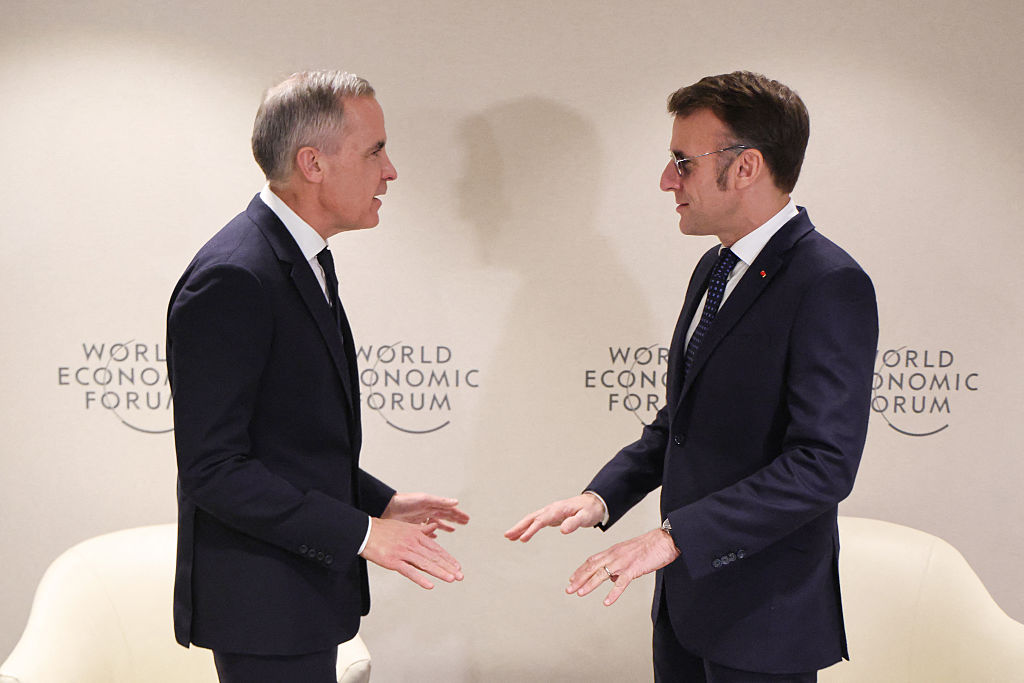
Carney and Macron’s speeches at this year’s World Economic Forum were a definitive statement of this “Far Center” and its limits. All its hallmarks were there. There is the new frankness, with the old Davoisie pointedly put to one side. In a time of general disruption, both the populists and the softer kind of liberal will have to be dealt some home truths. “We know the old order is not coming back,” said the Canadian PM, “We shouldn’t mourn it. Nostalgia is not a strategy.” Macron, flashing a pair of aviators, claimed that “today’s Europeans are too naive” and must now get used to a world “without rules.” There is also a self-conscious bolshiness in defense of centrist ideals, a letting-loose after a decade of supposed liberal handwringing. “But we do prefer respect to bullies. We do prefer science to plotism, and we do prefer rule of law to brutality,” said the French president.
“Globalism” increasingly means a strange inflationary Keynesianism that has banned phones and has all the young people confined to barracks
There was a more profound change as well. Neither speech made any real defense of immigration or diversity. The only theme of both leaders’ remarks was “strategic autonomy.” With America now erratic, says Carney, the middle powers must now forget the old talk of international law and club together in their mutual defense; build up their own capabilities. “When the rules no longer protect you, you must protect yourself,” he argued. This will mean a liberal version of national economics. There will be reshoring and a de-risking of supply chains. Services must now give way to weapons, chips, rare earths. There are nods to FDR and his “arsenal of democracy;” a liberal center with teeth.
Populists preach a doctrine of force and hard power; the establishment now answers back with the same. Strategic autonomy is presented as geopolitical hedging. Really it is a moral project. For all the talk of the great powers using “economic integration as weapons, tariffs as leverage, financial infrastructure as coercion, supply chains as vulnerabilities to be exploited,” the EU is far more neurotic about foreign competition than Donald Trump, and it was happy to use similarly coercive measures against Brexit Britain.
The real meaning of strategic autonomy is to dish the populists through a revival of manufacturing and a selective appeal to patriotism. Shared struggle and hardship will reforge old solidarities; we find a parallel here with how, during Covid, lockdown was celebrated as a means to bring people back together in an age of division.
The dowdiness of this vision is striking. Compare it to what was being defended at Davos less than a decade ago. “Globalism” used to mean cheap things from abroad, the delights of the Cathay Pacific airport lounge. Now it will mean a strange inflationary Keynesianism that has banned phones and has all the young people confined to barracks.
Haven’t we been here before? Joe Biden spoke of reshoring, of manufacturing chips at home, of a rough-and-ready détente over cultural issues in the interests of national reconstruction. He also wore aviators.
Establishment politics is meant to be a defense of “institutions.” But it is precisely these institutions that make strategic autonomy impossible. Overmighty judicial review block development. Climate policies will keep energy costs high. Bloated officialdoms will not be able to execute at speed. Public procurement processes – all of which have a large and growing ESG element – will inflate costs. Western establishments used to be able to discuss a reform to these things. Now, with the new defense of “institutions” in the abstract all of this must be defended to the hilt – anything else would mean a dangerous concession to populism.
In late 2024 Keir Starmer upbraided the British civil service for its inefficiency, but then someone reminded him that this was all sounding too populist, and the proposed changes were dropped. Everything the “far center” believes works against the vision of lean, hard-edged states that can go it alone.
In their hands strategic autonomy would have no meaning. Keir Starmer’s Britain would not use a newfound independence from Washington to settle accounts with the Irish Republican Army; Macronist France will not seize bauxite mines in Africa – even if the “geopolitics” of these countries dictates that this is what they probably ought to do.
Carney and Macron want reindustrialization only in as much as they hope to avert social revolution, but only a social revolution – dissolving bureaucracies, reining in judges – can bring about reindustrialization. “Strategic autonomy”, then, simply means the foreign policy of a Democratic administration, and should one come again these countries would quickly fall back into line. All that would be left is the aviators.






Comments