
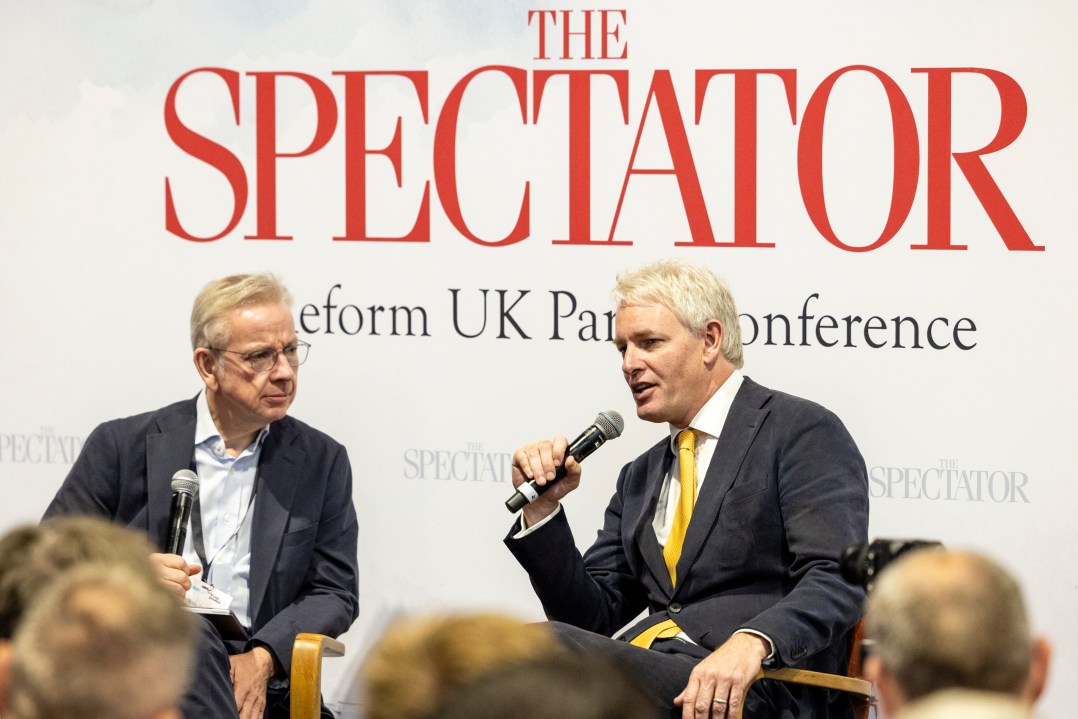
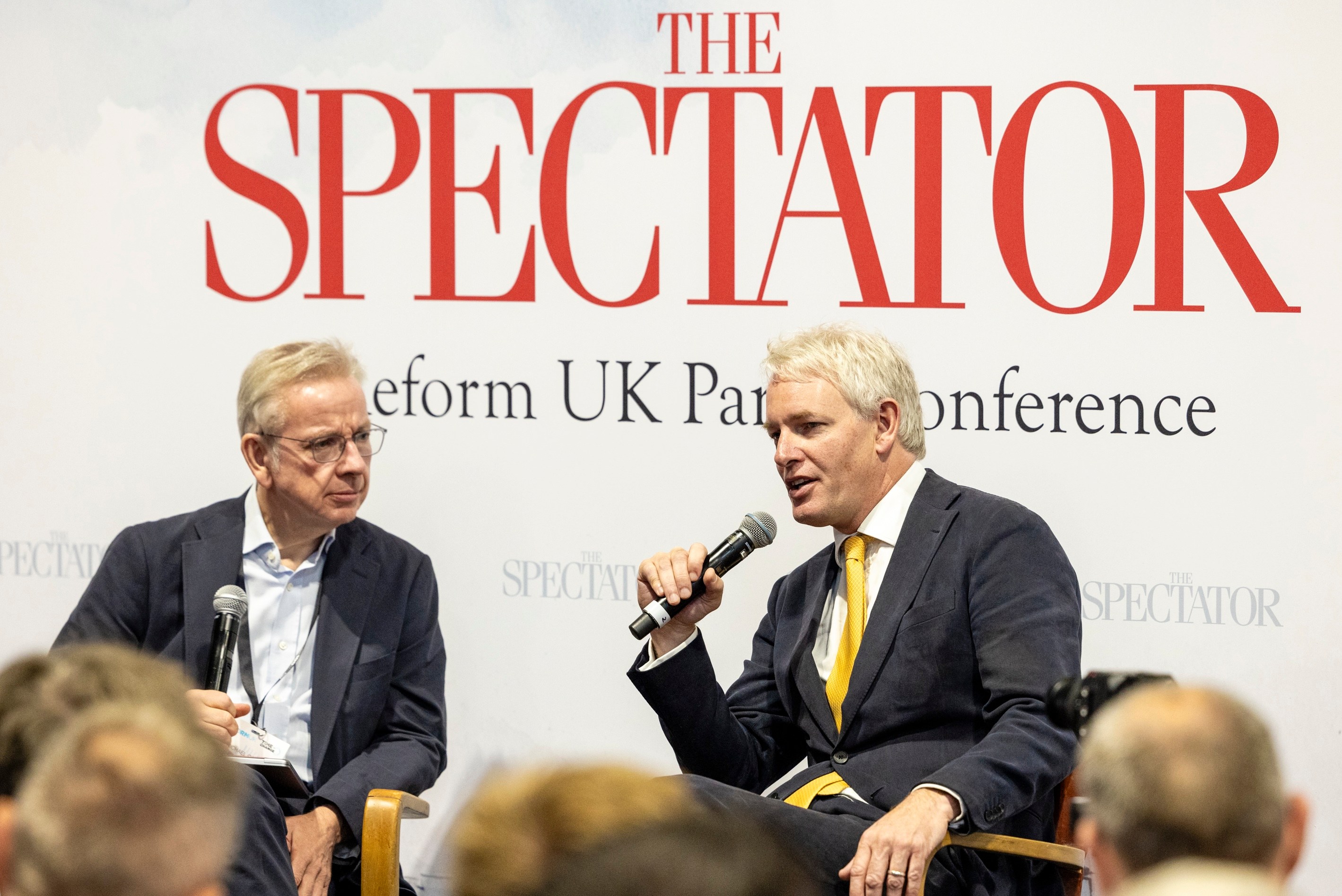
In swoops Danny Kruger. He is a late replacement for Zia Yusuf, who has pulled out due to diary commitments, but he is received in the Spectator lounge at Reform’s conference in Birmingham like he was always on the billing. The room is full. The man who wrote David Cameron’s ‘hug a hoodie’ speech and served as Boris Johnson’s political secretary is accepted by Reformers. No Conservative gambled as much as Kruger in leaving the party. He was the first proper Tory (one whose career was on the up) to switch sides. Reform members appreciate that.
It is almost a year since Kruger left the Conservative party, and he has spent the last 12 months making preparations for what Reform will do in power. Michael Gove begins a live recording of the Quite Right! podcast by asking Kruger to respond to Channel 4’s investigation into Reform – ‘I wish you wouldn’t join Channel 4 and the Guardian and the rest of them in pursuing this frivolity,’ says Kruger – and then asks what a Reform government will achieve in its first 100 days. ‘This country is broken,’ Kruger replies. ‘The institutions of the state are not delivering for the British people. And in consequence, we have a crisis in our economy and a crisis in our security.’ Reform’s first priorities will be detaining and deporting migrants, taking steps to ‘free up the energy supply’, and changing the civil service code.
The bulk of Kruger’s work over the last year has been considering what Reform’s Whitehall will look like. But what he has settled on is not very different to the status quo. Reform wants a politicised civil service – but to the right rather than the left. ‘You have hundreds of senior civil servants who are enormously important in the way that the state works at the moment,’ Kruger says. ‘Permanent secretaries, director generals… chief executives of government agencies. Not all of them need to go… But many of them, I’m afraid, will be replaced. We will identify new people to lead government agencies.’ Michael suggests that Reform will probably need to find 1,000 people to fill various government roles. ‘Expecting to change a few thousand of them doesn’t feel unreasonable,’ Kruger responds.
What kind of people will fill the key roles? Who will be chancellor Robert Jenrick’s economic advisers? Who will be the defence secretary? Reform still hasn’t delegated the portfolio. Kruger says that he has counselled Nigel Farage that the MoD should be led by a modern Robert McNamara, the Cold War American secretary of defence who revamped the Ford Motor Company and then the DoD. ‘My ideal would be someone who’d run a large, probably private sector institution, transformed it, made it effective, made it work,’ says Kruger. And in the important economic positions? ‘That is definitely one for Rob. He’s recruiting people at the moment to help him.’
The state will receive other alterations. Kruger says that Natural England will go, and that Reform will ‘take a torch to Defra quangos’. ‘We are very interested in the plethora of city regulators,’ he adds. Michael asks about the fate of the Office for Budget Responsibility – ‘The OBR we are committing to keep,’ Kruger says, ‘for the time being’ – and unprompted, Kruger hints that the remit of the Bank of England could be clipped. ‘The Bank of England itself is a quango of the state,’ he says. ‘Their independence over monetary policy needs to be reviewed.’
Repeatedly, Kruger tells Michael that the country needs to be ‘saved’
In 2023, Kruger said that his deepest fear was the breakdown of civil order in Britain. He was ‘very, very nervous about what could be coming’. Ultimately, it was this analysis that led him to leave the Conservatives. Kruger says today that while he agrees with many current Tory policies, his old party’s prescriptions are too mild. Repeatedly (and perhaps it is the Christian in him speaking) Kruger tells Michael that the country needs to be ‘saved’. ‘How can we save this country?’ he asks at one point. ‘Only Reform can save us,’ he says later.
This is melancholic language. These are defensive words. ‘We are not revolutionary,’ Kruger says, ‘we are trying to restore good government.’ Do you notice? Kruger does not speak like Zia Yusuf or Richard Tice. He is not gung-ho. Kruger seems to stand alone in Reform in doing his work with sadness, rather than excitable aggression. He would, I think, rather not be here.





Comments