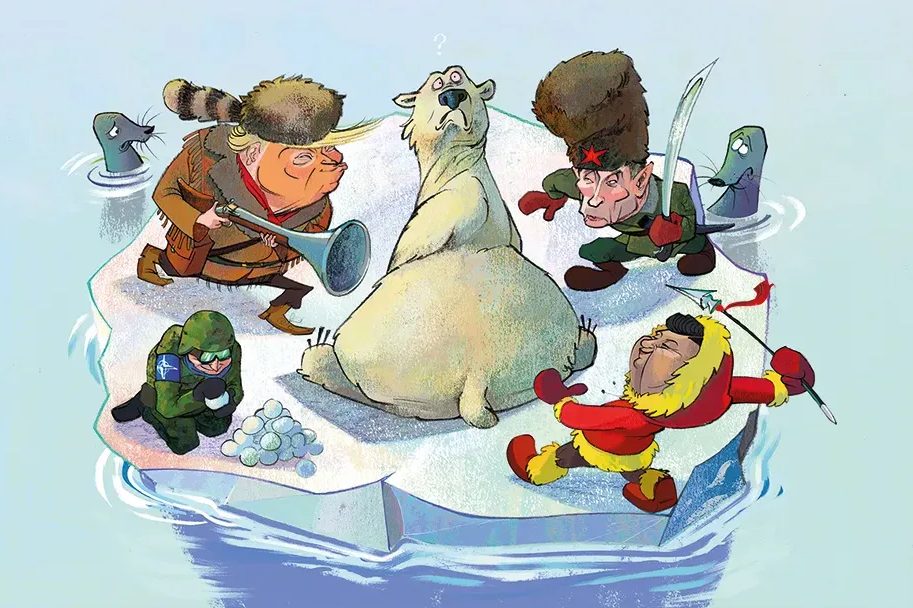
President Trump has returned home from Davos, Switzerland, basking in the glow of his latest diplomatic Houdini act. For weeks, the President made Europe shudder with fear and sputter with rage as he abruptly escalated his demand for a total US takeover of Greenland.
He said he was ready to launch an invasion or reignite a trade war to do it, even in the face of threats that such an act would destroy NATO. On Truth Social, the President shared a post suggesting NATO was a greater threat to America than Russia or China, along with AI slop depicting not just Greenland but also Canada under US dominion.
To pick up some land on an ice sheet and some mineral rights, Trump put a remarkable number of things at risk
Europe scrambled to respond, only to display how pathetic its atrophied militaries have become, and how unready it is to go it alone without American handholding.
Germany, which has the fourth-largest defense budget on Earth, deployed a 13-man unit to Greenland as a show of force. The soldiers then promptly flew back two days later, on a commercial flight no less. At the World Economic Forum, Finnish President Alexander Stubb boasted that his country could certainly defend itself without America, only to immediately backtrack and admit that the Finnish air force cannot even stay airborne without American help.
Then, even more quickly than the crisis broke out, it was over. Mere hours after repeating it onstage at Davos, the President’s demand for total annexation was gone, replaced with a compromise deal that will apparently involve American access to Greenlandic mineral resources coupled with small territorial carve-outs for new American bases. Despite retreating from his stated position, for Trump the deal is another win, another demonstration of how his disorienting, aggressive, maximalist diplomacy can extract blood from a stone. For the Europeans it is another humiliation, another confirmation that, even united, they are unable to shut down the demands of their transatlantic patron. For now, NATO endures.
But appearances can be deceiving. There is something qualitatively different about the President’s latest coup. For ten years, Donald Trump’s statements and actions have put stress on the US-led international system. Now, he may be pushing it to the point of collapse. The US-Europe relationship may have shifted, quietly, from a struggling marriage to one where an unhappy partner has started to plot the divorce.
The President is no stranger to handling allies roughly, but his treatment of Denmark was unprecedented. Of America’s European allies, the Danes have consistently been good-faith actors. After 9/11, more than 18,000 Danish troops participated in the 20-year nation-building effort in Afghanistan. Instead of just providing lower-risk training or security work, Danish troops actively joined combat operations, suffering 43 deaths. On a per capita basis, Danish losses were higher than any NATO member save America. The country lost another seven soldiers when it dutifully joined the coalition occupying Iraq. Denmark has answered Trump’s call for Europe to pay more toward its own security. Over four years, it has given more than €10 billion in aid to Ukraine, an amount equal to about 3 percent of its annual GDP. It has tripled its defense spending since 2015. Last summer, Danish Prime Minister Mette Frederiksen endorsed surging defense spending all the way to 5 percent of GDP – a proportion that would exceed America’s own.
After all that, Denmark was still denounced as an ungrateful freeloader, told it had no right to land it had held for nearly three centuries and threatened with its first hostile incursion since World War Two. For Copenhagen, the feeling isn’t just one of being disrespected, but one of betrayal. But it wasn’t just the Danes who were left feeling abused.
In order to pick up what will, apparently, be a few pockets of land on an ice sheet and some mineral rights, President Trump put a remarkable number of things at risk, including the greatest win of his 2025 trade war. The Turnberry agreement, reached last August with the EU, allowed America to levy 15 percent tariffs on nearly all EU goods while simultaneously requiring the Europeans to eliminate tariffs on industrial goods and give preferential access to American agriculture – in effect, allowing America to impose one-way tariffs on Europe for the privilege of continued access to the American market.
European leaders fumed, yet felt compelled to accept. US Trade Representative Jamieson Greer touted the establishment of a new “Turnberry System” of bilateral trade deals, which would let America exploit its economic size to protect crucial industries. Other experts echoed the view that Turnberry represented the greatest shift in global trade norms since World War Two.
And yet, if Trump had levied the tariffs he was threatening to get Greenland, it would have meant ripping up the Turnberry system completely. The President’s top accomplishment on this signature economic policy would have been thrown out, like so much other garbage. It would have been difficult to revive again.
The President’s diplomatic aggression also imperiled his recent National Security Strategy. The NSS specifies “restoring Europe’s civilizational self-confidence and western identity” as a core US foreign-policy goal (by contrast, the 33-page document never mentions Greenland).
‘America First,’ if it means anything, must mean making the United States safer, stronger, more prosperous
The Trump administration wants a Europe that is well-armed, reindustrialized, consciously western in outlook and pulling its weight in tandem with the US. It’s obvious what needs to happen to bring that about: the victory of right-populist parties in European elections, or the growth of their electoral strength to the point that rival parties incorporate some of their agendas.
But with America as the new bully on the block, Europe’s status quo parties can now strike a pose of aggrieved patriotism, while the anti-immigration, largely pro-US parties on the European right are tainted with a faintly treasonous miasma. In forthcoming elections, they will perform worse and the established parties will perform better – in elections that might mark the last chance for European states to cut back on immigration before it passes a demographic tipping point.
For a sign of how this could all end, one need only look at the other diplomatic storyline unfolding in the week of Davos. For decades, to the extent that Canada has had a national identity at all, it has been to see itself as like America, only far more liberal. As much as it might have disliked Trump’s bluster, Canada dutifully renegotiated the North American Free Trade Agreement when President Trump asked, joined in with sweeping tariffs on China and firmly stood within America’s geopolitical orbit.
But over the past year that solidarity has vanished, thanks to the President’s prior act of baffling aggression toward a longtime ally, when he spent weeks bullying Canadians on the need to become America’s 51st state – then threatened economic coercion to make it happen. That rhetoric fueled a 25-point comeback for the governing Liberals and gave Justin Trudeau’s replacement Mark Carney an upset victory.
A year of back-and-forth trade war followed, until just days before the World Economic Forum, when Carney struck a trade deal with the People’s Republic of China. One hundred percent tariffs on Chinese cars, adopted in lockstep with America, were abolished, and in return China revoked its own tariffs on Canadian agriculture.
Carney hasn’t minced his words about why he struck the deal. China, he says, is a “more reliable” country, more predictable in its actions, more likely to stick to a deal once made and decidedly less likely to make random threats of annexation. While the old America-led order had long offered “open sea lanes, a stable financial system, [and] collective security,” that system is now in “rupture” – and Carney leaves no doubt about whom he blames.
“Great powers have begun using economic integration as weapons, tariffs as leverage, financial infrastructure as coercion, supply chains as vulnerabilities to be exploited,” Carney said at Davos. “You cannot live within the lie of mutual benefit through integration, when integration becomes the source of your subordination.”
At the risk of stating the obvious, a China-aligned Canada, or even a neutral one, is a far worse blow to American well-being than anything related to Greenland, even if the Chinese somehow bought the entire island. Similarly, whatever resources that may lurk beneath Greenland’s mile-thick ice sheet are dwarfed by the harm that would result if Europe collectively comes around to Canada’s view that America is an untrustworthy partner.
The simple truth is that a rich continent of 700 million, even an over-the-hill one, matters infinitely more than an impoverished island of 50,000.
The consequences wouldn’t be immediate: Europe really is militarily and economically dependent on the United States and will remain so for some time. But a sufficiently jilted Europe may finally decide to rearm, reindustrialize and make new deals, not to preserve its ties with America, but to escape them. More dominoes of American dominance could fall.
If relying on American trade and the American dollar means vulnerability to a territorial shakedown, the rational next step is clear: nations ought not rely on American trade or the American dollar.
President Trump sees himself as the one creating a new global order on trade, on security, on migration and more. But there cannot be a global order without there first being order: durable agreements that enshrine America’s role and the relationship of other countries to it. The President’s rough handling of Denmark doesn’t just make America look unfriendly. By throwing out a hard-won trade agreement before the ink is dry, ignoring his own National Security Strategy and abruptly targeting the territory of an Article 5 signatory, the President makes America look erratic.
Preserving America as a global superpower means accepting that every negotiation is not a one-off event
And that is how the Greenland strategy could imperil Trump’s legacy. America’s superpower status has never been about mere size. It has also been about dependability. Nations rely on the US dollar because America will not default, hyperinflate or fall into revolution. They look to American trade because America will not cheat them the way China often has. They rely on America’s security blanket not just to save money, but because they believe that blanket is real.
“America First,” if it means anything, must mean making the United States safer, stronger, more prosperous and more stable. A trade war that blasts apart America’s military alliances, drives nations toward China and destroys the viability of foreign political allies does little for that. Preserving a robust coalition of economic and military partners, on the other hand, does a great deal.
The President’s tactical style and willingness to throw America’s weight around makes him spectacular in one-off negotiations. But preserving America as a global superpower also means accepting that every negotiation is not a one-off event. America will deal with its allies over and over again. It must be willing to treat them as friends. For all their pouting and sneering, the Europeans have proven themselves entirely willing to exist in America’s shadow. They ask only not to be humiliated.
The Greenland spat mercifully ended with de-escalation instead of a blow-up. But the President’s next three years will go better if he doesn’t see his maximum-pressure tactic as a tool to be used over and over again.
The American empire will eventually end, like all empires before it. But it ought not to end like this, in 2026, scuffling over a heap of hyperborean ice.
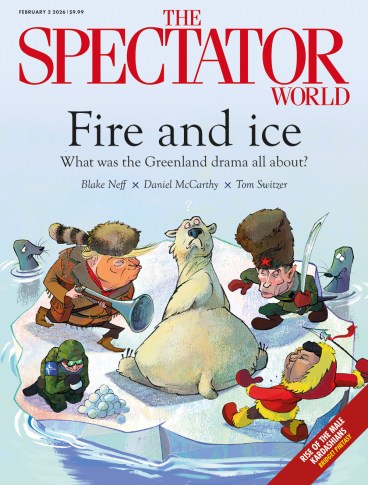
This article was originally published in The Spectator’s February 2, 2026 World edition.


Comments