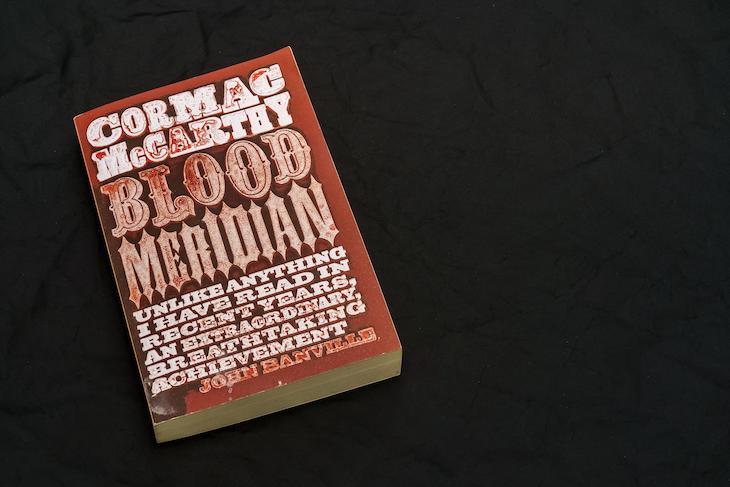
“In the dawn there is a man progressing over the plain by means of holes which he is making in the ground…he enkindles the stone in the hole with his steel hole by hole striking the fire out of the rock which God has put there. On the plain behind him are the wanderers in search of bones … He strikes fire in the hole and draws out his steel. Then they all move on again.”
Cormac McCarthy, Blood Meridian or the Evening Redness in the West
One evening this past summer, the sun sets on the blasted playing fields of Britain as another day of merciless heat draws to a close; the air loses its sting and half-light sets in. I sit, book in hand, taking notes in the margins, far away. Suddenly anxiety rises in my chest and the scorched world narrows. My breath catches; I am afraid. Yet as quickly as it closed in, it is gone. What did I fear? Where did it come from? And where has it gone to wait? My eyes return to words underlined in the dog-eared paperback: “His meridian is at once his darkening and the evening of his day.”
Cormac McCarthy’s Blood Meridian confronts us with the frightening possibility that violence and domination are not inhuman aberrations but among the most primordial conditions of our world. McCarthy gives this contention voice through the nightmarish Judge Holden. More disconcerting even than his atrocities on the page are the uncomfortable elements of truth which might lurk in his dark worldview. “War”, the Judge proposes, was not invented by man; “it waited for him”.

In the figure of Holden I begin to comprehend my fear as more political than personal. It feels as though we who seek to practise politics increasingly find our most basic assumptions about the task torn loose from their moorings. Confronted with a political world of twilight, with the order we inherited losing its power to orient us, I am troubled by the question: what is the statesman to do?
Strange Leviathans
The domestic post-war order and its international counterpart were not the same thing, but both can be traced in part to a determination that political conflict should never again become existential. The generation which built them lived through economic collapse, political disintegration and the brutality which followed. At home came expanded social security, commitment to human rights and political inclusion. Internationally, laws and institutions placed guardrails around statecraft and war, while supranational blocs and open trade gave states avenues to compete without their interests becoming aligned with one another’s destruction.
Today, though, the eyes which had seen Dachau and Buchenwald and Nanjing have almost all been shut forever. The thing continues to cast a light, yes, but it is only a pale glow now. Elections continue, the ‘international community’ meets still, the fraying bonds between people and state keep us suspended above the state of nature. Collapse is not thundering around us; the old order remains, but it is no longer illuminating the road which lies ahead.
The promise that a fading day can become high noon again if we will only embrace the past is but a pleasing fiction. The settlement was made under historical conditions which cannot simply be restored. Preserving its core values requires recognition that its existing architecture may never return to its former glory. We are in a world where John Gray’s ‘New Leviathans’ cast their shadows across rival modernities: states that become both stronger and stranger. No universally recognised moral order remains.
Cormac McCarthy’s Blood Meridian confronts us with the frightening possibility that violence and domination are not inhuman aberrations
Multiple crises of modernity come to a head around us. Demography crashes headlong into the post-war welfare state, as ageing populations lean on fewer workers. Large-scale migration has already convulsed the politics of the West, with pressures only likely to rise as regional wars and climate change bite. Hard power has returned as the primary currency of international relations; preparation for war is once again a fact of European political life. Even the strongest Western economic settlements strain as weak productive capacity makes record debt piles appear increasingly unassailable. Artificial intelligence upends our most basic understandings of everything from office work to particle physics, holding at once promise and privation. These incoming storms collide, each making the others harder to navigate. All force choices which the assumptions of the past allowed us to defer.
The relative abundance and security of the old settlement provided slack in which many competing demands could be postponed. That luxury is dissipating before the eyes of today’s political class. We are left with stark contests over power which cannot be dissolved into proceduralism and technocracy – they demand political judgements about what must be protected, what can be surrendered and who will bear the cost. Within the cushioning of abundance, the old settlement saw entitlements – both financial and justiciable – mount one atop the other. An ageing country in need of rapid rearmament on the cusp of new technological epoch cannot forever treat every one of these as untouchable while tax and public debt rise inexorably. Something has to give; the statesman’s task is to be willing to say what that will be, bear the cost that comes with it and lead the country to a judgement about what the common good requires.
This must be done in the face of institutions that have calcified, been captured by special interests and clung like drowning sailors to shibboleths from bygone times. Their outward forms are maintained even as they grow less able to serve their purpose. The people watch these husks shambling on until the decay of the form drags the purposes into question.
At its post-Cold-War moment of triumph, the liberal consensus increasingly mistook the containment of conflict for something closer to dissolution. Politicians came to treat politics as little more than argument, compromise and repetition. The new world makes the insufficiency of this account impossible to ignore.
The Soul at Hazard
Confronted by a world the political children of that age are so little equipped to handle, it is easy to despair. In No Country for Old Men, McCarthy shows us Sheriff Ed Tom Bell facing a threat he fears he cannot comprehend, given form by the emotionless hitman Anton Chigurh. In the Coen Brothers’ pointed but faithful adaptation, Bell concedes that he feels “overmatched”. Though his office requires him to contest this threat, Bell cannot bring himself to “put his soul at hazard”.
Maybe Bell is right; maybe he, maybe we, cannot contend with it. At times the forces gathering around us seem so asymmetric to the defence we are willing to mount that I wonder what is to be done. Withdrawal into the frivolity of the daily news cycle or cynical isolation can be alluring; at least then the soul can be taken intact in the retreat.
Bell’s uncle Ellis, a former lawman shot in the line of duty, answers with a rebuke: “What you got ain’t nothing new. This country’s hard on people.” We are not uniquely cursed; the world was broken long before we found it. And then: “Can’t stop what’s coming. Ain’t all waiting on you. That’s vanity.” History is not waiting on us to alter its course. The sun sets and we have our choice of what to do.
Blood Meridian confronts us with the possibility that the world is made wrong; the Judge seeks to turn all around him into instruments of this creed. No Country asks what those charged to set a watch might still do in the face of that. Chaos and conflict are not simply the manageable residue of an otherwise rational cosmos. The movement towards order and liberal ideals – the long arc of history toward justice – is neither natural nor to be expected. McCarthy’s work has often been read through the lens of Gnosticism: holding that creation itself was malign, but something of the divine survives as a spark within the human being. That is why carrying fire becomes an act of resistance in his work.
The task is to act upon the spark. It is fragile, irregular and must be cultivated and protected. It is an unnatural – or at least non-guaranteed – human achievement against the grain of the world. This need not be terrifying; it can be freeing.
The Courage to Govern
Some in politics would have the statesman be a steward, holding fast to that settlement which served so well when it served. But the world demands the new when the old can no longer be preserved. The truer role would be the pathfinder, carrying the fire without certainty of the route, no prophecy to follow. It is purpose which propels us, the future we seek, but this is undertaken in the face of the most radical uncertainty.
As for the fire itself, my mind is drawn again and again to moral courage, the willingness to act upon what we judge right when there is a cost to it. It means standing by what we believe is truth when the world bends us towards consensus, while having the humility to admit when our path has proven wrong and change direction if the way is lost. It is the fire, and where we carry it, rather than any particular path to which we owe fidelity.
We must be ready to speak harsh truths and challenge dogma. That may mean telling our own side what it may not wish to hear: that some achievements of our rivals, such as the success of England’s schools, are worth building on; or that entitlements we cherish cannot be exempt from the hard choices we demand of others. It could also mean confronting rapacious vested interests, whether by restructuring and taking back control of failing public utilities, or changing the incentives of digital platforms that turn the atomisation and addiction of British people into profits booked in another country. Statesmanship is not a blanket preference for preservation or rupture; it is the judgement to know which the purpose requires.
We must be honest with the people about what needs to be done so we may hand on a world to those still to come, but bold enough to sketch a way untravelled. That might mean making the argument that we must all bear the cost of rearmament in a harsher world, but only on the condition of ruthlessly reforming a parlous defence establishment so that the sacrifice will then actually buy that which will keep our children safe. The risks we decline to take are not simply deferred; they accumulate as debts, fiscal and metaphorical, coming due beyond the political horizon. None of these are particularly complicated ideas, but they are difficult to practise, which is why politics has long been full of perfectly intelligent people ill-equipped to carry fire.
Blood Meridian confronts us with the possibility that the world is made wrong
Democracy cannot be protected by binding the exercise of power ever more tightly through procedure, making government generally impotent lest forces we fear come to control it. The powers needed to govern must be ones we are prepared to see our opponents wield should they win the people’s mandate. Democracy is eroded when citizens learn that their votes cannot change things, that the power they believe was theirs to give sits elsewhere. The essential boundary is that they must always remain free to take that power back, and no mandate may remove the freedoms that make this possible. The institutions that guard those freedoms – from our national broadcaster to parliament itself – are owed protection, not unfettered deference; if they venerate their form at the expense of their purpose, they will find a public with little appetite to defend them.
Some contests cannot be reduced to polite argument. Where that is true, the political man or woman in the arena has to comprehend hostile purposes and organise power to defeat them.
Yet even when worldviews are irreconcilable, the adversary – to borrow from Bobby Kennedy – still shares with us the same short moment of life and is a person whom other people love and need. The object is the defeat of their project, never to deny the humanity of those who advance it. This is not a plea for politeness; cowardice, dishonesty or moral repugnance should be named more plainly than many now allow themselves to. The statesman in the gathering dark has to accept the hazard, without permitting the conflict to take possession of the soul.
Something this fragile cannot survive on private virtue alone; it requires vessels – institutions, doctrines and cultures that recognise moral courage, reward it and make it less lonely. If the person who speaks up is crushed while obeisance is promoted, the inherent values are revealed regardless of what is claimed. The inverse is also true: one act of bravery makes the next more plausible, more fires are lit. Many of the old vessels are now broken. We should not discard them casually, but the vessel without the fire is nothing worth worshipping; the task is to create something anew, better made to hold it.
Blood Meridian closes with the Judge imperious: “His feet are light and nimble. He never sleeps. He says that he will never die. He dances in light and in shadow.” Resistance to his dark creed appears futile.
No Country offers us instead an elegiac dream of Bell’s dead father. He sees them riding through a mountain pass among snow and darkness; the father rides ahead “carrying fire in a horn”, visible only from the pale light inside of it. He understands that his father is going ahead to “make a fire somewhere in all that dark and all that cold”, and that he will be there whenever Bell arrives. I see this as the role of the statesman in the twilight: not to turn night back into day, or defeat the darkness entirely, but to ride on ahead carrying that fire, creating places of warmth and succour where we might find one another along the way – in the full knowledge that night will not wait for us, but others may come and seek out the fire we carry in the dark.



Comments