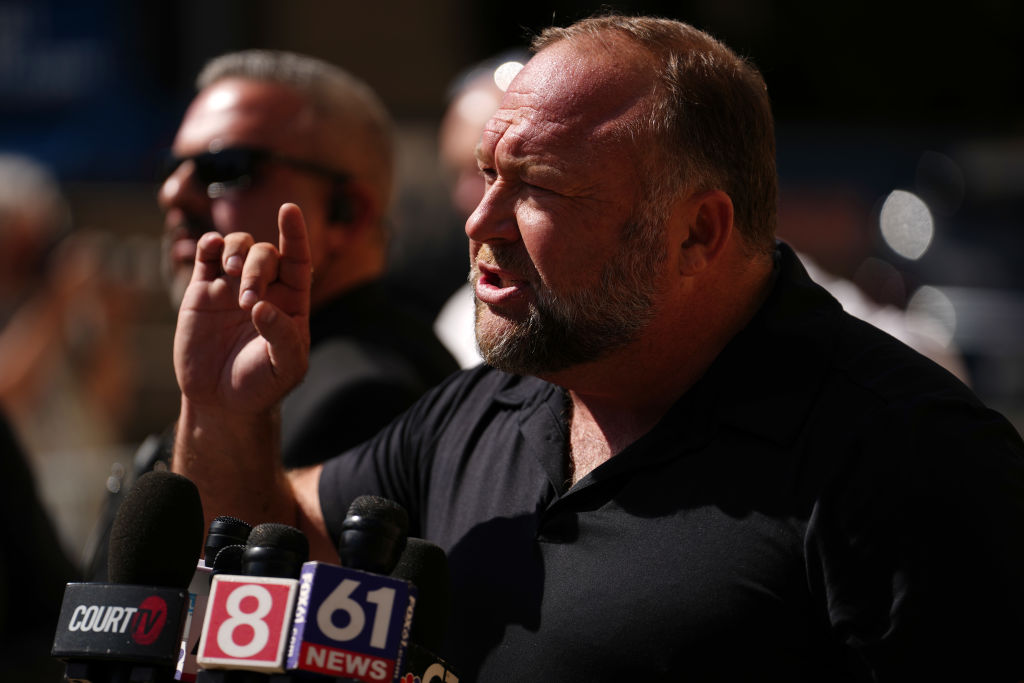



American conspiracy culture is a tradition with a long lineage, though not a simple one. It runs through the John Birch Society and Mae Brussell, through Bill Cooper and Alex Jones, into QAnon and beyond. There are other tributaries – black nationalist suspicion of COINTELPRO, evangelical end-times theology, militia movements, UFO subcultures – but one dominant current exists in every conspiracy: it speaks from below. The conspirators operate as the hidden orchestrators of surface reality. The deep state, the intelligence agencies, the Fed, the media – at worst, Jews – all sit above normal people, controlling their world. The people telling these stories understand themselves as excluded from power.
For decades conspiracy culture circulated through pamphlets, shortwave radio, VHS tapes, xeroxed newsletters, message boards, prisons and schools. You would never normally find it in the White House briefing room. But the Trump administration has fused outsider language with governing authority. “Deep state,” “rigged systems” and “pedophile networks” moved from the fringe to the podium. That has created a tension the tradition hadn’t faced. Populist conspiracy culture defines itself against power. But what happens to a tradition built on opposition when the opposition wins?
What happens to a tradition built on opposition when the opposition wins?
Cooper understood that instability. A shortwave broadcaster who wrote Behold a Pale Horse, he is remembered for predicting in June 2001 that a major attack on a US city was imminent, and that Osama bin Laden would be blamed. His book has never gone out of print. What he is not remembered for is his distaste for Jones, a fellow broadcaster – but it’s important.
Cooper opened every broadcast of The Hour of the Time by telling his listeners not to believe anything they heard on the show. Not from him, not from any other shortwave host, certainly not from the mainstream media and definitely not from the president. Listen to everyone, read everything, believe nothing until you can prove it yourself. This was the structure of Cooper’s method. Cooper positioned himself as a researcher, not a prophet. Conspiracy thinking, in his world, was work. It disciplined both the speaker and the audience. If you were too lazy to do the work, you would march into the New World Order as a docile slave. This method didn’t produce reliable knowledge. Cooper was wrong about plenty of things. “Do your own research” often led his listeners to confirmation loops rather than verifiable truth. But the method contained one destabilizing feature: it could be turned against him. When Cooper recanted extraterrestrial documents he had promoted, saying they were likely government disinformation, his audience shrank.
Jones represented something different, and Cooper identified it early. As Mark Jacobson recounts in Pale Horse Rider, his biography of Cooper, Cooper’s dislike for Jones went beyond professional rivalry. He believed Jones represented a genuine threat. The breaking point came on New Year’s Eve 1999, when Jones narrated the Y2K scare as though the apocalypse were arriving in real time – cash machines failing, geopolitical chaos unfolding. It was pure adrenaline. Cooper’s response was blunt. Jones had done no research nor sought any truth. He was making it up, using fear as entertainment.
Cooper aired a broadcast titled “Alex Jones, Liar” barely a month before his death in late 2001. Arizona police had attempted to arrest Cooper on a charge of aggravated assault and endangerment after an altercation with a neighbor. There was an exchange of gunfire, a deputy was hit in the head and Cooper was fatally shot. When a local newspaperman told Jones that Cooper had spoken for years about going out in a blaze of glory, Jones’s audience rejected it. The death had to be a conspiracy. In the newer posture, everything is. Both Cooper and Jones believed in secret governments and hidden controllers. The difference between the two comes down to what the conspiracy broadcaster owes his audience. Cooper’s standard admonition placed a burden on the listener. Jones’s posture removed the burden.
Cooper’s model scales poorly. But it did produce a small, committed audience of autodidacts. There’s friction in Cooper’s call to do your own research, however factually wrong the conclusions may be. Jones’s posture, on the other hand, scales beautifully. Fear translates across every medium. Intensity wins over verification.
This is why the Trump-era fusion – suspicion of authority by those in authority – was possible. A tradition that retained even the pretense of self-scrutiny would have had a harder time exempting a new authority from suspicion. But the Jones mindset cares only about spectacle. When internal suspicion emerged in the Jones model, it could be reframed as betrayal rather than inquiry. There was no looking inward, no scrutiny of one’s own beliefs. But the fusion produced an unstable compound. Conspiracists must be outsiders. If their concerns are found in presidential speech, the tradition must split. One version accommodates power, policing the boundary of acceptable suspicion. The other version seeks a new outside.
Candace Owens is testing that boundary. While at the Daily Wire, she promoted suspicion of elite cabals and defended Kanye West after he made anti-Semitic remarks. Controversial, but aligned. Since leaving she has pressed further, turning suspicion toward figures that are not external to the coalition that once platformed her. She followed Cooper’s logic: pursuing suspicion wherever it led. Whether she knows it or not, she represents one of the last stands of right-leaning conspiracy theorists. Cooper’s funeral drew 50 people. His method, flawed as it was, imposed limits because verification is slow and slowness constrains reach. The post-Trump version has no such constraint. The insider conspiracist is rewarded with proximity to power. The outsider variant will be rewarded with audience growth through escalation. Whether they can ever accommodate each other is the question, and so far the evidence is not encouraging.




Comments