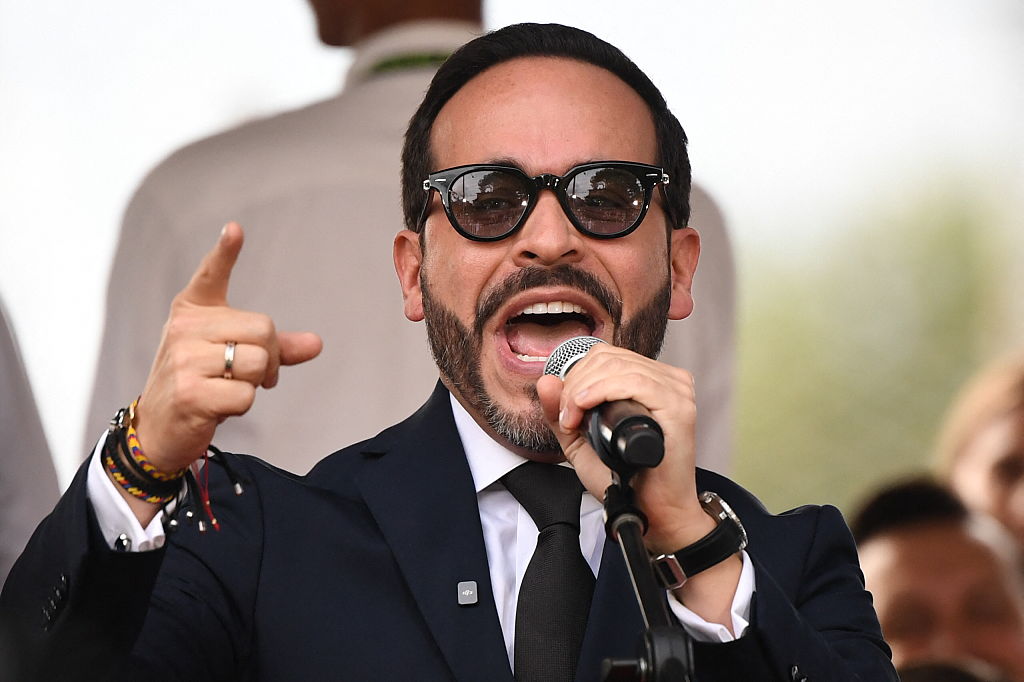
It is another sweltering afternoon in Washington, and the room at the Atlantic Council is filling with businessmen and diplomats for a speech already ten minutes late. José Manuel Restrepo, Colombia’s vice-president-elect and a former finance minister, is no stranger to the venue: since last fall he has been a senior fellow at the Atlantic Council. But the think-tank polish sits on top of a crisis back home.
In June, the right-wing outsider Abelardo de la Espriella won Colombia’s presidency by a whisker – some 250,000 votes out of 26 million – beating the chosen candidate of the outgoing president, Gustavo Petro.

Petro, the country’s first leftist leader and a former guerrilla, has refused to accept the result. He alleges “algorithm manipulation” and, early on, blamed the State of Israel – a foe since he broke off relations over Gaza – for his man’s defeat. International observers, among them the Colombian-born Senator Bernie Moreno of Ohio, have found nothing behind the claims.
With relations souring, de la Espriella froze the transition from his own side, accused Petro of mounting a coup and – though he will not take office until August – urged the serving armed forces to disobey the sitting president. A handover both sides have walked away from, even as the clock runs to August 7.
That’s why the cabinet-in-waiting is in Washington. The “Patria Milagro” (Miracle Homeland) delegation has run a four-day gauntlet: the World Bank, the IMF, the Inter-American Development Bank, the US Development Finance Corporation, the Treasury and congressional calls on the Miami Republican María Elvira Salazar among others.
The most telling was a 45-minute audience with the Secretary of State, Marco Rubio. Beneath the diplomatic wrapping, what the delegation wants is a guarantor – an insurance policy on a victory Petro will not concede, sought in the one capital whose word still settles such things.
On stage, Restrepo admitted that his team has spent months gathering the state’s information through back channels and completed some 80 percent of the handover – conducted around the sitting government rather than with it.
A figure close to the president-elect told me the delegation also courted private investors and infrastructure funds, promising fiscal discipline, legal certainty and long-term foreign money for energy and logistics.
There is something almost medieval in the spectacle: a newly elected government traveling to the imperial capital to have its crown blessed
Nothing captured the visit better than Restrepo’s offer on Venezuela. Colombia, he told the room, could become a “platform for the democratization of Venezuela” in partnership with Washington – importing Venezuelan fuel, perhaps, now that the United States has removed Nicolás Maduro. Here was a government volunteering as an instrument of American regional strategy three weeks before taking office.
There is something almost medieval in the spectacle: a newly elected government traveling to the imperial capital to have its crown blessed. Europe is nowhere in the story. The Western Hemisphere is sorting itself back into spheres of influence, and Latin America’s new right is lining up for a place in Washington’s.
This is the age of the “Donroe Doctrine” – in which legitimacy is brokered on the Potomac. Colombia’s incoming government looks to Washington for its guarantee of power rather than to its own institutions. It fits a pattern: Trump has cultivated El Salvador’s Bukele, Ecuador’s Noboa and Argentina’s Milei, backed de la Espriella – who holds US citizenship – and let Senator Moreno cultivate a personal rapport with him.
Restoring the relationship after Petro’s rupture is rational statecraft. But de la Espriella ran on sovereignty, and the first pilgrimage of his presidency-in-waiting was to the State Department. On August 7, Bogotá will show how smoothly the handover goes, but the courtship has already happened in Washington.

Comments