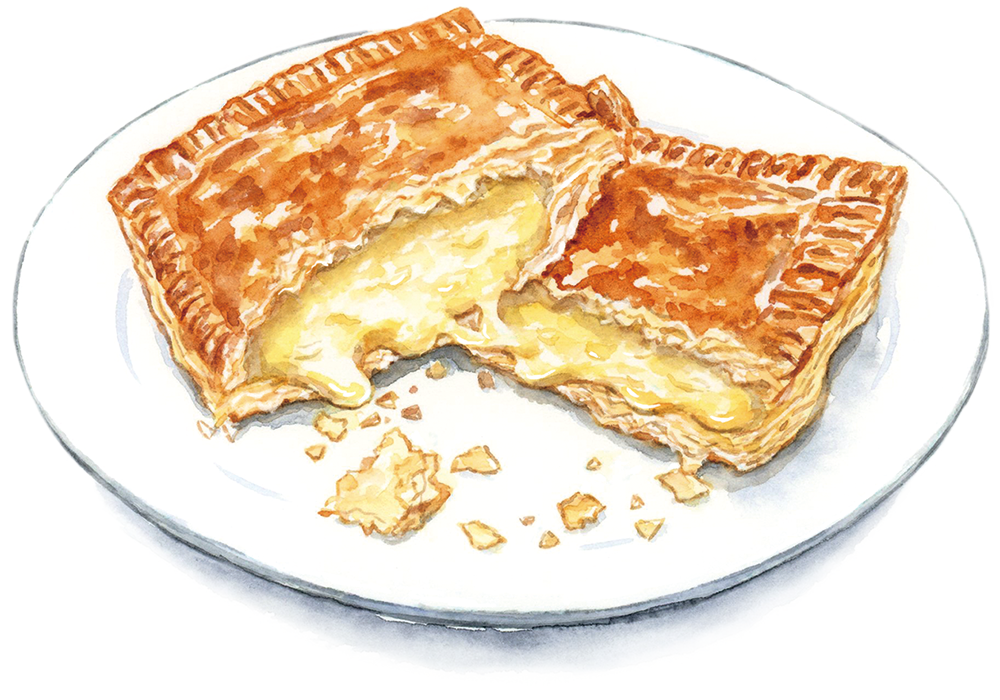

‘That’s not a pasty!’ my husband declares loftily, eyeing up what most definitely is a veritable clutch of cheese and onion pasties emerging from my oven. Handsome, puffed up, golden brown (the pasties, not the husband), filled with a cheese, potato and onion filling, contents threatening to splurge. The steam rises from them like in a cartoon, almost beckoning us towards them.
‘Oh, OK,’ I reply, sweetly. ‘I shan’t trouble you with them.’ He backtracks. No, no, perhaps he was hasty. What did he know about pasties? Shouldn’t he just try them anyway?
Crisp, light, golden pastry filled with soft cheesy mash and mellow onions
Normally my husband and I are simpatico when it comes to food, not least because we were both brought up in the north – but here our paths diverge, literally. While I grew up in the north-east, he grew up in the north-west. For me, rectangular, puffed cheese and onion pasties were a mainstay of my childhood, a staple of school dinners and unpretentious bakeries. For him they were unknown. For me, these are pasties.
But I do see where he’s coming from. These cheese and onion pasties are a whole different beast to the Cornish pasty. Cornish pasties are cubes of potato, swede and beef folded inside a lard-and-butter shortcrust; all the ingredients are raw when baked, and the pasties are shaped into distinctive half-moons, with crimped edges.
With these cheese and onion pasties, the potatoes and onion have been cooked before baking, then mashed together with the cheese to create a smooth, soft filling; the pastry itself is puff, and they’re rectangular, not half-moon, pressed together with the tines of a fork. Now, some will argue that, regardless of its shape or contents, a pasty should be made from a single, continuous piece of pastry which is folded over, but I’d argue that those are, in fact, turnovers. Anyway, whatever you call these, they are delicious.
If you weren’t lucky enough to see them once a week in the school dinners rotation, you may nonetheless have encountered these cheese, potato and onion pastries in Greggs, where they have their own cult status, even if you knew them as something else. In 2017, Greggs realised that some of their pastries had different names depending on where the shops were located. In branches in north-east England these had been called pasties, but in a bid to simplify matters the bakery chain streamlined its terminology, and the cheese and onion pasty became a generic cheese and onion bake.

Well, not on my watch. We will be calling this unassuming-looking delicacy by its correct name. Now, I’m not sure I need to give the hard sell on crisp, light, golden pastry filled with soft, cheesy mash and mellow onions, melting and oozing – but for the pasty sceptics among you, let me justify the various constituents.
Puff pastry is the correct choice in this particular dynamic: it complements the thick filling better than a more robust shortcrust would. The mash acts as a (delicious) glue, just enough to bind the onion and cheese together. I like the onions cut long and cooked until soft, while the cheese should be sharp, mature cheddar, and generous in quantity. That teaspoon of English mustard is a must even if you don’t like mustard: it just makes the cheese taste cheesier.
I always think there’s something rather charming about a fork-tine-pressed pastry, the egg glaze pooling and burnishing in the indentations, but perhaps it simply appeals to my lack of finesse. Either way, the egg and fork technique is a far more reliable way to seal puff pastry than crimping is. Make sure you cool the filling before stuffing the pasties: that way the pastry won’t melt, the filling will stay put, and the finished pasty will keep its shape – but the cheese will still melt and ooze within its confines as it bakes.
As for the husband and his opinions, he had less to say about the ‘correct’ classification of savoury bakes halfway through his first cheese and onion pasty, and was eyeing up the rest of the batch… Funny, that.
Serves: 6
Hands-on time: 15 minutes
Cooking time: 25-30 minutes
- 300g floury potatoes, peeled and cubed
- 30g salted butter
- 1 large onion, peeled and sliced
- 150g strong cheddar, grated
- 1 heaped tsp English mustard
- 2 sheets of puff pastry
- 1 egg yolk
- Boil the potatoes in a large pan of salted water for 15-20 minutes until soft. While the potatoes are cooking, melt the butter in a small frying pan and gently fry the onions for 5-10 minutes until they are soft and transparent, but without colour.
- When the potatoes are cooked, drain and mash them, and then add the cooked onion and grated cheese. Season well, stir the whole mixture together, and leave to cool.
- Preheat the oven to around 220°C/200°C fan. Roll out the two sheets of puff pastry and cut each sheet into six equal rectangles. Divide the potato mixture equally among six of the 12.
- Brush the edge of each filled rectangle with egg yolk, and top with one of the remaining rectangles of pastry, creating a lid. Use the tines of a fork to press down and seal the edges of each pasty. Glaze the completed pasties with the
egg yolk. - Place the pasties on a lined baking sheet, and bake for 25-30 minutes until golden and puffed.
Join me for a couple of upcoming gastronomic trips – Spring at Swinton Park and Truffles and Trattoria in Rome
Go to spectator.co.uk/tastings for more information
The Spectator in the Dales; A taste of spring at Swinton Park Hotel


Comments