
George W. Bush’s war haunts Donald Trump, who is now calling the Iranian operation a “little excursion”. But Iran differs from Iraq in one significant way: Bush spent years fending off accusations that he had invaded for oil, whereas Trump wholeheartedly embraces the idea. In fact, he doesn’t even need to invade a country to get oil flowing.
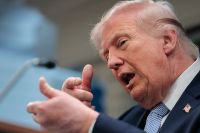
“I will not allow a terrorist regime to hold the world hostage and attempt to stop the globe’s oil supply,” he said. “And if Iran does anything to do that, they’ll get hit at a much, much harder level,” he said at his golf club in Miami, Florida, last night. As well as declaring that the war is “very complete, pretty much,” Trump explained that he is “thinking about” taking over the Strait of Hormuz and using the US Navy to protect shipping. The Strait – through which a quarter of the world’s oil moves – is effectively closed after Iran threatened to sink passing vessels.
Oil will no doubt be discussed when Trump meets Xi in Beijing at the end of this month
Trump’s words, spoken just before markets closed, were oil on troubled waters. US stocks immediately regained their earlier losses while oil futures, which had surged above $119 over the weekend, fell below $90 a barrel. At his State of the Union address last month, Trump boasted about cheap gas prices. He knows that his greatest political danger is at the pumps. This is why he ordered that an additional 100 million barrels of oil would be extracted from a now-supplicant Venezuela, although it’s unlikely the country has the infrastructure to meet that demand.
Can the US Navy really defend every tanker in the Strait? Yesterday Trump boasted that Iran’s “navy is gone. It’s all lying at the bottom of the ocean – 46 ships. Can you believe it?” It’s unclear whether we can. Are all the small, swift attack boats that Iran uses to harass tankers gone as well? The Revolutionary Guard still has some stockpiles of rockets, drones and missiles that it can fire at vessels from shore. Trump is deploying a third aircraft carrier strike group to the region – the USS George H.W. Bush – just to make sure of American dominance.
These days, Trump rightly commits little of Washington’s might for free. When asked if he was thinking of seizing Iran’s oil industry just as he has Venezuela’s, he said: “People have thought about it, but it’s too soon to talk about that.” In public, at least. Perhaps there will be a fee on ships that want to pass through US-defended waters. But this huge US naval presence will serve another purpose: clamping down on the shadow fleet that supplies China with black market energy.
“We’re really helping China here and other countries, because they get a lot of their energy from the Strait. But look, we have a good relationship with China. It’s my honor to do it.” President Xi may have detected a twinkle in Trump’s eye – it’s an honor the Chinese leader knows he will end up paying for. China imports an estimated 90 percent of Iran’s oil supply at a steep discount thanks to US sanctions. Around 50 Chinese-flagged ships are currently unable to enter the Strait.
Oil will no doubt be discussed when Trump meets Xi in Beijing at the end of this month. By then, Trump may have a stranglehold on Iranian production – just as he has on Venezuelan oil. China imported around 75 percent of Venezuelan oil in 2025 but exports to Beijing have fallen by three quarters since Nicolás Maduro’s rendition.
There are a dizzying number of geopolitical factors at play. Trump spoke to Vladimir Putin yesterday morning and later at his press conference said he was going to remove oil sanctions on some countries, although didn’t specify which ones. “We’re going to take those sanctions off until this straightens out. Then, who knows, maybe we won’t have to put them on – there’ll be so much peace.” Reuters reports that Trump may ease sanctions on Russia. If he does, the usual shrill voices will accuse him of capitulating to a dictator that he admires. But Trump knows that to wean the Russian economy off war with Ukraine, Putin needs an alternative source of revenue. And this will be a source controlled by America. If it works.
While Trump claimed that action against Iran will be over “soon, very soon,” in all likelihood the fighting will shift to the Strait. A war to defang Iran and for regime change has quickly morphed into one of global economic management. We may soon be seeing a new shipping lane: the Strait of America.


Comments