
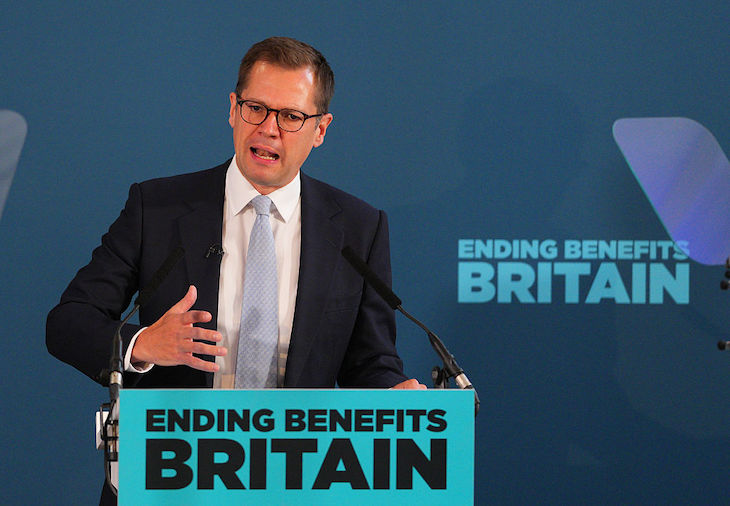
Benefits claimants will be required to carry out 20 hours of community service a week under a Reform government, Robert Jenrick announced today. The party’s Treasury spokesman said those who are fit to work must help clean up high streets and parks and carry out minor repairs to libraries and town halls, or face penalties.
The measure is the latest addition to Reform’s welfare blitz, which would strip all foreign nationals, including EU citizens, of access to benefits such as universal credit, housing benefit and pension credit. The party believes its cuts would save taxpayers £21 billion by the fifth year.
Welfare is fertile political ground for Reform as it competes with the Conservatives
The new ‘Welfare to Work’ community service scheme would apply to work-capable universal credit claimants in the ‘seeking work’ group who have claimed continuously for more than 12 months. It would be administered by local councils or approved charities, which would receive £3,200 per participant each year. Those who refuse to participate or perform poorly would risk an immediate sanction, including a permanent ban from receiving benefits. Reform expects 50,000 referrals in the scheme’s first year and 200,000 annually thereafter.
Reform says the programme is modelled primarily on Ireland’s Community Employment and Tús schemes, under which unemployed people undertake part-time work for community organisations while receiving welfare support. The party claims evidence shows that participation in such programmes makes recipients more likely to find employment and increases their earnings. By the fourth year after taking part, individuals are eight per cent more likely to find work than those who do not undertake a similar scheme.
Addressing reporters at a Westminster press conference, Jenrick said: ‘How can it be that one family on a street, with working parents, strive and work hard, only to help fund the lifestyle of another who chooses to not bother with work at all? This isn’t just an aberration, a small number of isolated cases to be dismissed as a triviality. It is an epidemic that has been allowed to take hold across the country, and spread into a full blown national crisis. My message today to those taking everyone else for mugs: under a Reform government it’s going to stop.’

Welfare is fertile political ground for Reform as it competes with the Conservatives. Under the Tories, the non-pension welfare bill expanded by £41 billion – a record for which the party still finds itself apologising.
Responding to today’s press conference, the shadow chancellor Sir Mel Stride said: ‘Reform continue to flip flop like they did on the two-child benefit cap, and their fantasy numbers are simply not plausible.’ Jenrick and many other senior Reform figures, of course, served in Conservative governments. But the party can reasonably claim a cleaner record than the Tories when it comes to promises to cut welfare spending.
The ground becomes more difficult when Reform turns to benefits claimed by British citizens. It wants to abolish PIP (Personal Independence Payment) and replace it with a ‘health security allowance’, a change that would leave around half of current claimants without the benefit altogether.
House of Commons Library data shows that around 10 to 12 per cent of people in Clacton currently claim PIP. Indeed, every Reform MP has an electoral majority smaller than the number of PIP claimants living in their constituency. This may prove the harder change to sell.
Judging by today’s press conference, however, the prospect did not appear to faze Jenrick. Asked about the figures, he said: ‘We are going to protect the most vulnerable in society. We’re ensuring that children will be protected and that those people who really need this are going to be protected under a Reform government.’




Comments