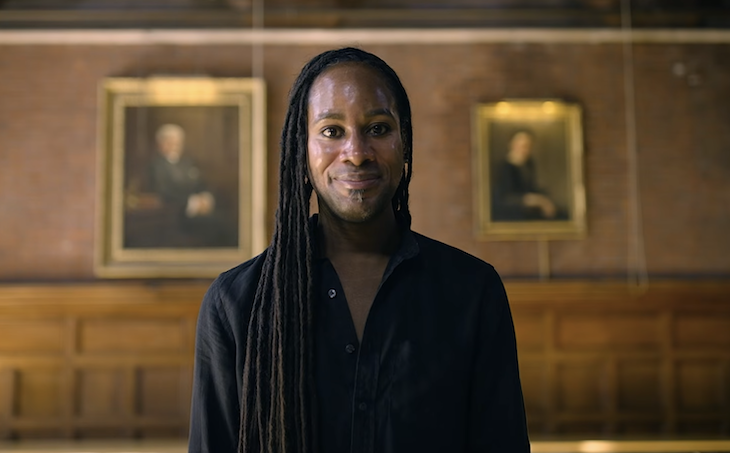
I’ve never met Professor Jason Arday. I don’t know whether he has genuinely run 600 miles in six days. I also genuinely don’t know the truth about the remarkable similarities between parts of his doctoral thesis at Liverpool John Moores, which helped propel him rocket-like up the academic greasy pole to a chair at Cambridge, and passages in a dissertation written six years earlier by someone at Brunel.
Did it never strike either Cambridge University or some member of the academically distinguished electors who made up the appointment board for his chair to suggest an elementary piece of due diligence?
It is undoubtedly possible that this is nothing more than an honest, if rather careless, omission to acknowledge earlier work: academics are, after all, proverbially absent-minded, and writing theses is stressful. On the other hand, the passages may indeed have been copied as an intellectual labour-saving device in the assumption that no one would be any the wiser. This happens; and frankly, if you do it in a provincial university you’re probably safe. Turgid post-modernist theses on social education theory normally sink lead-like into the intellectual mire as soon as the degree is granted: the chances that an examiner in Liverpool will have chosen to read an obscure thesis written years earlier for intellectual stimulation are pretty thin. On this the jury’s out: we must await the verdict.
But all this is a side-issue. Whether Professor Arday is saint or sinner, the outfit that comes incredibly badly out of the whole affair is Cambridge University, and to some extent senior UK academia as a whole.
Take first the process of his appointment. It’s one thing for examiners in Liverpool to take at face value a doctoral thesis couched in well-worn academic jargon presented for a run-of-the-mill PhD. It’s not the same when the same document is put forward by a 37-year-old with an unorthodox academic career, who has on his own admission been illiterate until 18, applying for a pinnacle professorial position in Cambridge. Did it never strike either Cambridge University or some member of the academically distinguished electors who made up the appointment board for his chair to suggest an elementary piece of due diligence? Something like that done, without any difficulty, by academic enfant terrible Nathan Cofnas after the event?

Of course it might be said that doing this to an unorthodox candidate like Jason Arday would be discriminatory if it wouldn’t have been done to a more straight-up candidate. But then unorthodox situations call for unorthodox responses. The University was happy enough after the event to trumpet its appointment of a candidate very much out of the normal academic rut: it should equally have been concerned to ensure it wasn’t making a possible error.
There is of course a more Machiavellian possibility. No one can doubt that Cambridge knew all along that, if hired, Prof Arday would tick every DEI box imaginable: poverty, race, neurodiversity, unorthodox upbringing, you name it. Indeed there is an interesting question about whether he was discreetly put up to apply. (It happens.) Consciously or unconsciously, one does wonder whether the appointing committee actually wanted the election to sail through, and might have been less willing to apply the kind of scrutiny they might have given to a more ordinary candidate. Unfortunately, we’ll never know: the board’s discussions will doubtless bear a seal a bit like that of the confessional, so we can but speculate.
But forget the process, however rum. Could this be a case of all’s well that ends well? That’s certainly Cambridge’s view: quite apart from its foolish diversionary reference this week to a ‘vile campaign’ to undermine Prof Arday, its line is that, as a senior Cambridge academic gushed shortly after the election, he was simply the ‘best in the world’. If he is, we might not worry too much about his appointment.
But is he? Some, whose views deserve respect, are very unconvinced. Kathleen Stock, who has read much of his output, sees much of it as ‘unambiguously mediocre’ and at times simply made up of rambling platitudes. From the parts I have seen, I also have found some fairly thin gruel. As someone firmly anchored in empiricism, I always find it troubling when arguments start, as many of Professor Arday’s do, by invoking critical race theory (a theory that sees the scholar’s job as stating how, rather than asking whether, institutions reflect structured racism) and then using it to draw conclusions on racism.
I’m not an expert here. But faced with a claim that this is not only sound scholarship but the best around, the intellectual public could be forgiven for a degree of scepticism. Put bluntly, if this is the world’s best when it comes to scholarship on education, sociology and race, we should be grateful we don’t have to read the worst.




Comments