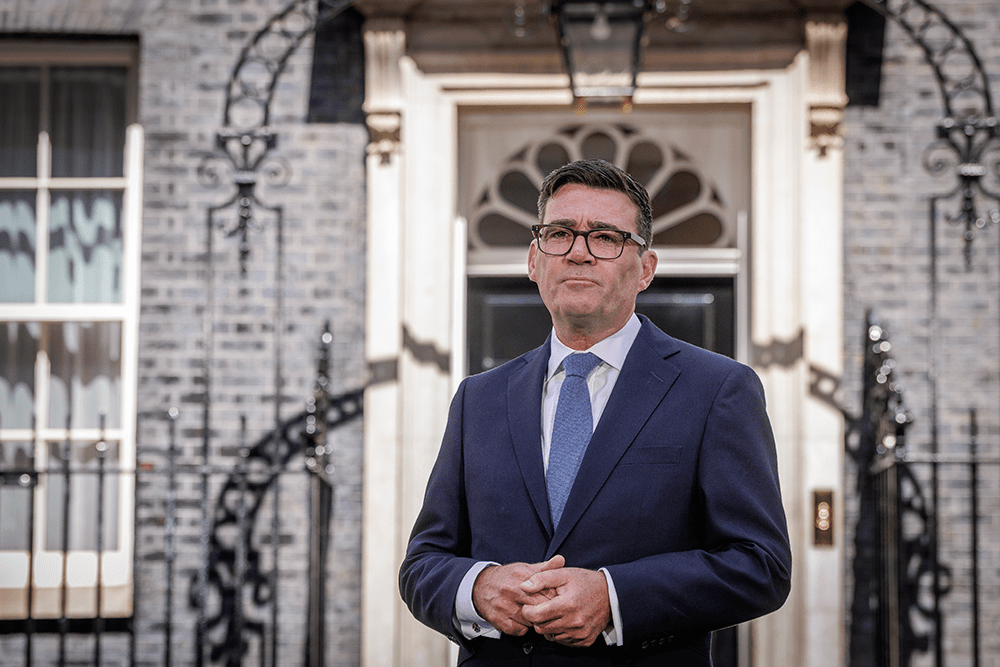
Nothing so became Keir Starmer’s premiership as his leaving of it. Farewell remarks outside Downing Street, unpunctuated by the odious Steve Bray; a brief goodbye in Buckingham Palace, before the King welcomed his fourth new prime minister in four years; then to the pub to drown his sorrows with Rachel Reeves, leaving Andy Burnham and John Healey to pick up the national tab.
There is an irony to Healey’s appointment as Chancellor. Burnham blames Margaret Thatcher for so many of the country’s ills but her time in office was devoted to clearing up the dreadful inheritance left by the last Healey at the Treasury: a top rate of income tax at 98 per cent, untamed inflation, union disarray, socialist sclerosis.

Rather than take a wrong turn in the 1980s, Britain flourished. A million council tenants became homeowners, one in four adults became shareholders, GDP was up a third and we had the fastest growth in manufacturing productivity in the G7. In hoping to reverse ‘40 years of neoliberalism’, Burnham is on an ideological crusade to kick out the props of prosperity.
If Britain’s economy took a wrong turn, it was not while Thatcher was prime minister, but in the years following the 2008 financial crisis. As Chris Curtis, the MP who formerly chaired the Labour Growth Group, has highlighted, between 2008 and 2025 GDP per capita grew by just 8.7 per cent; in the 17 preceding, post-Thatcher, years, it had grown by 43 per cent.
Successive governments have struggled as an ageing and sickening population, the Covid pandemic and a reluctance to cut spending have forced up taxes and borrowing. In fiscal terms, we have long since reversed the boom of the 1980s. The tax burden is now at its highest level since the 1940s; public spending as a share of GDP is at its highest level since the 1950s; public sector debt stands at 95 per cent of GDP, the highest level since the 1960s. We are spending £109 billion a year on debt interest alone, far more than on defence.
Starmer and Reeves did their best to make this situation worse. From national insurance hikes and public sector pay rises, to reversing the two-child benefit cap, their brief time in office left Britain stagnant and spendthrift. Yet Burnham’s plans appear to be a doubling down on that approach.
A swirl of spending pledges accompanied Burnham’s entry into No. 10. The Prime Minister wants the largest council housebuilding programme in a generation, the creation of an NHS-style system for social care and an end to rough sleeping – all ideas lifted from Jeremy Corbyn’s 2019 manifesto.
Also mooted is a possible increase to the tax-free personal allowance, which would place the burden of paying for our bloated state on a smaller number of taxpayers; the removal of VAT from energy bills, supposedly covered by scrapping the Digital ID programme (which we now learn was unfunded); placing Thames Water into special administration, at a cost of £2 billion; and boosting defence spending. This last point is especially contentious. Healey resigned from Starmer’s cabinet over the former PM’s refusal to fund the Defence Investment Plan. Now Healey must hit his own target of spending 3 per cent of GDP on defence by 2030.
Already, reports suggest some of these pledges are being rowed back on due to lack of money. But there is no doubt that Burnham wants Healey to spend more. The new Chancellor must balance this with sticking to Labour’s 2024 manifesto pledge not to raise income tax, national insurance or VAT, as well as Burnham’s promise to stick to Reeves’s fiscal rules. A failure to do so might trigger a reaction from the bond markets.
Starmer and Reeves did their best to make the situation worse. Burnham’s plans appear to be a doubling down
Either Healey fails to deliver on Burnham’s promises, or taxes will have to rise. The former would disappoint all who hoped the new Prime Minister would bring change; the latter would represent a breach of trust between Labour and an electorate already surprised by Burnham’s rapid rise to No. 10.
Trapped between this Scylla and Charybdis, Burnham has an option not open to Odysseus: calling an election. But since his personal ratings are already falling, the more likely outcome seems a drift towards defeat, as he fails to reckon with the country’s structural problems. Burnham promises a ten-year plan: suitably Soviet, but with no suggestion of how to raise our anaemic growth rate, only to tax and spend more. Long gone are liberalisations of planning rules and other supply-side measures that MPs like Curtis once hoped for.
For Healey to rise to the Treasury challenge, he must break from Burnham’s instincts in two ways: by looking south and towards the 1980s. Roger Douglas, the New Zealand Labour party finance minister in that decade, presided over a series of liberalisations, by slashing subsidies, deregulating finance and simplifying tax. This upset party orthodoxy but reversed his country’s torpor and ensured his government’s re-election. A similar boldness here is Labour’s best hope.
Burnham’s premiership has so far repeated the worst sins of Starmer’s: grand promises of change from a cast of politicians who have been around Westminster for decades, and vague plans which unravel on contact with fiscal reality. If he wants to restore trust, Burnham must challenge tax-and-spend orthodoxy, revive growth and liberate the economy – just as one of his predecessors did, in the 1980s.

Comments