
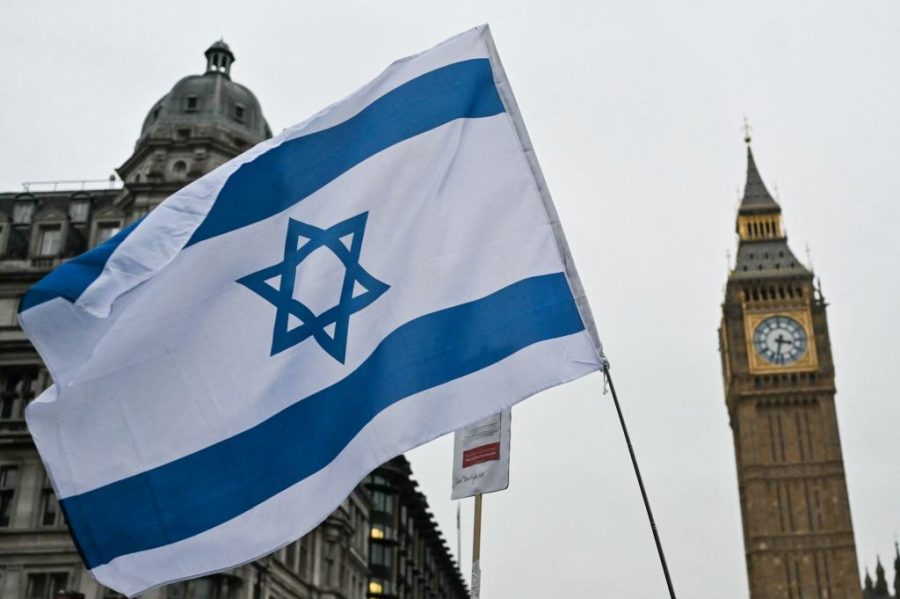
I sat in the synagogue where I grew up last night, waiting to interview Colonel Richard Kemp, the retired senior officer of the British Army who served for nearly three decades across Northern Ireland, the Balkans, the Middle East, and Afghanistan. Our conversation would end a service marking the transition between Israel’s Memorial Day for its fallen and its Independence Day. A British Jew and a British Colonel, in a room full of emotion, pride, and more than a little apprehension, after a week in which multiple arson attacks on Jewish-linked sites have taken place in London. There was an uncomfortable sense of the fall of Rome in the air.
That place feels like home to me. I have sat on its wooden pews for as long as I can remember, under the light of the stained glass windows, surrounded by its decorative wrought iron railings – all distinctly Victorian British features, shaped by a church-like grandeur of domes and arches layered with Moorish and Romanesque ornaments. Its blended architecture embodies the cultural fusion of my own British life and many of those in the congregation.
Layers of identity sit comfortably together: Jewish, British, Sephardi, Mizrahi. They work together as notes in a symphony, textures in a painting, interlocking bricks in a tower of strength. The congregation is Britain’s oldest Jewish one, founded by the first Jews to resettle here after Oliver Cromwell permitted our return in the 17th century.
Most of us chose Britain. Not by accident, but deliberately
As we waited during the service, I found myself acutely aware of where we were sitting: Colonel Kemp was in the seat of the late Rabbi Dr Abraham Levy OBE, my godfather and the community’s former spiritual leader. This was just in front of the seat where my own late father, an Italian Holocaust survivor who built the majority of his adult life in Britain, once sat. He chose this country deliberately, to raise his children as British Jews. That choice has shaped everything that followed. Yet something felt different this year.
At the dinner afterwards, intended to celebrate Israel’s independence, the tone across the room was not celebratory in any simple sense. The conversations were sober, even heavy. People spoke to me openly about decline, about Britain, about the condition of Jewish life here. And, strikingly, they spoke about contingency plans. Where they might go. When they might leave. What threshold would trigger that decision.
What was most unsettling was not necessarily the content of these discussions, but their assumption. They spoke as if departure were not hypothetical, but eventually necessary.
For Jews, this carries a particular historical resonance. The memory of those who remained in Germany too long casts a long shadow over us. For decades, that memory functioned as a warning in the abstract. But last night, it felt closer to a practical lesson – one many believe they have already internalised. I would be dishonest if I claimed I had not thought along similar lines. I, too, have options in mind. And yet, that is not the whole story.
Marking Yom HaAtzmaut in Britain brought something else into focus. There is no inherent contradiction between being British, being Jewish, and feeling pride in Israel. The idea of ‘dual loyalty’ misunderstands the reality. What we in that room felt was not divided allegiance but layered attachment. We remain here, and that fact matters.
I could have built a life in Israel. I can see it clearly enough to know it would have been a good life. Many British Jews share that sense: Israel is not merely a refuge of last resort, an ‘insurance policy’ against catastrophe. Over its decades of existence, it has become something far more substantial. It is a functioning, dynamic country with its own culture, strengths, and tensions. It is a real alternative life, not just a theoretical escape from danger.
And yet most of us chose Britain. Not by accident, but deliberately. This is the path we continued, the society we invested in, the place where our lives took shape. Britain has offered opportunity, stability, and a sense of belonging that is not easily relinquished. It is our home. We want it to be our refuge.
So the attachment to Israel is not a substitute for Britain, nor a rejection of it. It is closer to the pride one feels in the achievements of family: genuine, sometimes critical, but rooted in recognition rather than dependency. If Jews of my parents’ age might once have considered immigration to Israel to be pioneers in a start-up state, leaving behind them the comforts and conveniences of a life in the far more established cities of Europe, many 21st century Jews are contemplating leaving behind places they love, but which they feel are in decline, and worst of all are no longer safe in the long term.
Because 78-year-old Israel represents qualities that many in that room felt are under strain here: national confidence, clarity about identity, a willingness to defend cultural and civic norms, resilience under pressure. These are not foreign virtues in the British tradition, but there is a widespread sense that they have weakened.
In that sense, observing Yom HaAtzmaut in Britain is not an act of distance from this country. Listening to Kemp’s warnings, formed from his experience of Britain and the Middle East, war and peace, extremism and intelligence, it becomes a reflection on, and mourning of, what Britain has been – and what it may yet struggle to remain. It took the words of a non-Jewish British army general, appointed Commander of the Order of the British Empire for his contributions to national security, to make us truly realise it.
There is also a cultural dissonance. Britain does not celebrate independence in the way Israel or the United States does. The very idea of an ‘Independence Day’ sits awkwardly in the British context, where identity has historically been more continuous than declarative. That difference sharpens the experience. The celebration feels imported, but the questions it raises felt last night to be distinctly local.
So I left the event feeling a tension that resists easy resolution. People are preparing, quietly, for the possibility of leaving their country. At the same time, they remain. They are invested, engaged, and unwilling to abandon their home. But their admiration of and appreciation for Israel is alive inside them, too. Both commitments are real. Neither cancels the other. For now, the decision, conscious or otherwise, is to stay. But the conversations are ever more persistent and urgent.





Comments